The experiment began with twelve portable classrooms. Orange County Public Schools had thousands of them, each with heating and cooling to manage. Sending someone from room to room was an expensive way to discover what the equipment was doing. The district tried a KMC Controls retrofit. According to KMC’s case study, energy use fell 40 percent, and the initial installation paid for itself in less than six months.
- KMC makes the hardware and software that run commercial buildings.
- Its niche: connect existing equipment, then make it easier to manage.
- The useful lesson: test a small group of buildings before expanding.
Twelve rooms make an unusually good introduction to a company whose catalog includes pneumatic relays, programmable controllers, airflow sensors, and cloud software. The connecting idea is practical: buildings consume money in places their owners cannot easily see. A control system makes some of those places visible, then gives somebody a way to intervene.
01 / The building already has a past
KMC began in 1969 as Kreuter Manufacturing Company. Founder Ken Kreuter supplied original equipment manufacturers with damper actuators, pneumatic-electric switches, and logic relays. These were components for making physical things happen: opening a damper, switching a circuit, directing an HVAC system. Electronics followed, then digital controls and software.
There is a pleasing wrinkle in the company’s own history. A photograph of a demonstration panel from the mid-1970s shows pneumatic relays; KMC’s 2018 retrospective says some were still being made as part of its RCC-1500 series. In this business, an old product can remain useful long after the photograph becomes an antique.
That history helps explain KMC’s position. A school, hospital, or office building comes with installed equipment, maintenance routines, and a budget. Replacement is a decision with consequences. KMC’s emphasis on interoperability addresses that reality: let equipment communicate, retain useful infrastructure, and give operators more control over what they already own.
02 / A phone meets a cardboard box
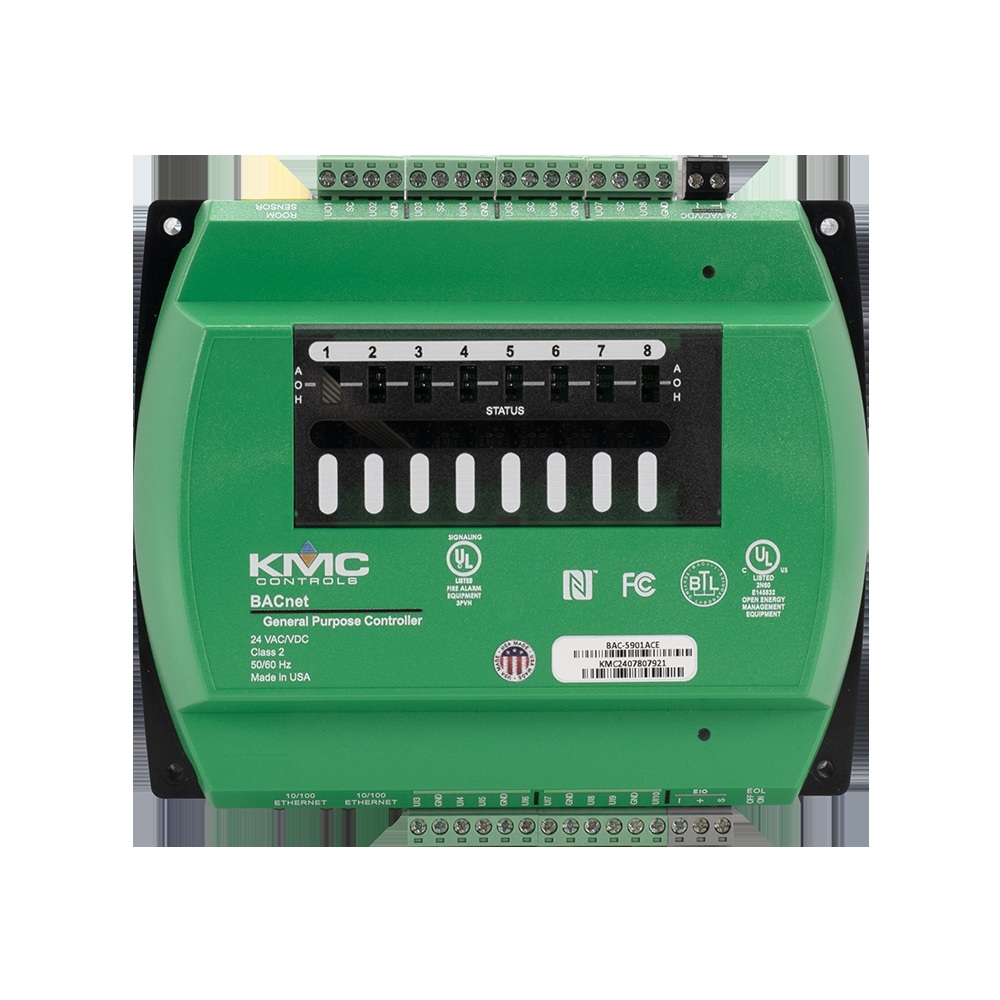
The Conquest family makes that proposition tangible. These BACnet controllers and sensors handle building systems and HVAC equipment, with scheduling, alarms, and historical trends. BACnet provides a common communications standard. KMC introduced its BACnet controller line in 2004, making open-protocol control a substantial part of its business.
One small detail deserves attention. Using KMC Connect Lite and near-field communication, technicians can preconfigure supported Conquest controllers while they are unpowered and still inside their boxes. Anyone who has watched installation time disappear into repetitive setup will understand the attraction. The cleverness is in removing a chore before the installer reaches the equipment.
Above those devices sits Commander, KMC’s cloud-connected platform. It gathers building data, displays dashboards, tracks trends, manages schedules, and sends text or email alarms. Facility teams can inspect multiple locations through one interface. KMC also offers room controllers, actuators, valves, configuration software, and its TrueFit airflow measurement system. The company spans the sensor, the control decision, and the operator’s screen.
03 / What twelve classrooms proved
Orange County’s challenge involved a fleet of 4,300 portable classrooms. The initial twelve-classroom installation gave maintenance staff remote monitoring and control, along with earlier warning of equipment trouble. KMC’s account says the district subsequently adopted a broader approach. The small deployment supplied a reason to expand.
in energy use
That result belongs to that installation. It is not a savings forecast for every school. The transferable method is more interesting: establish a baseline, connect a manageable sample, measure the change, and expand when the economics justify it. A district can learn something useful before committing its entire estate.
At Logansport State Hospital, the first weak link was unreliable airflow sensing. KMC’s November 2025 case study reports that replacing it with TrueFit restored ventilation control and reduced air-handling-unit energy use by 18 percent. The distinction matters. A control system needs trustworthy measurements; a polished dashboard cannot rescue a bad reading.
04 / The factory behind the dashboard
KMC designs and manufactures building automation products at its northern Indiana headquarters. In 2022 it added an Ersa Versaflow 335 selective soldering machine. Instead of moving an entire circuit board through molten solder, the machine targets individual joints, reducing material use and the risk of heating neighboring areas.
“That translates into an improved capacity to fulfill orders and keep our commitments to customers.”
Mitch Kehler, CEO, on the manufacturing investment, July 2022
The factory detail matters because KMC sells through people who must install and support these devices. Its factory-certified partners engineer, install, commission, and explain systems to customers. KMC supplies the products and technical foundation; the integrator turns them into a working building. A five-year limited warranty covers hardware manufactured by KMC.
This puts the company in the commercial building-controls market, alongside alternatives such as Johnson Controls, Siemens, and Honeywell. KMC’s case rests on its combination of manufacturing, controls expertise, open communications, and partner delivery. Buyers should evaluate the local integrator as carefully as the controller.
05 / Count the points. Then count the cost.
The economics combine equipment, installation, engineering, and ongoing software licensing. Commander licenses run annually and are sized by selected data points: a temperature reading, a pressure value, or equipment status, for example. Its selection guide illustrates 60 controllers reporting eight points each: 480 points, covered by a 500-point license. Cloud storage and software and security updates accompany licensing.
That makes disciplined scope useful. Decide which readings support an action, budget for commissioning and renewals, and confirm compatibility before connecting equipment. Internet access and security planning belong in that calculation. KMC’s Veridify partnership and Dome offering address device-level protection for building networks, including existing systems.
Commander’s October 2026 release added portfolio health dashboards and automated report delivery. The direction is clear: help fewer people oversee more equipment. Whether the investment pays depends on the waste available to remove, the quality of installation, and somebody acting on the information. The twelve-classroom experiment offers a sensible place to begin: small enough to measure, useful enough to change a decision.