At Chrysler House in Detroit, the trouble was in the timing. The building already had an optimized start/stop function, the sort of feature meant to wake the machinery just early enough to make occupants comfortable. But it had been altered or disabled. When KODE Labs began testing in August 2020, its engineers found equipment running unnecessarily before people arrived. A building could possess the right feature and still operate on the wrong schedule.
- The job: connect existing building systems and give their data a common language.
- The buyers: property portfolios, retailers, campuses and government facilities.
- The useful twist: diagnose equipment, change operations and test whether the fix worked.
The clock was the clue
KODE examined 23 air-handling units and 320 variable-air-volume units at Chrysler House. Its model used historical temperatures and operating conditions to predict how long equipment needed to reach the desired temperature. The everyday question was simple: how late could the machinery start while still making the rooms comfortable on time?
The company reports that wasted runtime fell 55.93% in August compared with July, while energy costs fell 9.02%. Those are different measurements. They are also a month-to-month comparison, with all the weather and occupancy complications that implies. Still, the project offers a useful place to begin: inspect the operating logic before assuming a building needs more equipment.
First, teach the building its own names
KODE Labs was founded in 2017 by Edi Demaj, Etrit Demaj and Gentrit Gojani. The name contains a small map: KO for Kosovo, DE for Detroit. Its product, KODE OS, addresses a problem familiar to anyone managing several properties. Heating, lighting, meters and maintenance software can each work perfectly well while remaining awkward companions.
The company’s expertise sits where controls engineering meets software integration. KODE OS connects those systems, organizes their data and makes it usable across a portfolio. A temperature reading needs context: which room, which piece of equipment, which expected behavior? Normalization supplies that shared meaning. Without it, comparing two buildings becomes a translation exercise.
In an October 2026 interview, Etrit described the earlier approach: stitching together third-party platforms building by building. He remembered it as expensive, manual and difficult to scale. That experience helps explain KODE’s bet on a reusable cloud platform. The change was architectural, with less dependence on assembling a fresh software puzzle for every property.
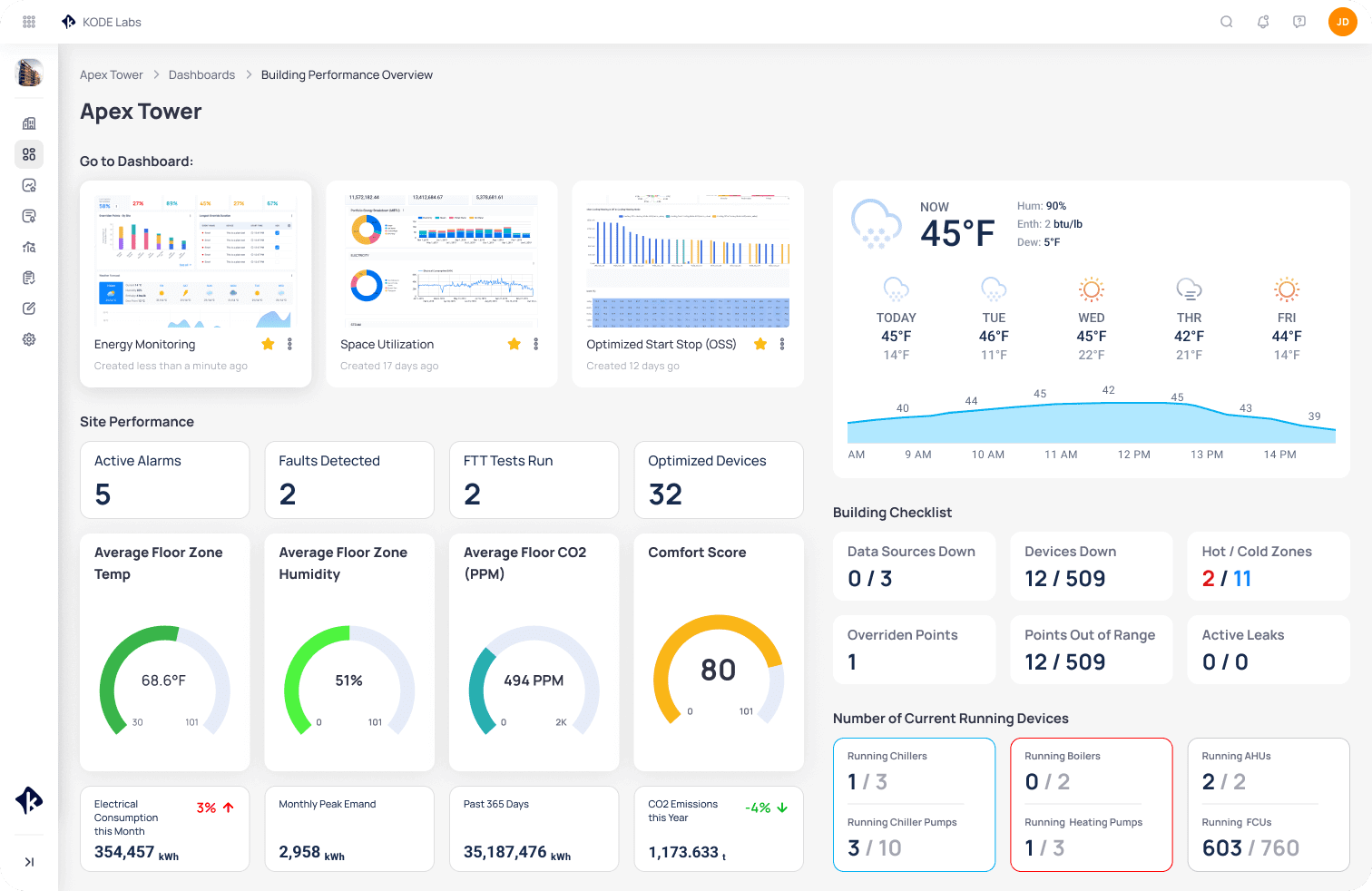
A dashboard needs somewhere to go
The product range follows the operator’s work. Cloud BMS provides centralized monitoring and control. Building BI turns data into dashboards and comparisons. Digital Maintenance combines fault detection with digital commissioning and functional testing. Optimized Start/Stop tackles schedules. The mobile app puts access in an engineer’s pocket.
There is a consequential distinction between flagging a fault and testing a machine. A warning tells someone to investigate. A functional test checks how the equipment actually behaves. At Detroit’s Shinola Hotel, KODE reports running tests across all 200 heat pumps with the commissioning agent, rather than relying on the smaller sample described in its case study.
“Users prioritize a seamless experience over managing multiple screens and platforms.”Edi Demaj / April 2024
That gives the platform a practical ambition: connect detection, maintenance and verification. Closing a work order records an administrative event. Retesting the equipment supplies evidence about the repair. For a facilities team, that difference can decide whether the same complaint returns next week.
existing systems02 Normalize
their data03 Diagnose
and act04 Test
the result
The portfolio is the point
The buyer is usually responsible for more than one room, and often more than one city. KODE’s named customers include Bedrock, QuadReal, Hines and Empire State Realty Trust. Its ESRT case study describes integrating more than 30 systems across nine buildings, including the Empire State Building. TJX selected KODE in 2024 for an energy management information platform across its U.S. store network.
QuadReal’s case study makes the integration work concrete. KODE and the property group’s smart-buildings team first assessed systems, sensors and devices, mapping what existed before connecting it. Different properties had different vendors and protocols. Custom integrations threatened to make every additional building another expensive project. A common data structure was therefore part of the scaling strategy, rather than a reporting detail added afterward.
Scale also changes distribution. Local controls contractors and system integrators can deploy the platform through KODE’s partner network. This keeps building knowledge close to the site while giving owners a common operating environment. The company itself works from roots in Detroit and Prishtina.
The bill has several moving parts
KODE sells software as a service. Its published pricing factors include integrated data points, floor area and implementation complexity. The scope includes implementation, licensing, hosting, maintenance, updates and training, plus applicable middleware and API development. A buyer needs a scoped proposal built around the property’s systems and goals.
The company announced an $8 million Series A in 2022, followed by a $30 million Series B in April 2024 led by Maverix Private Equity. A separate September 2024 announcement described a $14.35 million GSA contract, in collaboration with EY, covering 150 federal buildings. That contract is an enterprise project, not a useful shortcut to pricing an individual office.
The federal work also carried personal meaning for the founders. In the GSA announcement, the Demaj brothers described arriving in America as refugees after the Kosovo War. Serving the U.S. government became a way to return something to the country where they had rebuilt their lives.
The next mess is in the utility bills
In February 2026, KODE launched EnerG, extending its approach to utility and sustainability information scattered across bills, portals and spreadsheets. It can operate independently or alongside KODE OS. September’s product updates added live fault streams, batch work-order creation and synchronization between EnerG and ENERGY STAR Portfolio Manager.
The competitive field includes Siemens, Schneider Electric, Honeywell, Johnson Controls and software specialists such as Facilio. Verdantix placed KODE among five Leaders in its 2026 building orchestration assessment. Its distinction is a software layer designed around mixed-vendor infrastructure, with diagnostics and control sharing a data foundation.
There is a lesson here even for someone buying nothing. Inventory the systems. Check the readings. Establish a baseline. Try one operational change, then verify it. The approach depends on usable data, access to controls and people who follow through. A dashboard cannot correct a sensor nobody trusts or repair equipment nobody visits. Sometimes the first useful question is simply: why is this thing running?