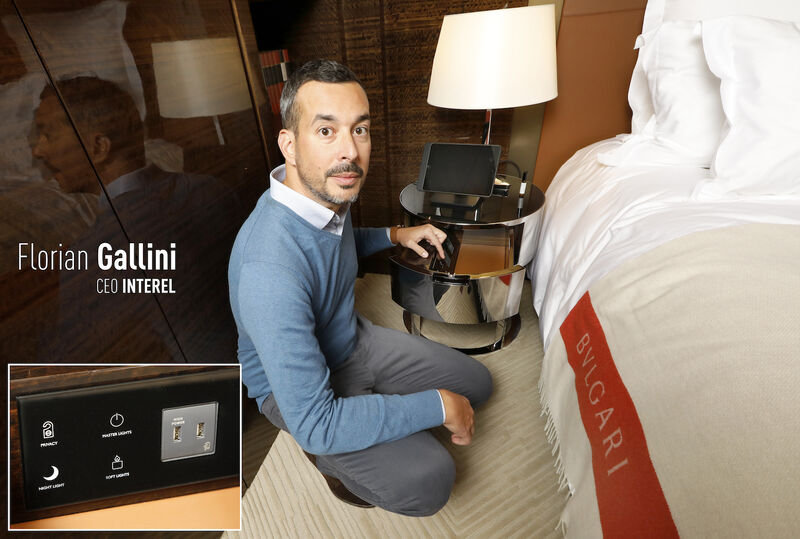
In a photograph from the Bulgari Hotel Paris, Florian Gallini is kneeling beside a bed. One hand rests near the bedside controls. He looks toward the camera with the alert expression of someone interrupted halfway through an explanation. The pillows are magnificent. His attention is on the hardware.
It is an unusually useful executive photograph. Gallini, the founder and CEO of INTEREL, is showing the part of a hotel room his business helps make work: the controls within reach of a guest, and the connections behind them. A luxury hotel can spend generously on what you see. Gallini’s company concerns itself with what happens when you touch it.
Jolt Capital shared the picture in a post that INTEREL reshared in 2022, identifying the hotel and explaining its connection to the lighting and temperature controls. The setting supplies the glamour. The kneeling supplies the explanation. Here is a chief executive, at mattress level, with something specific to demonstrate.
A business degree, then a building business
Gallini studied at the Free University of Bozen-Bolzano between 2000 and 2005. His subject was Economics & Management. Based in Dubai, he founded INTEREL in 2010 and became its CEO. His career since has been bound up with a practical question: how should the separate systems inside a room work together?
The company developed controls for hospitality, linking the guest’s immediate surroundings with the hotel’s operating machinery. Lighting, temperature and service requests became parts of the same business. There is a pleasing lack of ceremony in those subjects. People discover their importance when the room is too cold, the light refuses to go out or a request disappears.
By 2015, INTEREL’s connectBsmart technology had won an HTNG TechOvation award. Gallini accepted it with Andrea Benoni, then the company’s CTO, at the industry organization’s conference in San Antonio. The technology used Bluetooth Low Energy beacons as infrastructure within its room-management platform. Even the award photograph was a shared one: the CEO beside the technical colleague.
The button has to reach somebody
A 2017 installation at Palazzo Versace Dubai makes the work easier to picture. INTEREL and Amadeus connected the room-management system with HotSOS, the hotel operations software. A guest’s request through an INTEREL glass panel could automatically become a work-order ticket, assigned to the appropriate member of staff.
The connection also ran back toward the guest. Once the request was being processed, the panel could show that it was receiving attention. The small courtesy mattered: somebody asking for help could see that the request had entered the hotel’s working day.
For Gallini, this was a way to extend what the room infrastructure could do. For the hotel, it joined a guest-facing device to a staff workflow. The distinction is useful because the work does not end at the glass. A beautifully lit service button still needs someone on the other side of it.
The example gives his career a human scale. It involves the person waiting in the room and the person assigned to respond. Between them sits a collection of systems that must agree on what has been asked and what should happen next.
- 01Guest taps
the room panel - 02HotSOS creates
a work order - 03Staff member
is assigned - 04Panel gives
status feedback
A small request makes a round trip.
INTEREL’s current room-management offering continues to join those two sides of hotel life. Its controls allow guests to adjust curtains, lighting and temperature or request services through recognizable icons. For staff, integrations can share room status and requests for privacy or cleaning. The systems deal with different kinds of attention: a guest wants to be understood quickly; a housekeeper needs to know where to go next. Gallini’s company has made the connection between those needs part of its product, so the panel’s appearance is only one part of the job.
A roomful of allies
Gallini’s public work also reaches beyond INTEREL. He is named among the contributors to HTNG’s Internet of Things Fundamentals white paper, dated July 16, 2018. The contributor list brings together people from companies working on connectivity, security and hotel technology. It places him inside an industry conversation about how connected equipment should operate.
He also co-chaired an HTNG IoT working group with Ted Harrington, executive partner at Independent Security Evaluators. An HTNG overview lists Gallini on its Vendor Advisory Council. These are concrete forms of participation in the shared problems of an industry where products from different suppliers must coexist.
That collaboration fits the nature of his business. INTEREL’s controls have to interact with equipment and software a hotel may already own. The guest sees a room; the operator sees several suppliers, installation decisions and maintenance responsibilities. Making those pieces cooperate requires relationships as well as engineering.
Gallini has publicly acknowledged the less visible work within his own organization, too. In a 2022 LinkedIn post, he thanked Head of HR Louise Carr and described her as a pillar of the company. It is a modest detail, but a welcome one in a career whose public vocabulary runs heavily to devices and systems.
What €10 million was meant to connect
In September 2017, Jolt Capital announced a €10 million investment in INTEREL. At the time, the company reported deployments in more than 30 countries across four continents. Gallini described the investment as funding for global growth and further development of its Hotel of Things approach.
He singled out Jean Schmitt’s experience as an entrepreneur and technologist as a reason for choosing the investor. The relationship was meant to bring useful knowledge alongside capital. The announced ambition was to connect more of hospitality’s physical world through the company’s technology.
Jolt returned with an additional €6 million round announced in March 2021. The plans had become more specific: continue expanding in North America, develop an energy-and-automation partnership, enter adjacent markets and add features around the EOS Wi-Fi thermostat platform. The company reported 500,000 installed devices in more than 45 countries in that announcement.
Global hospitality expansion
Additional funding for broader markets
Announced in September 2017 and March 2021.
Gallini described an opportunity to make living spaces more intelligent and sustainable. Scott Watts’s appointment to lead the Americas earlier that month underlined the regional plan. Gallini specifically linked the lower-cost wireless EOS product to retrofit and select-service hotel markets. That expanded the commercial conversation beyond projects designed around extensive room automation from the outset.
Another appointment added experience from outside traditional hospitality. When Layne Spencer joined to lead global sales, INTEREL highlighted his background at smart-apartment technology provider IOTAS. Gallini welcomed his combination of selling, marketing and organizational experience. The hiring decision put a person with multifamily experience into the commercial team as the company pursued a wider range of buildings. Expansion appeared in the people it recruited as well as in the markets named in its funding announcement.
The thermostat gets another job
EOS had been introduced in 2019. Its launch combined familiar temperature control with wireless networking and connections to other devices. The product brought Wi-Fi, ZigBee and Bluetooth Low Energy together with HVAC control and occupancy-based energy management.
“We’ve been listening to the industry,” Gallini said at the launch. The rest of the announcement described a product intended to address recurring energy-management frustrations while leaving room for additional functions. For a founder selling equipment that lives inside buildings, the upgrade path becomes part of the original sale.
“We’ve been listening to the industry”
Florian Gallini, at the EOS launch, 2019
The later EOS 2 offering continues that logic. It is designed to act as a hub for locks, sensors and other connected equipment, reducing the need for a separate hub in every unit. Door-entry and exit events can contribute information to its energy-management algorithms. Software updates arrive over the air.
There is an operational reason to put several jobs into an object already on the wall. Each additional box brings an installation and something else to manage. Combining functions gives INTEREL a way to sell infrastructure through a familiar object. A thermostat has a respectable cover story: everyone expects to find one in a room.
The company’s open API extends the connections into other applications. Partners can retrieve occupancy information and device data, control room equipment and build workflows around events. In practical terms, it gives outside software a route into the room. Gallini’s business therefore depends partly on what other people can build with its equipment.
The next room may have a tenant
The company now addresses multifamily buildings, student housing and staff housing as well as hospitality. Its residential offering brings the EOS hub, device connectivity and integration tools to property managers, building platforms and system integrators. The occupants stay longer; the familiar questions about access, temperature and managing many rooms remain.
That broadening helps explain the emphasis on partnerships. A building owner may want to keep an existing platform while adding connected equipment. INTEREL presents its API as a way to support those choices. Gallini’s company supplies a layer that other businesses can use, which makes their willingness to connect part of his own opportunity.
In November 2024, INTEREL announced that Accor had selected EOS as its preferred energy-management solution. In April 2025, it announced that Gallini and regional sales manager Khrystal Milot would attend Accor’s Earth Frequencies Festival, with demonstrations extending beyond energy savings into room controls and operating efficiency.
Those developments bring the story back to the bedside. The aspiration is large enough to encompass building portfolios, but the proof still arrives through ordinary actions: entering a room, changing its temperature, asking for service. Gallini’s photograph in Paris catches him at precisely that scale, showing how something works. The pillows can manage the luxury. He has a button to explain.