The most revealing moment in Zan Compute's origin story happened during a conversation with a facilities manager. Founder Junaith Ahemed Shahabdeen described the possibility of automating restroom service through the cloud and watched the manager's eyes light up. The reaction redirected the product toward the people pushing cleaning carts, replacing paper and answering complaints. It was an unglamorous customer-discovery signal, which is often the useful kind.
Founded in 2014 and based in Santa Clara, California, Zan Compute set out to measure a part of the commercial building that most automation systems barely registered. Heating, lighting and access control had accumulated sensors and software. Cleaning still depended on fixed routes, clipboard checks and a supervisor's intuition. Two restrooms could receive the same service even if one had handled a morning rush and the other had barely been used.
Zan's first answer was a collection of small sensors, cloud analytics and a mobile application. Sensors could monitor foot traffic, paper and soap levels, waste-bin capacity, water events and feedback. The software could then tell a team what needed attention. An early company brochure described nearly 10,000 sensors across 25 buildings. The pitch was not to remove cleaners. It was to stop sending them to the wrong place at the wrong time.
A route sheet cannot see a rush hour
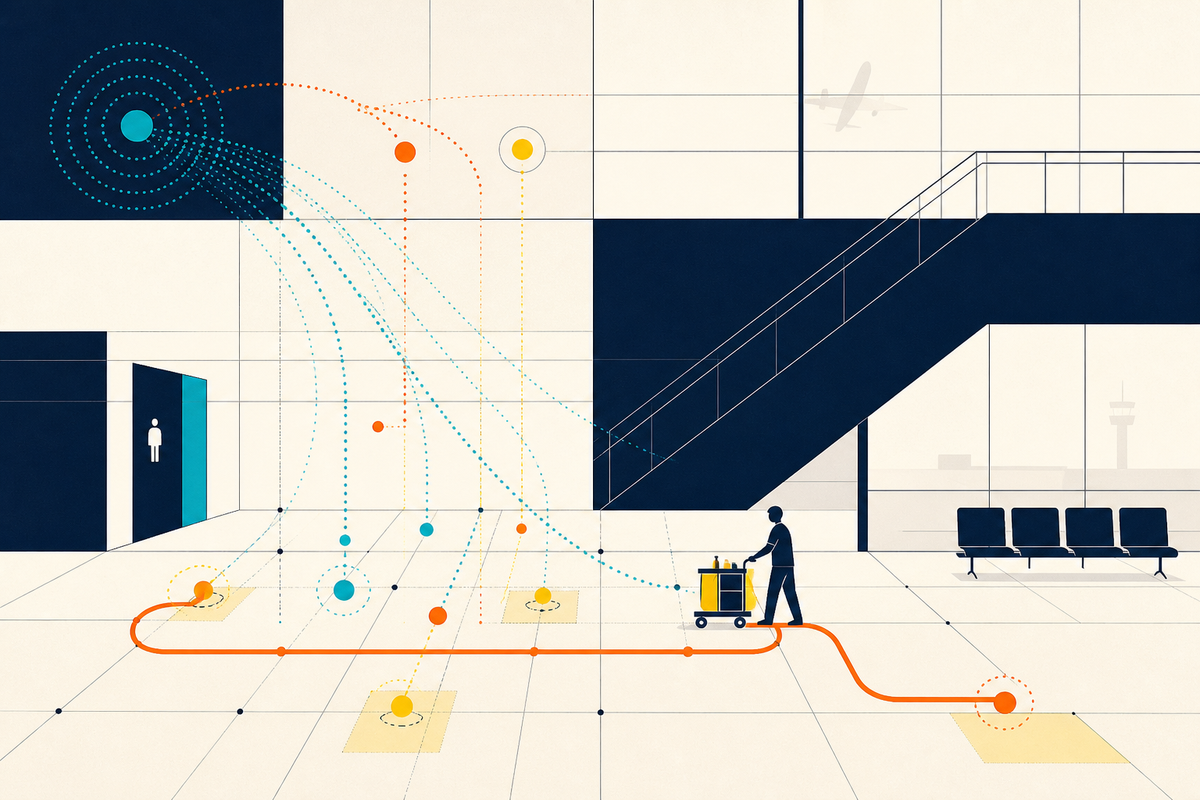
The failure Zan attacked first was the schedule. Traditional cleaning plans assume that demand is regular enough to fit a clock. In an airport, stadium, hospital or university, it is not. A delayed flight, halftime crowd or flu-season surge can create a sharp service need that a four-hour inspection cycle misses. Meanwhile, cleaners spend time visiting quiet zones because the route says so.
That mismatch creates two costs. Labor is consumed by checks that discover nothing, and complaints arrive from the places the schedule failed to anticipate. Consumables add a third: staff may replace a roll early to avoid a future stockout, throwing away material that could have remained in service. Zan's system tries to turn each of those unknowns into a signal.
Those performance figures are vendor-reported and should be read as deployment claims, not universal benchmarks. Bobrick's 2026 smart-washroom brochure takes a similarly concrete approach, citing up to 25 percent labor savings from a high-traffic Zan Compute case study. The important phrase is “high traffic.” A sensor earns its keep where conditions change often enough, and where a team can act when the alert arrives.
“With all the automation systems in place, people will be required to work to maintain the facilities.”Zan Compute, on the overlooked human layerProduct anatomy
Sense, decide, dispatch, verify, learn
Zan's product names have shifted as its ambition expanded. The Smart Washroom AI Platform, or SWAP, described the original mobile and cloud system. ZanWave added privacy-aware radar sensing for occupancy and traffic patterns without producing camera images. Zanitor became the facility-maintenance engine for predictive cleaning, alerts, inventory and workforce tasks. Cleansparency connected user feedback and service visibility. The iOS and Android applications put inspections, complaints, schedules and images into the field.
The copyable operating loop
conditions
need
work
service
patterns
The lesson is not “add AI.” Instrument a costly blind spot, connect it to an action, then capture the outcome.
The newest layer is ZANI, introduced in beta in 2025 as a multimodal AI platform for janitorial operations. It combines sensor readings, machine learning and language models with cleaning schedules, work orders, inspections, audits, user feedback and workforce data. Zan says specialized agents can help with workloading, task planning, historical queries, multilingual staff support, incident reports, compliance documents, quarterly business reviews and RFP responses.
This is a more credible place for language models than asking them to guess whether a restroom needs paper. The sensor handles the physical fact. The model can translate that fact into a priority, explain it in ordinary language, assemble a report or coordinate it with other systems. Founder Shahabdeen wrote that the company waited until it could combine sensors with language models because building AI has to understand the physical world. The sequence matters: measurement first, prose second.
Who buys itThe customer is a chain of people, not a building
Zan sells to property owners, facility managers and building-service contractors, but the software has several users. An operations manager wants workload forecasts and service-level dashboards. A supervisor needs assignments and escalation. A cleaner needs a short, clear task list. A customer wants evidence that the contract was fulfilled. If any link rejects the system, the data becomes an expensive decoration.
That is why partnerships are central to the business. In 2019, The Service Companies agreed to offer Zanitor across a client base spanning more than 1,500 hotels, casinos, resorts, stadiums, universities and commercial properties. In 2023, Siemens-owned Enlighted added Zan to its partner ecosystem, allowing Zan's analytics to use occupancy data already generated by smart-building infrastructure. Bobrick, an investor in Zan's disclosed $1 million seed round, now offers a turnkey BobrickSMART analytics option powered by Zan Compute.
The channel strategy solves a hard problem for a 11-to-50-person company: buildings buy through trusted equipment makers, service providers and existing technology stacks. Zan's open-platform pitch also allows data to arrive from third-party sensors and work to flow into CMMS or workforce systems. Its competition is therefore broader than another smart-restroom vendor. It includes Tork Vision Cleaning, GP PRO's connected-restroom products, Kimberly-Clark Professional's Onvation, TRAX Analytics, general maintenance software and, most stubbornly, the existing clipboard.
The mobile app's release history offers a surprisingly detailed view of what customers ask for after a pilot becomes an operation. Updates added role-based task lists, open-area alerts, wetness and air-quality alerts, external-bin monitoring, photo limits, complaint handling and periodic schedules. A 2023 version added alerts tied to flight schedules and cases where no cleaner could be found. The 2025 releases brought individual-task inspections, image uploads, escalation and grading by building. A security patch followed in March 2026. None of these features makes a dramatic keynote. Together, they describe the actual edge of facility software: exceptions, proof, permissions and the moment a plan meets an understaffed floor.
That detail also locates Zan within the market. It is not a dispenser manufacturer, though its data can begin inside a dispenser. It is not a general building-management system, though it can consume building data. It is not a robotics company, though its site describes coordinating robotic equipment. Zan sits between sensing and service delivery. Its job is to translate what a space is doing into what a cleaning organization should do next, then produce evidence for the person paying the contract. The narrower label is cleaning intelligence. The larger ambition is an operating layer for facility work.
The billThere is no magic price per square foot
Commercial pricing is quote-based. The real cost is a stack: retrofit sensors, local gateways, cellular or network connectivity, cloud software, phones or tablets, integrations, training and ongoing device care. Siemens' marketplace page lists sensor data, smartphones for compliance and staff actions, and gateway connectivity as prerequisites. That makes the buying decision closer to an operational project than a simple software subscription.
What the buyer is really purchasing
A closed loop between changing conditions and accountable work. Hardware observes. Software ranks. People respond. Inspections and feedback record whether the response worked.
- Retrofit sensors
- Gateway and connectivity
- Cloud and mobile software
- System integrations
- Training and process change
Zan and its partners frame payback in months and cite labor, material and complaint reductions. A buyer should model the case with its own wage rates, traffic variance, complaint burden and current service time. Savings require subtracting deployment and support costs, not merely multiplying an efficiency percentage by the full cleaning budget.
The stealStart with the blind spot that creates a decision
The most portable idea in Zan's story is its wedge. It did not begin by promising an autonomous building. It chose a frequent, measurable event: a restroom needs service. The condition has observable inputs, a clear owner, an immediate action and a recordable outcome. That makes it a good training ground for automation.
Other operators can copy the logic without copying the product. Choose one costly route or inspection. Measure actual demand for several weeks. Replace a fixed visit with a threshold or prediction. Send the result to the worker's existing device. Record completion and user feedback. Compare service quality and total time against the old baseline. Only then expand to adjacent workflows.
It works when
Traffic varies, labor is constrained, service failures matter, connectivity is reliable and supervisors can reroute work during a shift.
It stalls when
A site is quiet, sensors cover the wrong areas, alerts cannot change assignments, devices go unmaintained or the team sees monitoring as punishment.
There is also a cultural condition. Need-based cleaning can improve a worker's day by eliminating pointless rounds, but granular tracking can feel extractive if it is used only to squeeze labor. Zan's public language emphasizes workload balance, multilingual support and less manual logging. Customers still have to make that promise true through staffing and management choices.
Zan Compute's next challenge is not proving that a building can generate more data. It is proving that ZANI can make good decisions across messy enterprise systems and busy shifts without burying people in prompts, false alarms or another dashboard. The company has one advantage: it spent years in the restroom before arriving at the AI agent. In facility operations, that is close to field research.