Walk through the smart-building boom of the last decade and you will find dozens of companies fighting over the thermostat. They wanted to own comfort - the temperature, the lighting, the glossy lobby dashboard. Microshare, a Philadelphia company with a founding team that has worked together since 1989, looked at the same buildings and decided the money was somewhere less photogenic: the rat trap in the basement, the toilet paper roll in the washroom, the water line behind the wall, and the mop that runs whether the room was used or not.
The bet was simple and slightly contrarian. The valuable data in a building is not the stuff people brag about. It is the operational exhaust - what needs cleaning, what is leaking, what is nesting, what is empty - that facilities managers have historically guessed at. Microshare set out to stop the guessing.
What Microshare actually does
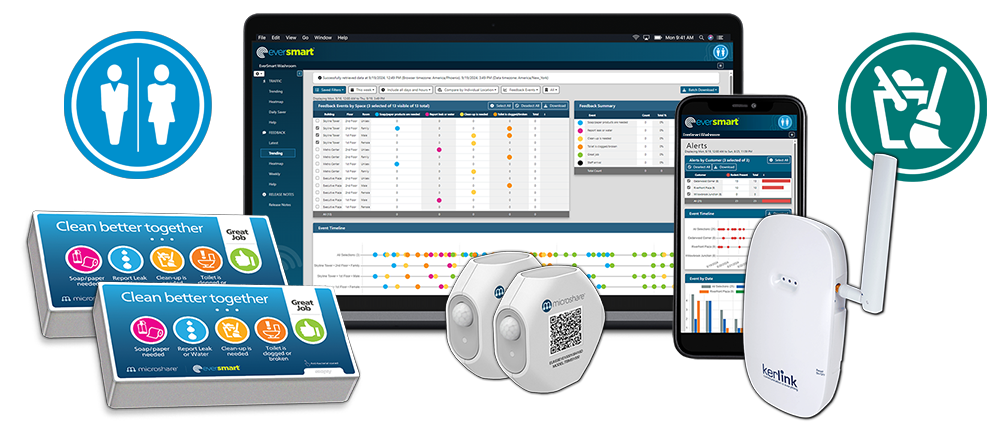
Microshare installs low-power, long-range LoRaWAN sensors on the operational parts of commercial and public buildings, then runs a cloud software platform - the EverSmart suite - that ingests, normalizes and analyzes the readings. The output is not raw numbers. It is dashboards, alerts, scoring and recommendations a facilities team can act on before the next shift. The company's own phrase for the goal is digitizing brick-and-mortar assets into "safer, more efficient, and more valuable structures."
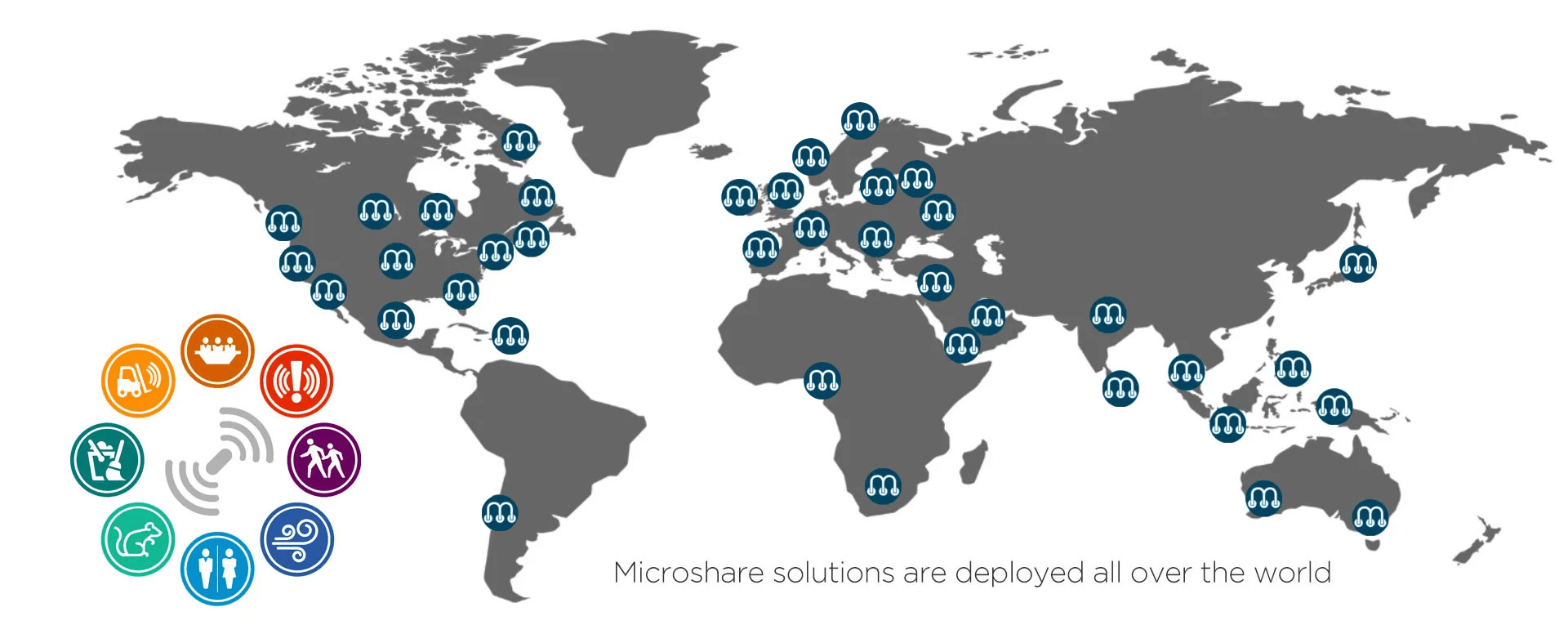
LoRaWAN is the quiet hero of the story. Because the sensors are cheap, battery-powered and long-range, Microshare can wire up an entire real estate portfolio without a construction project - no running cable to every trap and toilet. That is the technical unlock that makes portfolio-scale sensing economical, and it is why a 47-person company can credibly operate across five continents.
The product line reads like a building's to-do list
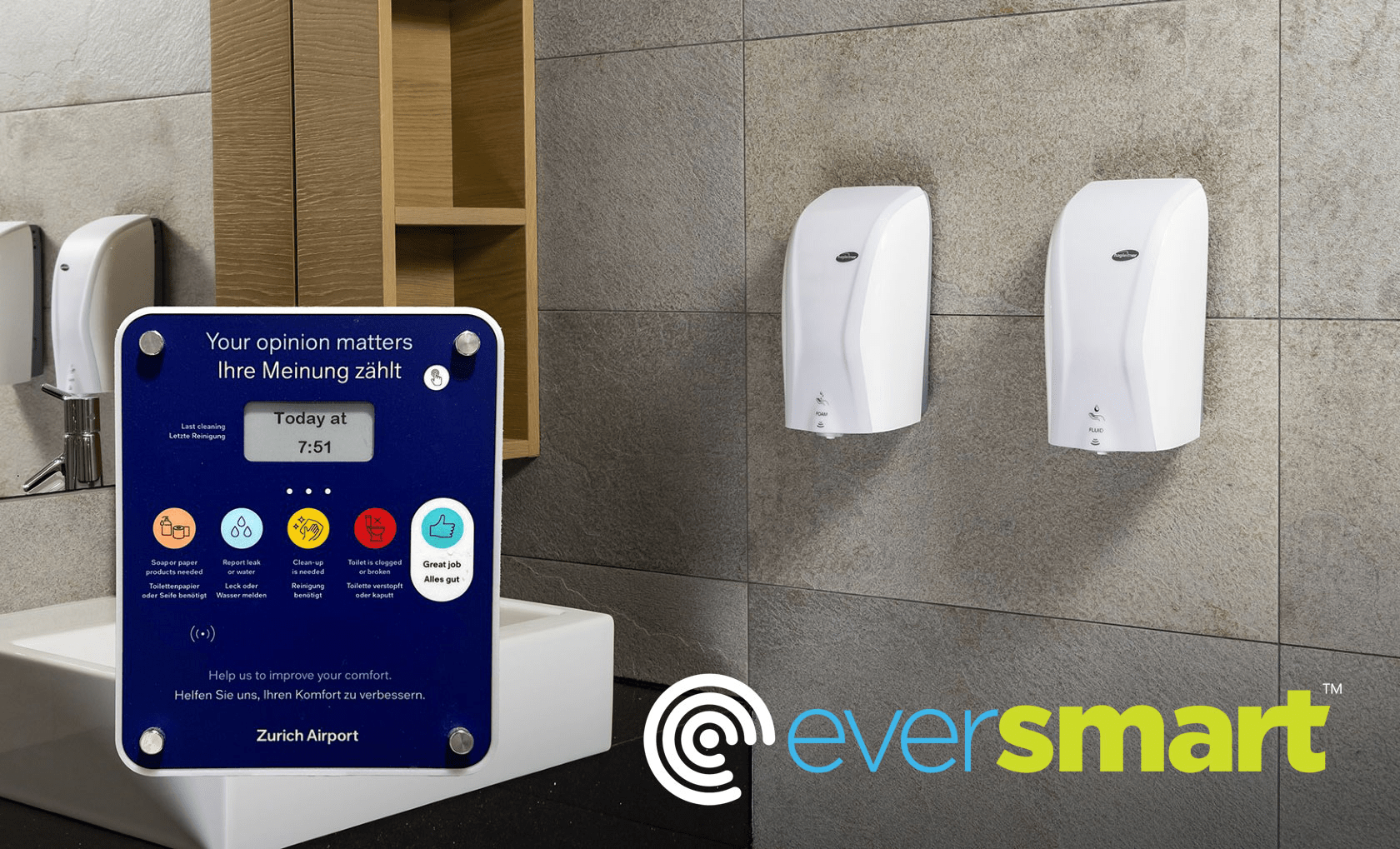
EverSmart is not one thing; it is a suite aimed squarely at the jobs nobody wants. EverSmart Pest monitors rodent, flying insect, crawling insect and bedbug activity - essentially a smart mousetrap that reports in so pest teams respond to evidence instead of a monthly walkthrough. EverSmart Clean & Washroom reads occupancy and usage to drive predictive cleaning. EverSmart Leak catches water damage early. EverSmart Warehouse Safety watches logistics environments, and EverSmart Space and Air track occupancy metrics and indoor environment for workplace wellness and sustainability reporting.
EverSmart Clean provides new data and insight into what needs to be cleaned and how often, so facilities managers can allocate resources based on need.- Microshare, on its predictive-cleaning approach
Predictive cleaning is the clearest illustration of the whole thesis. The old model cleans on a calendar: this room, every day, forever, whether anyone set foot in it or not. Microshare's model cleans on demand - the sensor says the space was used, so the space gets serviced. Empty rooms get skipped. That single shift turns a fixed cost into a variable one, which is exactly the kind of math a global facilities budget notices.
The rodent number people remember
Nothing sells a sensor like a before-and-after. Microshare's published EverSmart Pest case studies report reductions in rodent activity of roughly 39 to 56 percent once monitoring replaces guesswork. For a food plant, a hospital, or a warehouse, that is not a vanity metric - it is a compliance and reputation line item.
rodent-activity drop
rodent-activity drop

Who is actually buying this
The customer list skews large and unglamorous in the best way: Fortune 500 and FTSE 100 enterprises, public institutions, hospitals, universities and venues. Named deployments span GlaxoSmithKline, Aramark, Rent-A-Center, GXO, General Motors, Unilever, Zurich Airport and Audemars Piguet. During the pandemic, Microshare shipped Universal Contact Tracing wearables at scale - including for GSK's manufacturing plants - a use case it later dialed back as the world reopened, keeping the platform and swapping the application.
That pivot is a quiet lesson worth stealing: own the platform, and the use case becomes interchangeable. Contact tracing in 2020, rat traps and leaks by 2024, same sensors and same data pipes underneath.
The distribution trick: be invisible
Here is the part that makes the model scale. Facilities giants like Aramark and Elis do not just deploy Microshare - they resell it, white-labeled, under their own brands. The tech disappears into a service contract the building owner already has. Microshare gets reach it could never build with 47 people; the partners get a data product without building an IoT stack. It is why the company can punch far above its headcount, and it explains a footprint that would otherwise look implausible.
The company keeps stacking distribution the same way. It brought on partners across consulting and IT services - EY and Microland among them - and in 2022 it became the exclusive North American distributor of Skiply's customer-experience feedback terminals, the little smiley-face buttons that ask how your visit went. Each move follows the same logic: plug into a channel that already touches buildings rather than knocking on doors one lobby at a time.
The business model, and what you can copy
Underneath the product names, the model is B2B SaaS with connected hardware: software subscriptions layered on low-cost sensors, sold both direct and through resellers. The recurring revenue lives in the platform; the sensors are the on-ramp. That structure is the most portable idea in the whole company for anyone building in physical-world software. Pick a job that is currently done on a fixed schedule or a gut feeling - inspection, cleaning, restocking, safety rounds - and replace the schedule with a sensor and a threshold. The value is not the hardware. It is the decision the data lets someone stop making by guesswork.
The expertise that is hard to copy sits in the unglamorous middle: turning messy, low-power sensor streams into readings a non-technical facilities manager trusts enough to change a shift over. Anyone can stick a sensor on a trap. Getting SOC 2 certification, normalizing data across thousands of devices on five continents, and delivering it as an alert someone acts on before the room floods - that is the moat, and it took a decade to build.
Funding, round by round
Roughly $61M raised across the company's life to date.
The 2019 round drew participation from The Motley Fool. The 2021 financing - $15M from Avenue Capital's Sustainable Solutions Fund - underlined the sustainability angle, since occupancy and environment data feed directly into ESG reporting. The 2024 raise of about $5.86M, reported as a Series B, kept the EverSmart suite expanding.
How it is different from the pack
Most smart-building rivals - and the incumbents like Honeywell and Johnson Controls - orbit HVAC and comfort. Occupancy specialists like Density and VergeSense count people; sensor platforms like Disruptive Technologies and Infogrid chase broad monitoring. Microshare's edge is narrower and stubbornly practical: it went after pest, washroom, leak and warehouse safety, where the data ties to a measurable cost or compliance outcome rather than a nicer lobby. When the value is "you cut rodent activity in half" or "you stopped cleaning empty rooms," the sale writes itself.
Microshare digitizes brick-and-mortar assets, transforming them into safer, more efficient, and more valuable structures.- The company's stated mission
The people and the footprint
Microshare was founded in Philadelphia in 2013 by Ron Rock (CEO), Tim Panagos (CTO) and Charles Paumelle (CPO) - a trio whose collaboration on data ventures dates back to 1989. Rock's previous company, the BPM firm Knowledge Rules, was acquired by Accenture in 2010. Today the team spans roughly a dozen nationalities, with offices in Philadelphia, Boston, London and Pune, India, and it leans hard on data ownership and privacy as design principles, not afterthoughts. The founders like to talk about moving buildings from "smart" to "sentient" - spaces continuously aware of their own condition.
Where it fits in the market
The smart-facilities market is crowded at the top and thin in the middle. Microshare's position is the middle done deliberately: not the flashy building OS, not a single-sensor point product, but an operations-data layer sold through the firms that already run the buildings. The revenue is modest - an estimated $3.4M annually - and the company is not trying to be a household name. It is trying to be the invisible sensor layer inside buildings you already walk through, quietly telling someone what to clean, fix, or trap next.
Whether that is a durable business or a niche depends on how far predictive operations spread. But the wager is legible, and it has held up through a pandemic and three funding rounds: the least glamorous data in a building is often the most actionable - and someone will pay to finally see it.