Before Kip Kirkpatrick delivered his 2022 Northwestern convocation address, he took care of a small matter of credibility. He snapped a selfie with the graduating class behind him. His son, he joked, needed evidence that his father really had been invited to speak. A university trusteeship and a career in private investment apparently carried limited weight at home. The graduates would have to serve as witnesses.
It is a useful opening picture of Kirkpatrick: back at his university, surrounded by people finishing one stage of their lives, answering to an audience considerably harder to impress than a room of investors. He had been a Northwestern basketball player, earned two degrees there and become a trustee. Yet the credential that mattered in that moment was a photograph on his phone.
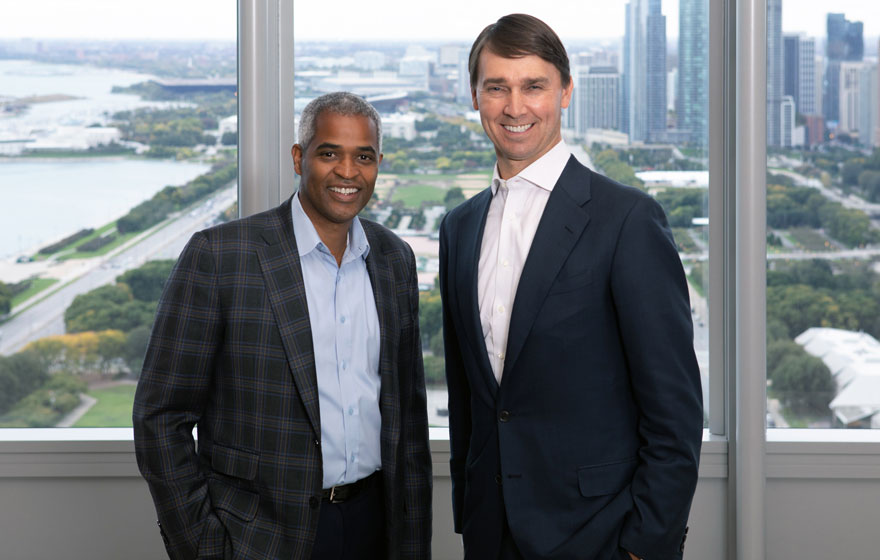
His public career offers several possible introductions. There are the investment firms he helped establish, the mortgage company he ran, and The Vistria Group, which he co-founded with Marty Nesbitt in 2013. There is also a surprisingly persistent geography. Northwestern keeps appearing in the story, as classroom, basketball court, institution to support and place to return. The connections have lasted considerably longer than a four-year eligibility window.
Before the business cards, a jersey
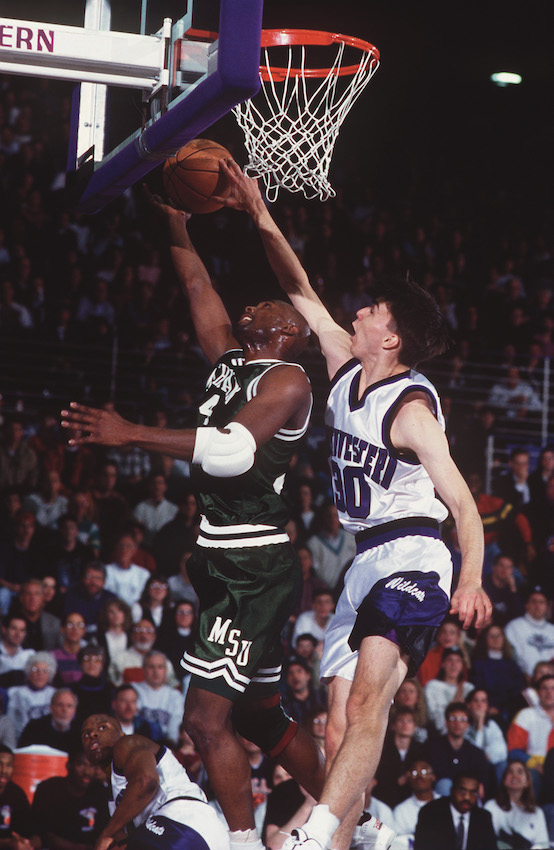
Kirkpatrick grew up in Lexington, Kentucky, and graduated from Henry Clay High School in 1990. Basketball took him to Northwestern. He became a three-year starter and played on the Wildcats' 1994 National Invitation Tournament team. His undergraduate subject was history. He finished that degree in 1994 and earned his MBA at Northwestern's Kellogg School of Management in 1997.
An archival action photograph catches him contesting a shot against Michigan State, arms extended toward the ball. It is a pleasing corrective to the polished office portrait. Before the investment committee and the carefully worded announcement, there was a player trying to make a basket difficult for somebody else. The work was visible, the assignment immediate, the result subject to a whistle.
The temptation with any former athlete's business career is to turn every subsequent decision into a sporting lesson. That would give basketball rather too much credit. What can be said is more concrete: the sport remained part of Kirkpatrick's social life, and it brought him into the circle where he and Nesbitt became friends. Their eventual partnership had a history before it had a fund.
The investor takes the operating seat
Kirkpatrick's early investment career included helping create One Equity Partners in 2001. He also co-founded Water Street, another private investment business. These were substantial apprenticeships in forming firms and working with companies. By the time Vistria arrived, he had already experienced the ordinary demands behind the word founder: colleagues, capital, transactions and the continuing obligation to make the organization work.
Then came a job with a different vantage point. From 2011 to 2013, he served as chief executive of United Shore Financial Services, an independent mortgage lender. During his tenure, the company hired more than 800 employees. Its expansion included senior appointments, a wider national presence and recognition in two Detroit-area workplace programs in 2012.
That interval matters because running a business exposes an investor to the consequences of decisions after the meeting ends. Hiring means finding people, giving them work they can do and making room for the next arrivals. Culture becomes something employees experience each morning. The United Shore chapter put Kirkpatrick inside a growing organization, with an executive's responsibility for the operation as well as its ambitions.
United Shore added more than 800 employees during Kirkpatrick's 2011-2013 tenure as CEO.
A friendship becomes a firm
Nesbitt brought his own operating experience. He had co-founded and led The Parking Spot, the off-airport parking business. Their pickup basketball circle also included Barack Obama, but the partnership Kirkpatrick and Nesbitt eventually built rested on their own mix of investment and company-building experience. In Chicago in 2013, they established Vistria.
The founding team wrote down its beliefs in a document called A New Vision for Investing in America. It linked investor returns with business growth, jobs, employees' living standards and the interests of communities. It also described a firm willing to engage with national policy, management and the people doing the work. Vistria later called the document its internal constitution.
A constitution is an ambitious thing for an investment partnership to keep around. It gives future decisions something to answer to. A new transaction can be measured against the business case and against the firm's own stated intentions. The document made the founders' preferred connection explicit: a more productive company should be able to create value for several groups at once.
Kirkpatrick's account of his working relationship with Nesbitt emphasizes common interests in building teams, spotting overlooked opportunities and creating a positive workplace culture. He has also been blunt about the investment industry's public image. “Our firm is focused on growth,” he said. It is a short sentence with a long list of practical obligations behind it.
A mentor declines to be astonished
One of the better episodes in Kirkpatrick's explanation of Vistria involves Bill Osborn, the former chairman and chief executive of Northern Trust. Kirkpatrick brought his vision to the older executive with considerable enthusiasm. Osborn's reply put the excitement in perspective: “that is what the great companies have been doing since the beginning of time.”
It is an elegant way for a mentor to acknowledge an idea while declining to declare a new epoch. Kirkpatrick kept the exchange in his own telling. That choice is revealing. He was willing to describe a moment in which his fresh proposition sounded familiar to someone with a longer memory. Finance has plenty of appetite for novelty; Osborn supplied a little historical seasoning.
The underlying questions are practical enough to survive a change in vocabulary. Does a company solve a useful problem? Can it develop its employees? Does it have enough different perspectives to notice trouble? Those questions can guide decisions about people and products. Their usefulness depends on what management does with the answers, long after the presentation has been put away.
capitalOperating
experiencePolicy
understanding
A diagram of the founders' stated approach, rather than a measurement of results.
Two kinds of graduation
Education gave Vistria an early example in Penn Foster, a business with roots in correspondence learning. Its students included adults working toward a high-school diploma and credentials that could help them progress at work. For Kirkpatrick, this was a way to connect the needs of learners with employers looking for people with useful skills.
Vistria worked with chief executive Frank Britt and the management team on employer relationships, leadership and technology. Kirkpatrick later described the company's graduations as particularly memorable for the investment team. That detail brings the business down to an understandable scale: a learner completes something, and a piece of paper may change which job becomes possible next.
A degree from a business school and a high-school diploma earned later in life occupy different places in the education market. Both can carry consequences far beyond the ceremony. Kirkpatrick's own route passed through Northwestern twice; the Penn Foster example asked how an investment business might participate in opening another route for somebody else.
His continuing university work also reaches beyond athletics. He has chaired Kellogg's Private Equity Advisory Council and served on its Global Advisory Board. These are institutional relationships, with the recurring demands that institutional relationships bring. His connection to the campus has acquired responsibilities as well as memories.
“running a business the right way leads to higher returns”
Kip Kirkpatrick · 2022
A basketball player's gift crosses the diamond
Kip and Sara Kirkpatrick were among the benefactors of the Welsh-Ryan Arena renovation dedicated in 2018. The arena serves basketball, volleyball and wrestling, and the renovation included a substantial effort to improve access for spectators. For a former player, supporting the building where the next generation competes is a recognizable form of returning the favor.
Their next major athletics commitment crossed to softball. In March 2024, Northwestern announced the couple's $5 million lead gift for a new stadium. Sara, a former Chicago Public Schools teacher, spoke about investing in future generations of players. The gift came from both of them, and the resulting venue carries both their names.
Kip and Sara Kirkpatrick Stadium opened in September 2026. The playing surface retains the name Sharon J. Drysdale Field, honoring Northwestern's former softball coach. There is room for more than one kind of contribution in that arrangement: the donors' support, the coach's history and the players' continuing work all remain legible.
The new venue includes a clubhouse, players' lounge, locker rooms, dugouts, chairback seating and a press box. These are tangible additions to the daily life of a team. A stadium dedication offers a public occasion; a better place to prepare for practice earns its keep on quieter afternoons. The basketball alumnus's contribution will be used by athletes whose game is played on a diamond.
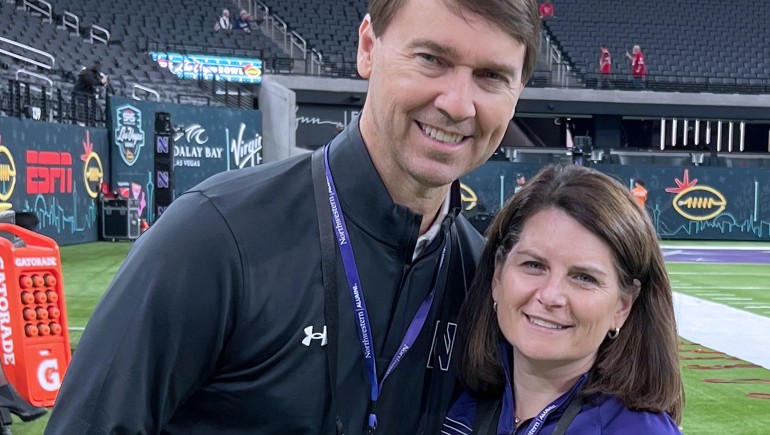
A Northwestern NIT player. A new softball stadium bearing Kip and Sara's names. Thirty-two years between chapters.
Making room for the next decision
By March 2026, Vistria reported more than $17 billion in assets under management. That figure describes the firm's investment platform, rather than Kirkpatrick's personal wealth. The company also announced Phil Alphonse and David Schuppan as co-presidents of its flagship funds, with Nick Potter becoming head of strategic initiatives. Kirkpatrick and Nesbitt remained co-CEOs.
The appointments gave formal authority to colleagues already carrying leadership responsibilities. They also introduced a different problem from the one a new firm faces. Founders first have to persuade people to join them; a growing organization has to give those people enough authority to keep building. The March announcement placed that work in the foreground of Vistria's next stage.
Kirkpatrick's story now includes institutions he once entered in smaller roles: a university he attended, a sport he played and an investment business that began with a partnership. The recurring action is participation followed by responsibility. He has kept showing up, with different jobs to do.
The 2022 selfie remains an agreeable final check on all the titles. At a ceremony celebrating other people's achievements, Kirkpatrick paused to collect evidence for his child. The photograph joined a familiar campus to a family joke. Whatever the occasion said about his professional standing, someone at home still expected him to prove he had been there.