There is a small indignity in the modern wilderness: the moment a glowing phone becomes a very expensive compass with no map. The bars vanish. The group chat goes quiet. All the polished machinery of ordinary life abruptly loses jurisdiction. Kim Layne has built much of her marketing career around that moment - not the panic of it, but the practical question that follows. What, exactly, should work when everything familiar does not?
Layne is Chief Marketing Officer at Roadpost, the Toronto satellite communications company founded in 1991. Roadpost sells and supports the devices, service plans and software used by people who travel or work beyond cellular reach. Its customers include individual adventurers as well as organizations responsible for remote employees. The technology arrives with a vocabulary of networks, airtime, activations and protocols. The customer arrives with a simpler vocabulary: Will it work out there?
That gap is where Layne operates. Her public career record is light on grand declarations and rich in finished projects. She led the Canadian introduction of DeLorme inReach. She wrote about work-alone legislation and documented how Dillon Consulting used a communicator in its remote-safety program. She designed and launched B2B and B2C commerce sites. Then she led the global go-to-market plan for ZOLEO and its commercial debut across Canada, the United States and Australia.
First, learn the terrain
The useful beginning is 2011, when Layne began bringing inReach to market in Canada as an exclusive master distributor. Roadpost operated the effort as inReach Canada. The product paired satellite communication with the habits people were developing around mobile devices. It had to make sense to outdoor consumers and to enterprise teams, two audiences that can share a need while speaking almost different languages.
For an individual buyer, the decision might begin with a route, a weekend or a worried family member. For an organization, the same category enters through duty of care, procurement, training and fleet management. One side asks whether the device is simple. The other asks whether the whole system is manageable. A marketer in the middle has to resist the temptation to describe one audience with the other’s brochure.
Layne’s six-year inReach project says something about her method. She did not merely announce the product. Her profile credits the plan with driving both consumer and enterprise subscriber growth through September 2017. Distribution became a long education in buyer language. Which feature creates recognition? Which question stalls a purchase? Which explanation survives the handoff from a website to a retailer to an activated device?
The remote-connectivity trust chain
Marketing owns more of this chain than the advertisement. Every unclear handoff spends trust.
Safety, written in plain language
In 2014, Layne published “Reducing Exposure,” a bylined article about tools that could help organizations comply with work-alone legislation. That same year, she authored a case study about Dillon Consulting’s use of DeLorme inReach to reshape its approach to employees working in isolation. These were marketing materials, certainly, but they were anchored in the obligations surrounding the product rather than gadget theatre.
This is the harder and more interesting version of technical marketing. A satellite communicator is full of specifications, but no one wakes up longing for short-burst data. They want a check-in to arrive. They want a location to be visible. They want an established process when a routine day stops being routine. Good explanation travels from the mechanism to the human job without becoming vague on the way.
Layne’s colleague Jennifer Bates described her as an encouraging mentor who paired market expertise with warmth. Bates also credited Layne’s market perspective with informing product development in machine-to-machine satellite communication. The compliment reveals a connection often lost in org charts: marketing insight can flow backward. Strong field questions do not merely improve the copy. They improve what gets built.
Begin with the human job
Describe what the customer can do before explaining the network that makes it possible.
Launch the whole path
Hardware, app, plans, retail, activation and support must tell one coherent story.
Let the market answer back
Questions from buyers are product intelligence wearing ordinary clothes.
Commerce is part of the product
By April 2018, Layne had designed and launched multiple B2B and B2C e-commerce websites using Magento 2 Enterprise. It sounds less romantic than a satellite launch because it is. Checkout rarely appears in the commemorative photograph. Yet for a category with hardware, service plans, rentals and accessories, commerce is not a cash register bolted onto the end. It is part of the explanation.
A customer may need to understand coverage, choose a device, compare an airtime plan and decide whether renting makes more sense than buying. An organizational buyer might have questions about multiple users and ongoing administration. Each choice creates an opportunity for confusion. The page hierarchy, plan language and sequence of steps become product decisions in their own right.
markets at commercial debut.
Layne’s ZOLEO go-to-market work culminated in a January 28, 2020 launch across Canada, the United States and Australia.
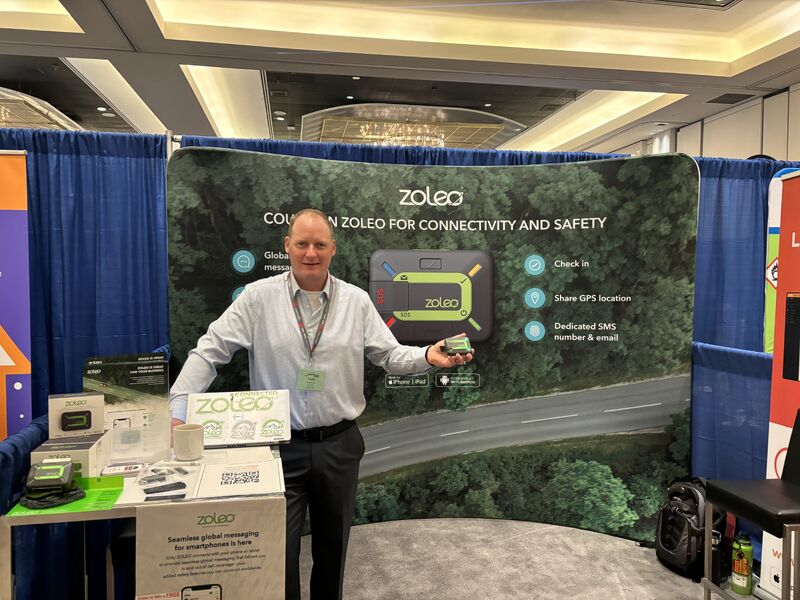
This commerce work ran alongside preparation for ZOLEO, a joint venture formed in 2018 by Roadpost and Beam Communications. ZOLEO combined an app and compact device with automatic routing across satellite, cellular and Wi-Fi networks. The engineering proposition was seamless messaging. The marketing challenge was making “seamless” visible before a customer had ever crossed a coverage boundary.
The long runway to launch day
Layne’s own project description is precise: she led global go-to-market planning and the commercial debut of ZOLEO and its flagship product. The debut came on January 28, 2020. Roadpost handled North American retail distribution while Beam covered Australia and the Asia-Pacific region. National retailers eventually included REI, Cabela’s, Bass Pro, MEC, Anaconda and Autobarn, with later availability extending into New Zealand and Europe.
A three-market launch forces a team to distinguish the portable truth from the local machinery. The need for communication outside mobile coverage crosses borders. Retail relationships, terminology, support expectations and channel economics do not. A global plan needs a stable center and flexible edges. Too much standardization makes it tone-deaf. Too much localization turns a brand into luggage packed by committee.
- Brings inReach to Canada for consumer and enterprise subscribers.
- Writes about lone-worker obligations and a remote-safety case study.
- Launches commerce sites and begins ZOLEO go-to-market planning.
- Leads ZOLEO’s commercial debut across three national markets.
- Serves as Roadpost CMO as ZOLEO becomes wholly owned by Roadpost.
One year after launch, ZOLEO won Outdoor Retailer Product of the Year. A 16-member panel chose it from 189 entrants and 34 finalists. Awards flatten a great deal of collective work into a tidy noun, so it is worth keeping the credit broad. The achievement belonged to the teams across the joint venture. For Layne’s story, its value is as a marker: the market could see the proposition the company had worked to articulate.
After the applause, keep building
The product continued to grow. Progressive SOS arrived in 2022, giving users continuing status updates during an incident. In 2023, ZOLEO announced integrations that allowed user-consented location data to flow into the OCENS SnapTrack and SpotWalla platforms. ZOLEO Track gave organizations a web map for viewing and managing device locations. Each addition stretched the story from a single communicator toward a broader system for individuals and remote teams.
Layne’s role is visible around these moments as Roadpost and ZOLEO’s North American media contact, the person positioned where corporate language meets public questions. In February 2026, after Roadpost acquired Beam’s stake and ZOLEO became a wholly owned subsidiary, the announcement identified her as Roadpost’s Chief Marketing Officer. The title had changed from the vice-president designation attached to earlier releases. The territory had widened with it.
Her public comments remain notably team-minded. In a recommendation for a Roadpost production colleague, Layne praised his commitment to process improvement and customer experience. In a post marking ZOLEO’s fifth anniversary, she wrote that she was proud to be part of a brand connecting people everywhere and looked ahead to more innovation and connection. The language fits the record: process on one side, purpose on the other.
What operators can steal
The first lesson is to treat translation as real work. Technical teams sometimes imagine that a precise product will explain itself. It will not. Customers encounter consequences before specifications. Layne’s work starts with the remote employee, the outdoor traveler and the person who needs a message to cross an invisible boundary. The network matters because the message does.
The second lesson is that channels teach. Years spent bringing inReach to Canada created knowledge that a launch brief could never supply. Articles, case studies, retail partners and commerce flows are not just outputs. They are listening posts. Every recurring question is a little flare fired by the market. Notice enough of them and the roadmap gets brighter.
The third is to respect the quiet pieces. ZOLEO’s award made a clean headline. The less glamorous work included store relationships, plan explanations, websites, activation journeys and the coordination required to cross borders without losing the core promise. This is the operator’s advantage: caring about the connective tissue after everyone else has wandered toward the ribbon cutting.
Layne’s career is well suited to a business whose products become relevant as the ordinary world recedes. She has spent years making a complicated category feel navigable without sanding away its seriousness. Out beyond the bars, there is no audience for puffery. There is only the product, the promise and whether the two remain connected.
Continue exploring