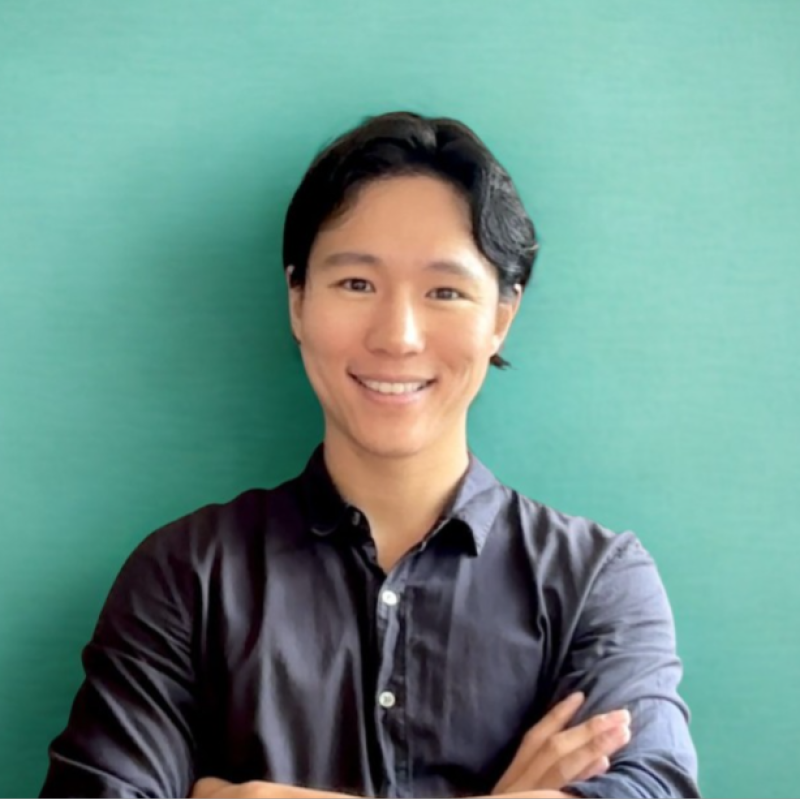
He builds wristbands that whisper directions. No screen. No earbud. Just the smallest possible buzz, in exactly the right place.
Kevin Yoo is the chief executive of Haptic, the New York hardware-and-software company you may know by its old name, WearWorks. From a workshop in Brooklyn he and his co-founders, Keith Kirkland and Yangyang Wang, are doing something almost no other consumer-tech company has tried at scale - building an entire navigation system that bypasses your eyes and ears completely.
The product they are best known for is the Wayband. Strap it to your wrist. Open the companion app. Pick a destination. The wristband does not speak. It does not chirp. It does not light up an arrow. It vibrates - left for left, right for right, harder when you drift, softer when you correct. Yoo and his team call the invisible path it draws around you a virtual corridor. Step out, you feel it. Step back in, the buzz stops. Walking becomes an act of listening with your skin.
Yoo did not come to this from neuroscience or robotics. He came to it from industrial design. He studied at Pratt Institute in Brooklyn, earning his BID in 2015, and met his future co-founders in the school's Digital Arts and Humanities Research Center. They were tinkering with vibration motors. He was thinking about a friend named Marcus who was losing his sight. Those two facts shook hands one afternoon and a company popped out.
The proof-of-concept Yoo and his co-founders kept hoping for arrived in 2017. The British ultramarathoner Simon Wheatcroft, who is blind, lined up at the start of the New York City Marathon strapped to a Wayband. No tether. No guide runner whispering turns. Just a buzz on the wrist.
Yoo ran with him. Not as a guide - the wristband was the guide. As tech support, in case the prototype hiccuped. The story landed on CNN, in The New York Times, on TED stages, on the Discovery Channel and TechCrunch. It was the first time a blind runner had attempted the race without sighted assistance.
What stuck with Yoo afterward was not the press. It was a quieter line from the National Federation of the Blind, who pointed out that the Wayband reduced the connotation of being blind. A piece of tech that didn't announce itself. A piece of tech that just helped you walk.
A wrist-worn haptic compass. Pairs with the HapticNav app. Programs your route as a virtual corridor. Vibrates when you leave the lane. Silent when you don't.
PATENT: HOLDER - YOO ET AL.
USE: SCREEN-FREE NAVIGATION
TESTED: NYC MARATHON, 2017
As designers, we focus on social impact as much as a beautifully functional product. Allowing a true problem of the people to be at the forefront of design gave us greater purpose, and this purpose fueled innovation.- Kevin Yoo, on why the company exists
Yoo has told the story many times and the shape of it does not change. A friend, an author, was going blind. Yoo asked himself the most useful possible question - what would help him walk through a city he could no longer see?
The obvious answers are loud. Talking phones. Beeping crosswalks. Cameras describing scenes aloud. Yoo's instinct went the other way: subtract the senses already overworked, recruit the one that isn't. Touch.
The bet was that a vibration applied to the right place, at the right intensity, at the right moment, could carry a message as clearly as a sentence. Walk left. Walk right. You are off-course. You have arrived.
Yoo is an iterative designer in the unglamorous sense. He talks about prototypes the way a chef talks about prep. Make it. Hand it over. See the face.
His co-founders are openly disagreeable - Yoo and Keith Kirkland did an entire podcast called You Get Much Better Products When You Don't Agree. Friction as feature, not bug. Three opinionated industrial designers, one wristband, no second-guessing.
"You got to make something super fast and super dunk immediately."
"Through touch, we can guide people, and that can be truly inclusive."
"We are committed to building the language of touch."
Graduates from Pratt Institute with a Bachelor of Industrial Design.
Co-founds WearWorks with Keith Kirkland and Yangyang Wang inside Pratt's Digital Arts and Humanities Research Center.
Wayband prototypes evolve from breadboards to wearable hardware.
Simon Wheatcroft attempts the NYC Marathon guided solely by Wayband. Yoo runs the route alongside.
Closes Seed round. WearWorks formally becomes Haptic, pivoting to platform and SDK plays.
Joins the Council of Korean Americans.
For pushing universal design forward.
For industrial-design excellence.
For research with public benefit.
A short list of topics he could (and does) talk about until the coffee is cold.
When Wheatcroft toed the line in 2017, Yoo's job was to be reachable in case the firmware sneezed. He covered the full course on foot.
The trio formed inside Pratt's Digital Arts and Humanities Research Center - the kind of campus room with too many soldering irons and not enough chairs.
He uses the phrase unironically. Make the thing immediately, hand it to a human, watch what their hands do.
Through touch, we can guide people, and that can be truly inclusive.- Kevin Yoo, on the company thesis in one sentence