Kevin Newell once attended Phillis Wheatley Elementary School on Milwaukee’s North Side. When he returned to the property as a developer, the assignment had changed considerably. The old school had closed in 2005. Its next chapter would involve apartments, new construction and a financing package assembled to make the numbers work. Most alumni settle for a reunion. Newell arrived with a redevelopment plan.
The result, Wheatley School Apartments, combined the reuse of the historic school with a new building to deliver 82 mixed-income homes. For the founder and CEO of Royal Capital, the connection was personal: he had grown up in the neighborhood as well as attended the school. The project put his business in a place already written into his biography.
An elementary school is a particularly good place to consider his career. It holds two kinds of memory: the public history of a neighborhood and the private history of the children who passed through it. Newell’s work keeps bringing those histories into the same room. A former department store becomes a place to live and gather. Apartments sit above a library. The past supplies a building; the present supplies another use.
One application, several doors
Newell arrived at the University of Wisconsin-Whitewater in fall 2003 having applied to just that one university. His mother, Velma “Lorraine,” helped introduce him to Freda Briscoe, an adviser to pre-business students. He became the first of his siblings to graduate from college. A business career began with a campus introduction, rather than a magnificent founding epiphany.
At Whitewater he joined Alpha Phi Alpha, serving as chapter president and later as assistant state director overseeing Wisconsin chapters. He earned a BBA in general management in 2007 and an MBA with an emphasis in finance and management in 2009. The leadership positions and the degrees belong together: learning an organization’s rules and persuading people to participate would both become useful.
Commercial real estate supplied another door. He entered Marquette University’s Associates in Commercial Real Estate program, known as ACRE, while still a college student. The program was designed to widen participation in an industry where access to training and professional relationships matters. Its subjects included property management, construction management and development techniques. A building requires a surprising amount of education before anyone orders the bricks.
His application was hardly routine. He was younger than the typical ACRE applicant when he sought a place in its second cohort in 2006. The program was competitive, accepting about one applicant in five at the time. Years later, Marquette would feature him among the graduates changing Milwaukee’s development landscape. The student who needed an opening had become an example of what an opening could produce.
Borrowing a résumé, building his own
After ACRE, a placement with the Wisconsin Housing and Economic Development Authority became a three-and-a-half-year education in public financing. Newell worked while completing his MBA, commuting among Milwaukee, Madison and Whitewater. He founded Royal Capital in September 2010. His first redevelopment involved 84 residential units in Kenosha; a subsequent Madison venture with Zilber Limited involved 335 units.
He described an early method with little mystique: bring capital and work to a project, and partner with a team whose experience could help get it done. During his first four years, joint ventures helped him establish Royal Capital’s own record. An inexperienced founder could contribute without pretending that experience was unnecessary. The arrangement gave him a way to start, and completed projects gave him a way to continue.
That approach helps explain the variety of names attached to his later work. Royal Capital’s developments involve public agencies, other developers, lenders and community institutions. The partnership itself does some of the heavy lifting. The person with a vision still needs someone who knows a funding mechanism, someone who can construct the building and someone who will use what gets built.
By 2017, the Milwaukee Business Journal had named Newell to its 40 Under 40 class. In 2019, he chaired the African American Chamber of Commerce of Wisconsin’s Breakfast of Champions, an event centered on economic development and wealth creation. The work had carried him from learning the mechanics of a deal to participating in the city’s conversation about who gets to make one.
- 2007BBA + ACRE
- 2009MBA
- 2010Royal Capital
- 2023Bank board
The library downstairs
The Good Hope project makes his approach easy to picture. Royal Capital and Maures Development Group, founded by Melissa Goins, worked with Milwaukee Public Library on a new branch at 7717 West Good Hope Road. The building combined a public library with the 65-unit Fortitude Apartments. A resident could have a library downstairs rather than another errand across town.
The library opened in 2020 as part of a $19 million development. Federal affordable housing tax credits helped finance the project; the financing required 85 percent of the apartments to have below-market rents for qualifying households. That detail matters because it connects the attractive idea to the transaction that made it possible. A library and apartments can share an address, but they also need a workable financial arrangement.
The branch offered more than shelves. Its design included a community room, computers, flexible spaces and a makerspace with a 3D printer. The housing added daily life above the public space. There is something pleasingly literal about this development: a building where a household and a public institution are neighbors, with each performing its own useful job.
Newell also became a real estate partner of the Milwaukee Bucks through Five Fifty Ultra Lofts in the Deer District. The six-story project brought 112 apartments and condos alongside the arena, connected by a glass skyway. His portfolio could accommodate both a basketball crowd and a library card. Those projects serve different markets, but both put housing beside a destination people already have a reason to visit.
Fortitude Apartments pairs mixed-income housing with a public library.
An old classroom earns another living
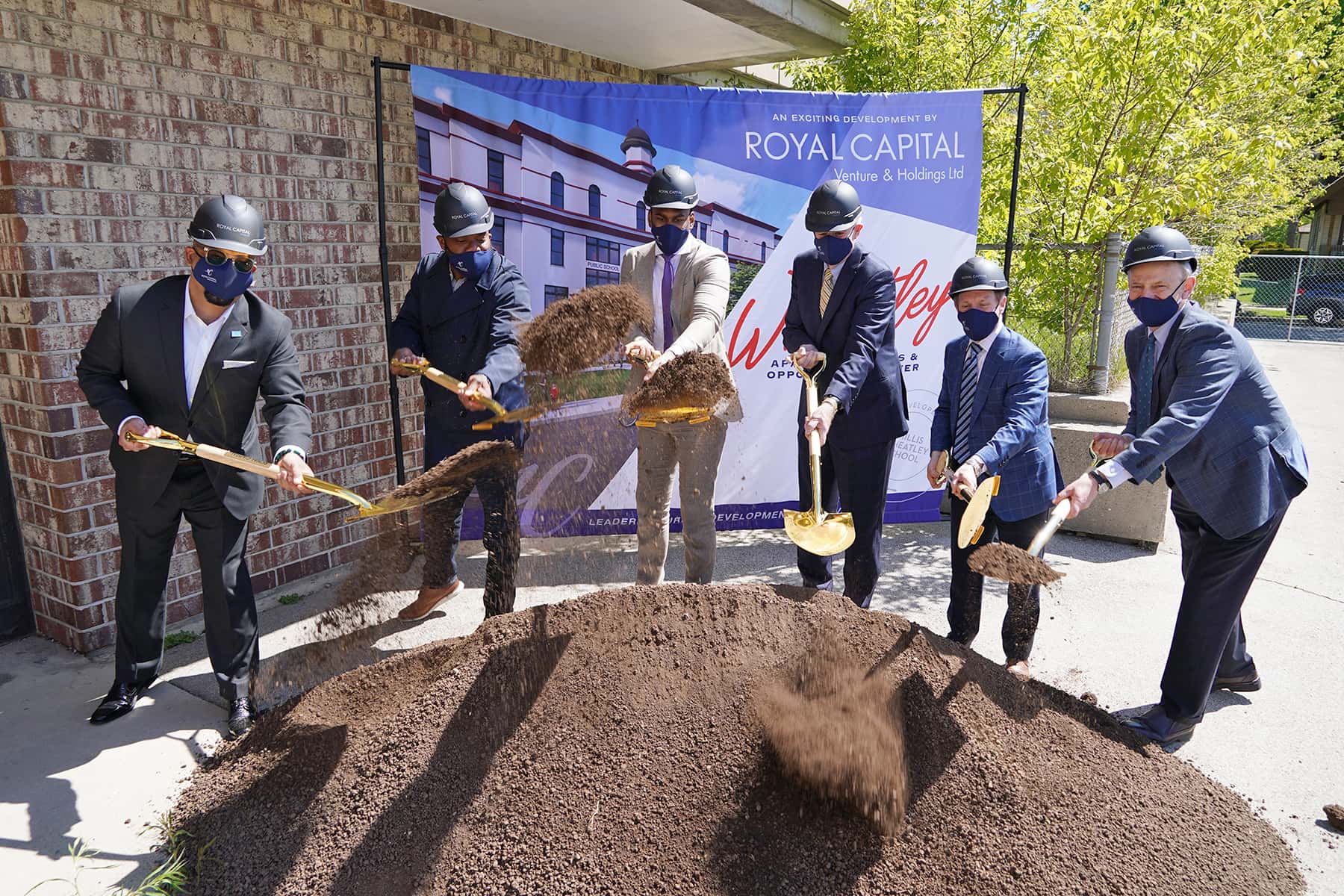
At Wheatley, construction formally began with a May 2021 groundbreaking for a $22 million redevelopment. Royal Capital executives joined city officials and financial partners at the former school. The property had been vacant for years, and the ceremony marked a change in what would happen there. A neighborhood landmark was moving from an unresolved question into a construction project.
The finished development’s 82 homes are the number that belongs in the story, rather than the larger figures discussed during planning. Reusing an existing school and adding new construction made a mixed-income residential development possible on the site. For a former pupil, that is a rather unusual form of homework: revisiting the place where you learned, then working out how someone else might live there.
There is a temptation to treat the childhood connection as the entire achievement. The connection gives the project emotional weight, but apartments still have to be financed, constructed and occupied. Newell’s return matters because it joined that personal history to the practical machinery he had learned to operate. Memory alone would have left the school exactly where it was.
The same distinction applies to his idea of responsibility. Who receives a contract, which partners participate and what a building contains are decisions a developer can actually make. The neighborhood appears in the work through those decisions. The sentiment becomes more useful when it has a place in the budget and a consequence on the site.
Auntie and Uncle get an address
ThriveOn King brought Royal Capital together with the Greater Milwaukee Foundation and a major Milwaukee institutional partner to adapt the former Gimbels-Schuster’s department store on Dr. Martin Luther King Jr. Drive. The collaboration began taking shape in 2018; construction commenced in 2022. Its plans gathered offices, housing and shared neighborhood spaces inside a building that had once been an anchor of commerce.
The first-floor plans included a café, a neighborhood hall, meeting rooms, a makerspace and an early childhood center. Putting these uses together gives the building several kinds of daily traffic. People can arrive for work, a meeting or their children, while others simply come home. A large building earns its place on a street partly by giving people ordinary reasons to enter it.
For Newell, the residential name carries its own explanation. Roosevelt and Ruth Wright, his uncle and aunt, offered a sanctuary to relatives arriving from the South, including his mother and him. He named the residences for them. Their hospitality had been an early model of what it means to make room for someone; now their names appear in a project devoted to housing.
His company’s name has a family connection too. “Royal” recalls his father’s affirmations about royalty and calling his son a young prince. It is a small detail that changes the sound of the business. On a corporate letterhead, the word might suggest grandeur. In Newell’s account, it carries a parent’s encouragement.
At a 2024 conversation with Burness, he put his working principle compactly: “Collaboration is the new innovation.” The phrase fits a career in which the combination often matters as much as the individual component. At ThriveOn King, the partners and the uses have to coexist. The building is an exercise in making their purposes share space.
“Collaboration is the new innovation.”Kevin Newell, 2024
The next neighborhood has its own history
Newell’s responsibilities now extend into the institutions that shape financing. He joined the Federal Home Loan Bank of Chicago’s board in 2023 after serving on its Community Investment Advisory Council from 2019 through 2022. The bank’s 2025 filing lists him on its Affordable Housing and Operations & Technology committees. It also records roles with organizations including Guest House of Milwaukee and the Wisconsin Preservation Fund.
Expansion has taken Royal Capital to Fort Worth’s Historic Southside and the Evans and Rosedale Urban Village. The city selected the firm after ending its arrangement with a previous developer. Plans evolved from the initial announcements: January 2026 documents described 181 affordable homes, including four live-work units, with commercial space nearby. This remains a development story whose approvals matter as much as its renderings.
In March 2026, Fort Worth’s Urban Design Commission signed off on final site plans for the $63 million project and recommended approval of requested waivers. Local reporting also documented outreach to contractors and residents. Moving a development approach to another city requires another set of relationships. The place comes with its own history, expectations and people who have already waited.
His public schedule still includes telling the story behind the work. A May 2025 CreativeMornings talk explored revival. In March 2026, he appeared in the first episode of Shannon Sims’s Rising Forward series, discussing his childhood moves and the route back into the neighborhoods that raised him. The account begins with a family making its way, and continues with a founder assembling a way for other people to stay.
Wheatley remains a useful place to end because it is also a place where he began. The former student’s career has acquired degrees, partnerships, board seats and projects in another state. Yet one of its clearest expressions is a familiar Milwaukee building with a different daily purpose. The old school has stopped giving lessons. It has started giving people somewhere to live.