The warehouse had the civic charm of a closed estate store. It sat near Tualatin’s Lake at the Commons, useful in the technical sense that it had walls, a roof and an address, but hardly the sort of place one would miss. Bart Dickson saw it come onto the market and began thinking less about the building than about the gap around it. Tualatin, he said, needed “a little bit of a soul.” His proposed instrument of urban feeling was pickleball.
There is something pleasantly Oregonian about that sentence. It is earnest, practical and just eccentric enough to work. Cobalt, the real-estate company Dickson founded, bought the 11,264-square-foot property for $1.7 million in early 2025. The tenant would be RECS, a club whose name spells out its purpose: Recreate, Exercise, Compete, Socialize. Four indoor courts went in, along with a lounge, food and drink, retail space and room for events. Portable nets allow the building to change jobs. The point was to make a place where a match could end without everyone immediately fleeing to a car.
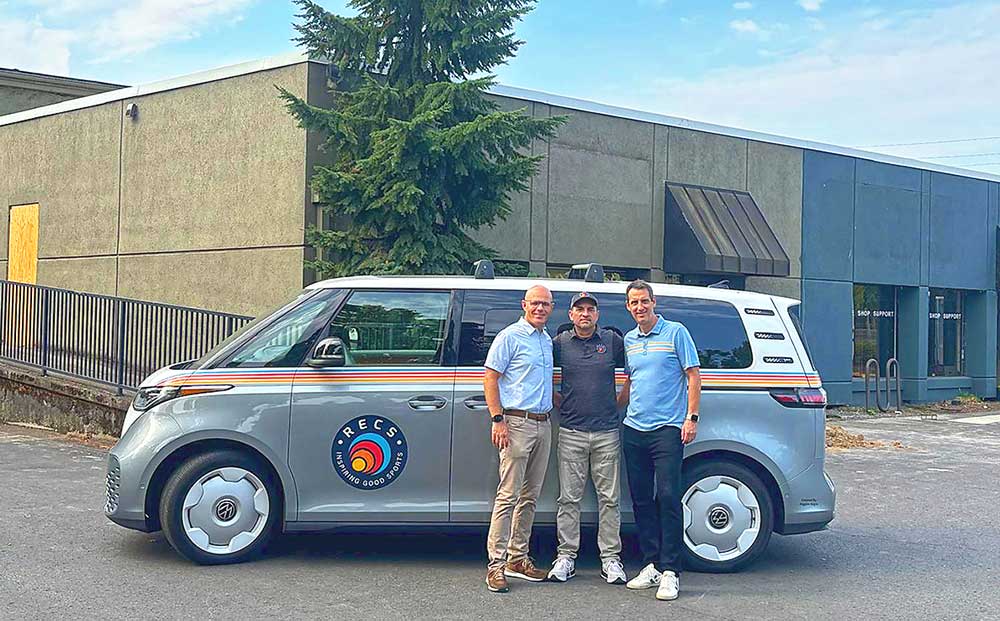
Dickson’s office is nearby. He knew the building, knew the downtown and knew the sensation of a suburb waiting for a center of gravity. His collaborator Kevin Richards remembers the conviction arriving early: Tualatin needed this, Dickson said; the project could help transform the community. Developers are often paid to imagine what a parcel might yield. Dickson was asking the warmer question of what it might cause: a game, a conversation, an extra hour spent downtown, perhaps a habit of returning.
Before the blueprints, a paper route
Long before he assembled parcels and project teams, Dickson delivered newspapers. From age 12 to 18, he learned that people notice when promised information fails to land on the porch. He liked being relied upon. He liked being dependable. He concluded that the early bird beats the late riser. The romance ended at the weather: delivering papers in the rain was miserable.
The anecdote is almost suspiciously tidy, yet it fits the adult résumé. Construction is a profession of sequenced promises. A late drawing delays a permit; a late decision stalls a trade; a late trade pushes the opening. Reliability is not an ornamental virtue when dozens of people are waiting for the next person to finish. Dickson studied construction management at Brigham Young University and joined Hoffman Construction in 2001. He moved through project engineering, operations and mission-critical work, including housing and data centers around the country.
Then he added law school to the schedule. Dickson worked full time as a construction manager while attending Lewis & Clark at night. He later called that stretch, followed by studying for the bar, a career low point. The phrase does useful work because it refuses the polished version in which every credential appears inevitable. A jobsite day followed by a law-school night is less an elegant multidisciplinary strategy than a prolonged argument with the clock.
Still, the combination endured. Construction taught him how buildings come together. Legal training taught him how agreements, land use and risk hold the arrangement in place. In real estate, the concrete may be visible, but much of the structure is made of obligations.
“I loved knowing people relied on me for their information. I took pride in being reliable and learned the early bird beats the late riser.”Bart Dickson, remembering his first job
The electrical years
At Hoffman, Dickson became director of mission-critical construction and an operations manager, helping deliver data-center projects for large customers. Mission-critical is an industry term with unusually little exaggeration in it. The buildings exist to keep systems running, and they are judged by what does not happen: interruption, surprise, failure. It is exacting work in which an unnoticed dependency can become an expensive public event.
In 2014, Dickson became president of OEG, one of the Northwest’s large electrical contractors. His stated responsibilities covered safety, customer satisfaction, employee development and financial performance. The list reads like four separate weather systems that a leader is expected to keep calm at once. He led OEG until 2021, overlapping those years with the young company he had founded.
The Portland Business Journal included him in its 2017 Forty Under 40 class. Asked then for a surprising fact, he supplied two: he was a cellist, and he had five sons. The cello is a useful counterweight to a career full of conduit and concrete. It rewards timing, attentive listening and the ability to make one line work inside a larger arrangement. No one needs to force the metaphor. It is already standing there, holding the bow.
- Hoffman Construction: project engineering, operations and mission-critical delivery.
- Lewis & Clark Law School at night while working full time.
- President of OEG while building Cobalt.
- Founder and CEO of Cobalt, based in Tualatin.
A company name with six witnesses
Cobalt began in 2014 with two ambitions. Dickson wanted to create good spaces instead of merely putting up buildings. He also wanted the work to leave him able to be the father and husband he meant to be, a balance the construction industry does not hand out with the hard hats.
The company name became a private promise rendered public. Caden, Cole, Bo, Amanda, Luke and Tyler - his wife and children - supplied the names and initials that inspired Cobalt. Many firms choose names engineered to suggest scale or solidity. Dickson chose a reminder of who should still recognize him when the workday ended.
Cobalt grew into an integrated platform spanning development, construction, advisory and operations. That structure reflects Dickson’s own mixed education. A project can be examined as a builder, a lawyer, an owner and an operator before it becomes someone else’s problem. The company’s portfolio ranges from multifamily communities in smaller Oregon cities to industrial work, office buildings and advisory assignments around the West.
The integrated Cobalt model
Four disciplines, one feedback loop. The useful information from operating a property can influence what gets designed next.
The present-day scale is visible in the firm’s own portfolio figures: $10.4 billion in total project value and 22.1 million square feet across the experience represented by its team. Those are company numbers, not a personal scoreboard. The more revealing examples are the buildings whose second lives change how a neighborhood behaves.
The useful afterlife of a building
Before RECS, there was Kiln Portland. The 36,000-square-foot coworking location opened in 2023 inside a building that had been a bakery, a candy-making facility and an appliance-parts warehouse. Cobalt worked with Kiln to turn that industrial succession into offices, studios, meeting rooms, a theater and gathering space. Dickson said the project could foster creativity and collaboration in the city. The old warehouse had already proved adaptable; the development simply gave adaptability better furniture.
Adaptive reuse is frequently described in the dutiful language of sustainability and preservation. Its emotional appeal is simpler. People enjoy watching a building surprise itself. A warehouse discovers it can host a podcast. An estate store learns pickleball. A structure made for inventory becomes a place for company.
RECS makes this philosophy especially legible because the project is local to Dickson. He lives in Tualatin, keeps Cobalt’s office there and had already spent years hosting people on a multi-sport court in his backyard. He has written that the laughter and competition produced memories and relationships; he first met one son’s girlfriend over summer pickleball. This is not market research in the conventional sense. It is closer to noticing that a good room keeps giving people reasons to return.
“I wanted to find a tenant so I could do something with it that would activate Tualatin and make the area more appealing because we need a little bit of a soul in Tualatin.”Bart Dickson on the building that became RECS
The club’s four indoor courts are engineered for play, but the lounge overlooking them may say more about the plan. Spectators can watch. Players can stay. Nets can move and events can take over. Outdoors, more courts and hospitality space are planned. None of those features guarantees community. Architecture cannot command friendship. It can, however, stop chasing it out the door.
Move before certainty arrives
Dickson has described his preferred form of learning as “informed and thoughtful experimentation.” First analyze; then test. He concedes that experiments find dead ends, but argues that action reveals people, information and better ideas unavailable to prolonged contemplation. It is a builder’s epistemology. Eventually, one must stop admiring the drawings and disturb the ground.
The important adjective is informed. Dickson’s willingness to move is backed by years spent studying the expensive ways complex projects can fail. His career has passed through data centers, electrical contracting, contracts, land use, finance and operations. Experimentation without that preparation would be gambling in a clean shirt. With it, the method becomes a disciplined way to learn while the project is still alive.
Cobalt’s 2026 brand refresh sharpened the company’s public emphasis on development and advisory work under the phrase “Built for Good.” Brand language is easy to print and difficult to inhabit. The test arrives in ordinary places: whether a multifamily project holds up, whether an owner understands the risk, whether an old commercial shell earns another chapter, whether a family still recognizes the founder named in its honor.
At RECS, that test sounds like shoes on a cushioned court and a ball struck back over the net. The warehouse remains visibly a warehouse. Its new life does not require disguise. People arrive to compete, then look through the glass, order something, sit down and talk. A little bit of soul, it turns out, may begin with the modest architectural decision to give everyone a reason not to leave.