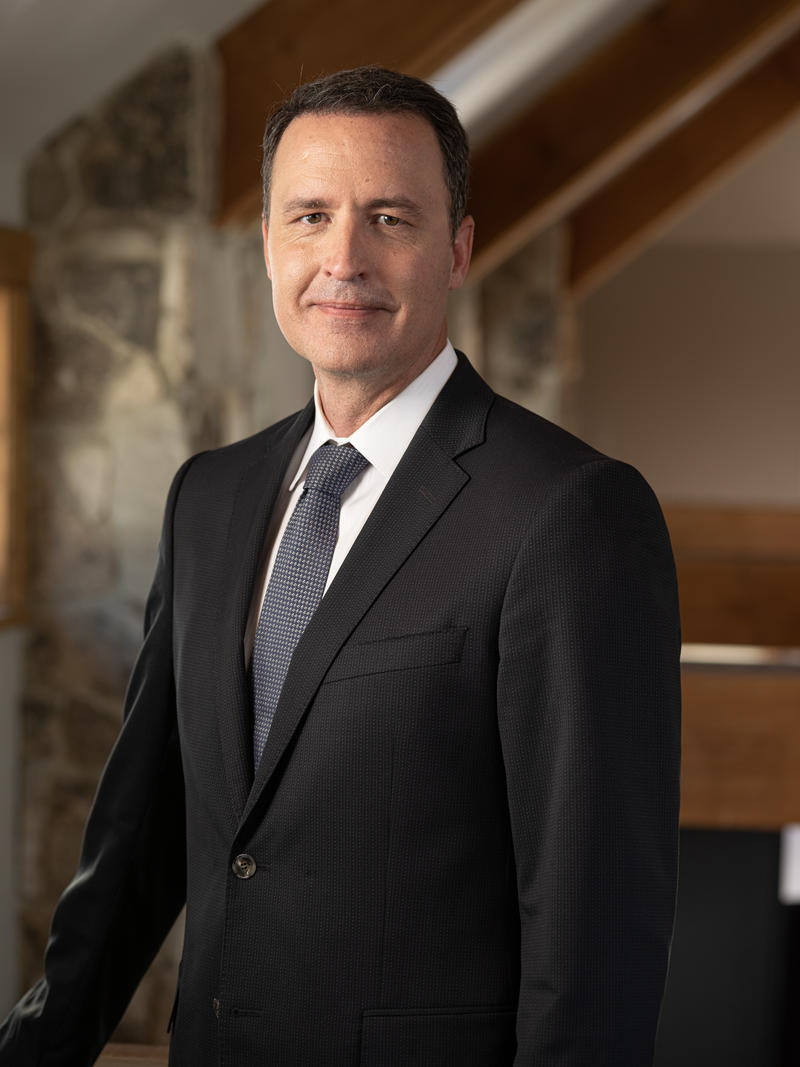
Craig Weston has a tidy way of describing his appetite for construction. “I like building things - businesses, opportunities, the occasional overcomplicated IKEA,” reads the line on his LinkedIn profile. The furniture joke is useful camouflage. His record suggests a more serious compulsion: find a system with loose parts, work out how they connect, and put an operating layer around the whole arrangement.
The raw material keeps changing. First it was information on a screen. Then it was the administrative clutter of trade associations. Later came international charity work, independent medical practices and, finally, 177 acres beside the Colorado River near Moab. A career that began with code now involves roads, utilities, public meetings and municipal ordinances.
That progression makes Weston difficult to file under a single industry. “Founder” fits, but only in the way “container” fits a moving truck. It says little about what is inside. His more consistent occupation is organizer of complexity. The interesting part is what happens as the systems get larger, more physical and less willing to behave like products.
The sophomore with a URL
Weston attended Brigham Young University from 1996 to 2000, studying construction and facilities management. During his sophomore year, he founded Estimate.com. The timing matters. In 1997, a good domain name still felt like a deed to a promising plot of land. Weston was studying how buildings come together while learning, in real time, how an internet business could do the same.
Estimate.com was eventually sold to Homestore.com. Weston then founded BuilderFusion, a software company aimed at an unglamorous but durable problem: home-builder and building-industry associations had members, events, directories, payments and daily office work to coordinate. BuilderFusion gave them one system for it.
Estimate.com begins while Weston is a BYU sophomore.
BuilderFusion turns association administration into a software business.
Weston becomes CharityVision's volunteer chief operating officer.
GrowthZone acquires BuilderFusion; Weston begins the Kane Creek chapter.
Forum Health formally launches with Weston as founding chief executive.
Weston chairs the board of the Echo Canyon preliminary municipality.
By 2008, a biographical filing for the Kane Creek project described BuilderFusion as the country's 11th fastest-growing software company in its category. GrowthZone acquired it in 2017. Weston said the combination would give BuilderFusion customers deeper industry knowledge, a larger support team and more frequent product updates. It was the language of a founder leaving users with a bigger machine than the one he had started.
“I like building things - businesses, opportunities, the occasional overcomplicated IKEA.”Craig Weston
When the variables became trucks and tarps
In 2011, Weston took on a different operating problem as the volunteer chief operating officer and a board member of CharityVision. The organization works through local doctors to support sight-restoring procedures. Weston's role was not ceremonial. He helped run daily operations and international programs, applying the habits of a software operator to a network spread across countries and institutions.
The stakes became vivid in November 2013. Weston was traveling to the Philippines when Typhoon Haiyan struck. He arrived amid wrecked villages and a relief system struggling to reach them. CharityVision coordinated with local church leaders to identify needs and move food, shelter material, generators and chainsaws toward affected communities.
“If you imagine everything that you've ever had is completely gone, I mean, that's what they're dealing with,” he said from Cebu. The sentence has none of the polished abstraction of a pitch deck. His follow-up was pure operations: “How do we get enough food?”
A later public filing credited his period at CharityVision with a tenfold increase in donations and operations supporting more than 100,000 procedures a year. The claim comes from Weston's development team, so it is best read as their account of the record. The more directly documented episode in the Philippines reveals the useful part: faced with a catastrophe too large for one organization, Weston looked for functioning local networks rather than pretending he could manufacture one overnight.
A network made from independent rooms
After CharityVision, Weston became a partner in WholeHealth Medical Group. In 2019 he co-founded Forum Health and served as its first chief executive. The company brought independent practices under a shared national structure, handling business functions and using common technology while clinicians retained responsibility for clinical work.
It was recognizably a Weston design. The doctors were like the associations in BuilderFusion's market: skilled at their core work, less eager to spend their days on billing, staffing, scheduling and promotion. Forum Health proposed to supply the connective tissue. At launch it combined practices, software and related services. The network later expanded across multiple states, while Phil Hagerman succeeded Weston as chief executive and Weston remained publicly identified as a founder.
The change in title is telling. Weston has often seemed most at home in the assembly phase, when the pieces are scattered and the operating logic is still wet ink. Once a structure can stand, he moves toward the next difficult kit.
A conceptual measure of public surface area, not financial value: customers become stakeholders, and stakeholders become residents and neighbors.
The product that already had neighbors
In 2017, Weston acquired land at King's Bottom along Kane Creek Road outside Moab. The site sits between red-rock walls and the Colorado River, close to trails, campgrounds and archaeological sites. He later brought in partners Trent Arnold and Tom Gottlieb. Their company, Kane Creek Preservation and Development, advanced plans for a large residential and commercial community now called Echo Canyon.
The project converted Weston's familiar verbs - acquire, integrate, scale - into earthwork. It also introduced a constituency that had never opted into his platform. Many Moab residents opposed the development over its size, floodplain location, water, road access, archaeological resources and effect on the landscape. The developers said they had followed the applicable rules and promised that at least 10 percent of the housing would be set aside for the workforce.
The argument soon escaped the boundaries of ordinary planning. Utah lawmakers created a “preliminary municipality” process in 2024. In June 2025, Echo Canyon became the first project approved under it. The structure gave the developing community its own public board and a route to govern land-use matters while it moved toward formal incorporation. Weston became the board chair.
On May 28, 2026, Weston called a meeting of the Echo Canyon Preliminary Municipality Board to order at the development site. The agenda included litigation counsel, land-use matters and the coming fiscal year's budget.
Opponents responded in court. One lawsuit challenges claimed water rights. Another, filed in February 2026, argues that the preliminary-municipality law unconstitutionally transfers public power to private developers. Weston and the development entity are defendants. Those allegations remain allegations; the litigation is active, and the municipal board continues to meet.
Political spending added another layer. Reporting in 2024 tied $41,300 in donations to a Utah attorney-general candidate to businesses connected with Weston. He acknowledged the support and said he would continue backing candidates he considered good. For critics, the giving reinforced concern about influence. For Weston, it was lawful political participation. Either way, the quiet systems builder was now operating in a room where every connection would be inspected.
Weston and his partners have not been silent about the broader criticism. In an April 2024 public statement, they said they had spent seven years acting professionally, relying in good faith on county land-use rules and official assurances. They maintained that the proposal had been submitted in 2021 and found complete and compliant that July. The statement did not settle the argument, but it clarified the developers' posture: they regard themselves as owners advancing an approved plan, not interlopers asking for an exception. The distinction is central to how Weston tells this chapter.
A software system can be judged by whether it works. A place must also answer the people who believe it belongs, in some moral sense, to them.
The limit hidden in the blueprint
Weston's career has a pleasing internal rhyme. His degree concerned facilities. His first company concerned estimates. His second helped builders' groups organize themselves. CharityVision required a human network that could cross borders. Forum Health gathered independent offices into a national enterprise. Echo Canyon gathers all those instincts in one physical place.
But the last project also exposes the limit of the operator's method. Complexity is not always a defect waiting to be streamlined. Sometimes it is democracy. Sometimes friction is how a community expresses attachment, fear or memory. The opposition around Echo Canyon is not a backlog to clear. It is part of the place Weston is trying to build.
His public persona remains spare: a dry IKEA joke, a list of companies, an occasional volunteer update. The work is louder. It has carried him from a college website to a municipal chair, from digital infrastructure to the politics of physical ground.
The question hanging over Echo Canyon is larger than whether the buildings rise. Weston has repeatedly shown that he can connect institutions and make complicated machinery move. Now he must demonstrate a different craft: whether a builder can make room for the people who never asked to be part of his design.