On a conventional building site, the weather is a manager nobody hired. Rain rearranges the schedule. Cold changes the work. Materials arrive, wait, get shifted, and occasionally become expensive scrap. Then dozens of trades must perform in the right order on a piece of land that changes every day. Great Gulf, the Toronto homebuilder and developer, looked at this choreography and reached an impolite conclusion: too much of it belonged in a factory.
That conclusion matters because Great Gulf is not a prefab startup with a glossy prototype. It is a private real estate business founded in 1975, when its first project comprised 30 homes in Cambridge, Ontario, sold for $33,000 apiece. The company says it has now designed and constructed more than 100,000 homes across North America. Its work ranges from suburban singles and townhomes to Toronto condominium towers, purpose-built rentals and luxury residences in Florida. Through the wider Great Gulf Group, the family also includes commercial developer First Gulf, U.S. builder Ashton Woods, construction manager Tucker HiRise and resort interests.
The breadth can look like an unruly corporate attic. Look closer and it reveals the business model: control more of the chain. Great Gulf develops land, designs and markets communities, builds them, cares for purchasers and, in selected projects, manufactures the bones of the building. Money comes from home and condominium sales, rentals, development, construction and management services. The buyers range from first-timers and growing families to investors, renters, industrial tenants and affluent Florida purchasers. H+ME Technology, its off-site manufacturing arm, also serves outside builders.
The first thing to fail was the old assumption
No public account describes a single catastrophic project that forced Great Gulf to change course. The trigger was slower and more useful. In the early 2000s, the company saw skilled labour becoming scarcer across Canada and the United States. It also saw an industry where productivity lagged other sectors, design coordination was fragmented and work stopped whenever labour, materials or weather fell out of sequence. Its founders challenged the team to become more innovative than its peers. The looming constraint changed their mind before it became a full crisis.
Great Gulf created H+ME Technology in 2007. Inside a 200,000-square-foot Etobicoke facility, teams translate three-dimensional designs into engineered wall and floor panels. Robotics and production-line methods assemble components under controlled conditions. Finished panels travel to the site, where crews can raise a precision-built frame in days. The factory can produce wood structures up to six storeys - detached houses, townhomes, stacked condominiums and apartments - and has drawn operating ideas from automotive engineers rather than only from conventional contracting.
One digital thread, four physical moves
“We are not just the manufacturer; we are a platform for an entire concept of the construction.”Tad Putyra, H+ME Technology
What it cost - and what it saved
Great Gulf has not published the capital cost of the factory, its robotics or the years of process development. That missing number is important. Industrialized construction does not eliminate cost; it moves spending from scattered job sites into a fixed plant that needs orders, trained operators and steady throughput. A factory with no pipeline is simply a very clean warehouse.
The public performance figures are more concrete. For a home larger than 2,000 square feet, H+ME president Tad Putyra has said prefabrication cuts work hours by at least one-third. Better material planning and earlier error detection can reduce waste by as much as 50 percent, depending on the product. By 2023, H+ME said it had supplied more than 15,000 residential units, including work for Brookfield Residential, Laurier Homes and Lindvest Homes. In 2026, Great Gulf reported that off-site fabrication and on-site assembly for 33 Habitat for Humanity GTA homes at Coxwell Avenue took 32 working days.
Those are company-reported operating claims, not a promise that every project will land at the maximum. But they expose the real product: predictability. A panel made indoors is less vulnerable to a snowstorm. A digital model can reveal collisions before timber is cut. Repeated assemblies let workers learn faster. Procurement becomes a measured input rather than an educated pile. The homeowner does not buy a robot-made wall for dinner-party bragging rights. The system is supposed to show up as straighter finishes, better performance and fewer surprises.
Precision also changes where accountability lives. When framing, openings and service routes are coordinated in one model, a defect has a traceable upstream cause. That gives designers, manufacturers and installers a shared object to improve. The loop is less romantic than a crane on a skyline, but it is how a builder can learn across thousands of homes instead of relearning the same lesson on every lot.
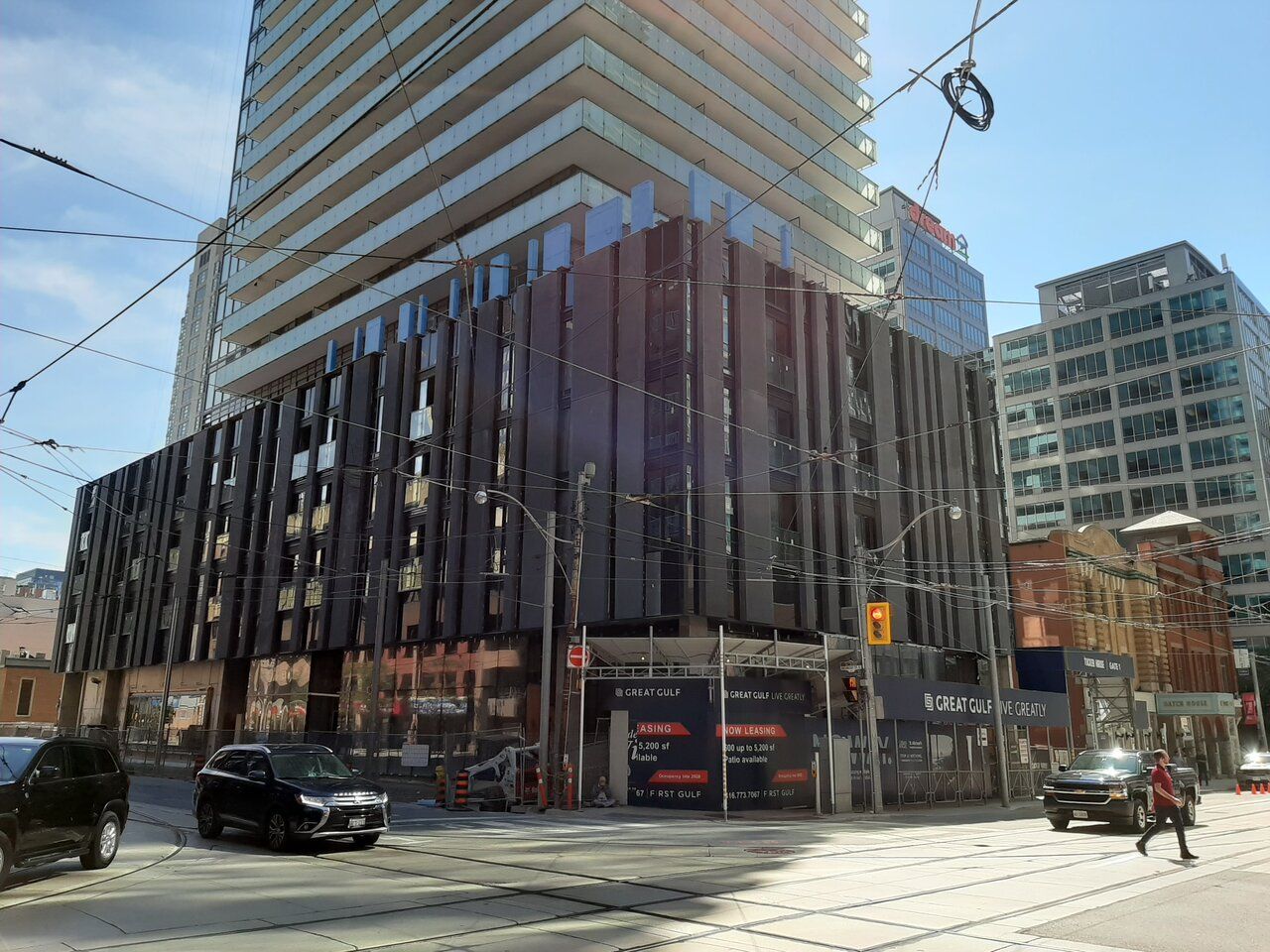
A factory is a moat, not magic
Great Gulf differs from competitors such as Tridel, Mattamy, Minto, Daniels and Menkes less through any single house style than through its integrated machinery. It can pair in-house design with panel production and construction management, then connect that backstage system to a consumer-facing sales and service operation. The wider group stretches the same expertise across industrial buildings, offices, resorts and U.S. housing. That creates more ways to reuse knowledge and more places to find demand.
Architecture remains part of the pitch. Great Gulf has worked with Moshe Safdie on Toronto's Monde, and it is part of the team behind Frank Gehry's Forma with Dream and Westdale Properties. In February 2026 it announced 87 Mandarin Oriental residences on the West Palm Beach waterfront, designed by Safdie Architects with interiors by Studio Munge. The move puts a 50-year-old builder in the branded-residence business, where hospitality service and design reputation matter as much as concrete.
Sustainability sits between the factory and the finished home. More precise cutting can mean less waste. Off-site work can reduce weather damage. Great Gulf also built the first certified Active House in North America, using a framework that balances energy, indoor climate and environmental impact. In 2025 it won both BILD's low-rise Home Builder and Green Builder of the Year awards; in 2026 it repeated the green-builder honour. Awards do not lower a utility bill, but they indicate that efficiency has become part of the operating brief rather than a decorative paragraph.
Where the model bends or breaks
- Too many one-offs: unique assemblies erase the learning benefit of repetition.
- Late design changes: factory precision punishes indecision after production data is locked.
- Weak volume: fixed plant costs need a reliable pipeline of compatible projects.
- Long delivery routes: large panels are expensive and awkward to move far from the plant.
- Approval friction: codes, inspections and local processes must accommodate off-site work.
The bit worth stealing
Most builders cannot copy Great Gulf by ordering a factory next Tuesday. Nor should they. The portable idea is to treat construction as an information problem before treating it as a labour problem. Freeze decisions earlier. Turn drawings into coordinated models. Catalogue recurring details. Measure defects and waste by assembly. Shift only the repeatable pieces off site, perhaps through a supplier, while keeping bespoke work where it belongs.
A five-step version for companies without 200,000 square feet
- Find the recurring delay that appears across nearly every project.
- Standardize the hidden component, not necessarily the customer-facing choice.
- Model and test the entire installation before materials arrive.
- Partner for manufacturing until annual volume justifies ownership.
- Track hours, waste, callbacks and cycle time - then publish the honest range.
There is a consumer lesson, too. Great Gulf's customer-care story is unusually tangible for a company whose product takes years to deliver. In a 2020 profile, Brampton buyer Jony Bahsous described buying three Great Gulf homes and convincing relatives to buy beside him. The company later reported that 90 percent of surveyed customers would recommend it. Niall Collins, then president of Great Gulf Residential, put the operating principle simply: “Selling a house is only the start of the relationship and journey.” In a category built on deposits, delays and defects, aftercare is part of the product.
The result is not a neat technology-company fairy tale. Great Gulf still faces the same interest rates, approvals, land prices and construction cycles as every developer. Prefabrication does little for a zoning delay. A celebrated architect cannot manufacture affordability. Vertical integration can become bureaucracy if the pieces stop serving one another. And a private company discloses less financial detail than public peers, making outside comparisons difficult.
Yet the company's long bet is legible. Build across enough categories to keep expertise moving. Own selected bottlenecks. Put repeatable work in controlled conditions. Preserve choice where the buyer notices it. Great Gulf started with 30 houses and eventually decided the homebuilding process itself needed a home. The factory in Etobicoke is that home - and the most interesting room in it is the feedback loop.