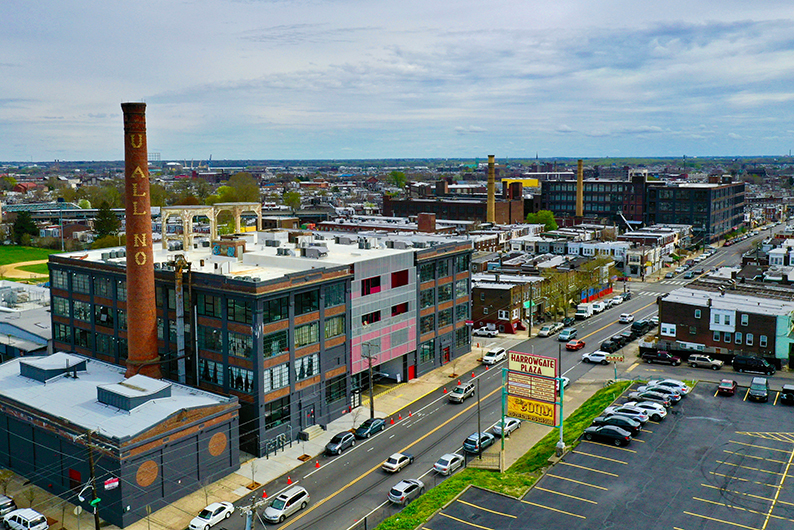
In 2012, Nathaniel Mell needed somewhere to work. The city had shut down his studio building at the old Viking Mills property in East Kensington. That autumn, he found an unheated corner in another building, where Brian Murray and a small team were attempting a renovation. Mell's assessment of his new landlords was affectionate, if hardly bankable: they looked like foolhardy idealists.
The building became MaKen Studios North. Mell went on to start Felt+Fat, a ceramics company. When the business needed more room in 2016, he returned to Murray's team and took space in its South building. A temporary refuge had become somewhere to expand. For a developer interested in neighborhood investment, that is a useful sequence: a person finds a foothold, builds a business, and needs a larger foothold nearby.
Murray, SHIFT Capital's co-founder and CEO, has spent years trying to make that sequence less accidental. His work connects workshops, homes, storefronts and the money that pays for them. The question running through it is easy to ask and troublesome to answer. When a neighborhood attracts investment, can the people who gave it its character afford to remain?
An accountant takes the long way round
Murray's route into property began at PricewaterhouseCoopers, where he worked as an auditor. He soon left for technology and helped found two startups. His first venture failed. The experience pushed him toward a different kind of work, and he joined the Peace Corps in Bulgaria.
There he encountered community development at the level where its promises have to become useful. He learned about listening, earning trust and the distance between a plan financed somewhere else and the experience of the people meant to benefit. He also encountered social enterprise. These experiences gave him reasons to keep asking what a business could accomplish beyond its own accounts.
Back in the United States, he returned to technology before attending Yale School of Management. During business school, he worked with Acumen Fund and made a side investment in a Philadelphia property: a neglected 30-unit building. He found the development process compelling. Property offered a direct connection between an investment decision and someone's ordinary day. His MBA followed in 2009. SHIFT was founded in 2012.
The career does have a certain administrative comedy. Auditing, startups, overseas service and graduate school are quite a collection of preparatory courses for becoming a landlord. They also help explain why Murray treats a building as something with financial obligations and a social life.
The subway was already there
By 2015, Murray was explaining a strategy built around places that had useful infrastructure but little investor enthusiasm. In Kensington, SHIFT was converting two warehouses near the Tioga stop on the Market-Frankford Line. MaKen North offered space for smaller enterprises; South could accommodate businesses needing larger premises. A tenant could grow without disappearing across the city.
Murray was also interested in North Broad Street. The long-vacant Beury Building occupied a consequential corner at Broad and Erie, and SHIFT bought adjacent property as well. His argument concerned the surrounding streets as much as the building: a difficult property could hold back an intersection, while restoring it might encourage further investment. Those were development ambitions, subject to the stubborn realities of financing and execution.
Transit helped make the case. The neighborhood already had ways to move workers and customers. Murray, who was living in New York and dividing his time between cities, saw possibilities for businesses seeking Philadelphia space. A subway stop is a remarkably practical amenity. It keeps working after the architectural rendering has been rolled up.
A lease can be a beginning
Mell's relationship with SHIFT eventually went beyond square footage. In 2020, the team introduced Felt+Fat to Baker Industries, helping the company focus its hiring on the surrounding community. SHIFT colleague Jeff Kahn later invested in the business. Looking back in 2024, Mell credited Murray with championing the company and making introductions throughout its growth.
This is the human detail in a phrase like neighborhood investment. Someone signs a lease, but someone else makes a connection that changes the next decision. A building provides proximity; people decide what to do with it. Mell's account offers a specific example of that process, without turning every tenant relationship into a fairy tale.
SHIFT also tried to lower the cost of starting a storefront business. Its Kensington Storefront Challenge gave nine small businesses a year of free rent and $10,000 for renovations. The assistance addressed two immediate obstacles: paying for premises before a business has momentum, and making those premises usable.
The experiment belongs beside the workshops because both concern a business's first difficult steps. A neighborhood's commercial life depends on people who can survive them. There is something agreeably concrete about a renovation allowance. It can buy work that a motivational speech cannot.
“The secret to strengthening place is to support great people and ambitious businesses.”Brian Murray, responding to Nathaniel Mell's account of Felt+Fat's growth, 2024
The awkward question at the exit
Buying and improving buildings creates another problem. An investor will usually expect to sell eventually. A new owner can bring a different calculation about rents and returns. Community-minded development therefore has to think about what happens after the developer leaves.
In 2019, SHIFT helped establish the Kensington Corridor Trust with Impact Services, IF Lab and the Philadelphia Industrial Development Corporation. The trust's approach puts commercial property under community stewardship, with a purpose intended to last beyond a conventional investment cycle. Its significance lies partly in the governance: residents and local business owners get to shape the use of neighborhood property.
The founding organizations initially expected a gradual, decade-long transfer of control. Adriana Abizadeh-Barbour, the founding executive director, and Casey O'Donnell of Impact Services pressed for a faster handover. The founders ceded board control to local stakeholders in 2021. A perpetual purpose trust followed in 2023.
That history makes the initiative more interesting than a polished origin story. People within the project disagreed about the right pace, and the arrangement changed. Community control requires actual decisions about who holds power. Its timing matters as much as the language used to describe it.
organizations
board control
trust established
Governance milestones for the Kensington Corridor Trust.
Murray has acknowledged the difficulties openly. In a 2022 conversation, he described the tension between rising property values and displacement, and the need for tools that preserve affordability. His public account leaves room for disagreement. A developer's intentions deserve scrutiny; the ownership arrangements that survive those intentions deserve it too.
Making room for another developer
For Murray, the question of access also applies to the people doing the developing. Real estate can be hard to enter when raising money requires a track record and building a track record requires money. SHIFT's Catalyst Fund supports emerging impact developers, with an emphasis on underrepresented managers.
In September 2022, Woodforest National Bank committed $1 million in equity to the fund. The investment backed a model that combined financing with practical support for developers and their projects. Woodforest had already worked with SHIFT on Sharswood Ridge, a mixed-use development undertaken with Mosaic Development Partners and the Philadelphia Housing Authority.
The fund represents a change in Murray's role. His company can work on its own buildings while also helping other firms obtain the resources to work on theirs. That creates another test of his approach: whether the expertise accumulated in one neighborhood can help a different developer serve a different place.
Alison Carey offers a recent example of that collaborative direction. She founded Aedera Companies in 2025. In December that year, Aedera and SHIFT acquired two Philadelphia affordable-housing properties, Congressman Robert N.C. Nix Homes and Haverford House. Together they contain 67 apartments. The partners renewed federal rental-assistance contracts for another 20 years and planned improvements including free Wi-Fi and solar panels.
Federal rental-assistance contracts renewed at Nix Homes and Haverford House in the December 2025 acquisition.
Keeping the work, keeping the homes
In April 2026, SHIFT, Aedera and Lafayette Square announced the L|S|A Affordable Housing Fund. Its focus is preserving subsidized multifamily housing across the Northeast, Mid-Atlantic and Midwest. Aedera handles fund operations and transactions; SHIFT contributes its investment and development experience; Lafayette Square brings capital-markets and asset-management capabilities. The partners also committed to donate a portion of sponsor profits to local nonprofits supporting economic opportunity.
The preservation theme has an industrial counterpart in Baltimore. SHIFT and Cross Street Partners closed a $16 million acquisition of Crown Industrial Park in October 2025, announcing the transaction in March 2026. The historic Crown Cork & Seal campus spans 30 acres and already houses more than 135 artists, makers and light-industrial tenants. The proposed redevelopment starts with that existing community and considers how to return vacant space to use.
In Ithaca, SouthWorks illustrates the longer timetable of turning old industry into a neighborhood. The ownership partnership includes SHIFT, L Enterprises, USC Builds and Xylem Projects. In January 2026, the team announced a $38 million New York State ACHIEVE award for infrastructure and the next development phase. Roads, water and sewer systems are central to the work, alongside plans for workforce training and manufacturing space.
Back in Philadelphia, a March 2026 announcement joined SHIFT, Essence Development and Temple University around a proposed North Station District. The early-stage vision includes transit improvements, commercial and maker space, and mixed-income housing. These are proposals with substantial work ahead. Across the projects, Murray's preferred ingredients remain recognizable: existing places, working businesses, housing and partners with different kinds of expertise.
The neighborhood after the deal
At The Mercer in Newark, the idea reaches into the terms of everyday residence. SHIFT and the Hanini Group launched the 110-unit office-to-home conversion in December 2025. It includes 22 affordable apartments and a Good Neighbor Program offering monthly rent credits tied to volunteering with local organizations.
The program tries to give newcomers a practical reason to participate in the place they have moved to. Cleanups, mentoring and local partnerships are less glamorous than a skyline, but they offer ways to meet people. The developer's responsibility continues into how the building operates.
Murray's career keeps returning to those small, consequential arrangements. A studio with room to expand. An introduction that changes hiring. A subsidy renewed. A board handing over control. Each has paperwork behind it and people in front of it. The unheated corner Mell found in 2012 was an unlikely place to begin a relationship lasting more than a decade. It makes a useful starting point for understanding Murray: the business of improving a place has to leave space for the people making a life there.
Follow the work
Projects, conversations and the people behind them.
SHIFT Capital Website ↗Brian Murray LinkedIn ↗Impact development, in conversation Watch on YouTube ↗Embedded in community Interview ↗Kensington Corridor Trust Community ownership ↗How one corridor changed who holds power Further reading ↗