In September 2011, Gene Zink had a rather practical observation about an Indianapolis redevelopment project: the nearest grocery store was three and a half miles away. New apartments could change the view from the street. They could not shorten that journey on their own. For a developer accustomed to assembling properties and arranging capital, the distance to the supermarket exposed a larger problem. A neighborhood could acquire handsome buildings and still make ordinary life difficult.
Warren Buffett was in town for the East Village at Avondale ribbon cutting. So were developer Tom Cousins and investor Julian Robertson. The names brought attention; Zink’s concern brought the discussion back to the weekly shopping. Asked about the development, he argued that attracting a supermarket mattered to its success. The ambition extended beyond the apartment doors.
“You can’t just fix one thing, or the bad would come back. You have to fix it all.”Gene Zink, 2011
Darell E. “Gene” Zink Jr. had spent years working in a business that measures things carefully: square feet, rent, debt, returns. In Avondale Meadows, those familiar measurements encountered schools, household budgets and the geography of daily errands. His later work makes an interesting companion to his earlier career in public-company finance. The same city contained both, though the questions had become considerably more intimate.
A lawyer learns the property business
Zink was born in Houston on July 29, 1946, and graduated from Bedford High School in Indiana. His education took him through three disciplines and three universities: political science at Vanderbilt, business administration at the University of Hawaii, and law at Indiana University. He earned his law degree in 1976. Before his legal career, he served as a captain in the United States Air Force.
In Indianapolis, he practiced at Bose McKinney & Evans, becoming a partner. In 1982, he joined the business that became Duke Realty, taking responsibility for finance and legal affairs. It was a useful combination for a property company. A building has a visible life of walls and windows, and another life in contracts, ownership arrangements and financing. Zink’s training gave him a place in that second world.
The transition also placed him inside a company preparing for a much larger audience. In 1993, he helped bring Duke Realty to the public markets. His job as chief financial officer put him at the intersection of the properties the company owned and the shareholders who financed its expansion. A real estate investment trust has buildings to manage and investors to answer to; neither group is known for accepting a charming anecdote in place of the numbers.
The decade after the bell
The decade following Duke’s public offering gives that expansion a measurable scale. From its October 1993 offering through the end of 2003, the company grew from roughly $600 million to more than $7.5 billion. Its footprint widened from three principal Midwestern markets into the Midwest and Southeast. With dividends reinvested, a $1,000 investment at the offering was worth more than $5,000 at the end of that period.
Value at the end of 2003 of an IPO investment with dividends reinvested. A historical company result.
Zink worked alongside Thomas Hefner and Gary Burk during those years. The three executives looked ahead together after the offering, then later made arrangements to hand over their daily responsibilities. Zink stepped down from his executive position on January 1, 2004, with longtime Duke colleague Matt Cohoat assuming the chief financial officer role. Zink served as vice chairman during the transition.
There was recognition along the way. Realty Stock Review awarded him its Outstanding CFO Award for the public real estate industry in 1999 and again in 2001. The awards belong to the financial chapter of his life, but the later projects did not dispense with that expertise. Neighborhood ambitions still require someone to work through financing. A good intention, regrettably, cannot sign a construction contract.
A second company, a different set of questions
Strategic Capital Partners launched in 2005 as manager of a $250 million private equity commercial real estate investment fund. Zink founded the firm with Richard Hurd. Its work developed beyond fund management into acquiring, developing, owning and operating properties. The firm’s geography included Indianapolis, Cincinnati, Nashville, Charlotte, Northern Virginia and Raleigh/Durham.
That remained a commercial enterprise with investment partners and property decisions to make. Over time, it also became a participant in projects where a city, a foundation or a university brought goals extending beyond a lease. These arrangements required several institutions to agree on what they were trying to build. The people at the table had different responsibilities, and the project had to accommodate them.
Avondale Meadows supplied a demanding example. East Village brought Strategic Capital Partners together with Purpose Built Communities, The Sterling Group, Meadows Community Foundation and the City of Indianapolis. Each name represented another piece of the undertaking. Zink’s involvement was part of that coalition, rather than a solitary developer’s rescue story.

Seventy percent, thirty percent, one neighborhood
The first phase of East Village included 248 apartments. Seventy percent were reserved for residents with low to moderate incomes, with the remainder offered at market rates. The broader 2011 plan described a 100-acre neighborhood. It proposed additional housing, a grocery store, a park, a garden and paths, alongside nearby schools. Those were plans announced at the time, and the distinction matters: a drawing of a future neighborhood is a promise of work still ahead.
The idea required more than a new housing product. Purpose Built Communities brought experience from Atlanta’s East Lake redevelopment, offering advice and seed capital. Cousins gave Zink a model for thinking about the surrounding institutions together. Zink described himself simply: “Like Mr. Cousins, I’m forever a real estate guy.”
Yet he was willing to describe learning a new approach. He acknowledged that mixed-income communities had been unfamiliar territory when the project began. That admission gives the career a more human scale. An executive who knew public markets could still have something substantial to learn about how a neighborhood worked.
The school came into the picture early
Education was already part of Zink’s civic work. He co-founded Challenge Foundation Academy and served as president of its board. In 2021, United Schools of Indianapolis credited him with leading the effort to start its first school, rooted in a belief that children should have a safe, positive and structured learning environment. Strategic Capital Partners also supported that year’s school fundraising event.
This history adds context to the housing project. A school has a schedule, families and a responsibility that continues after the opening ceremony. It draws attention to the people who will occupy a neighborhood year after year. Looking at housing alongside education asks a developer to consider more than whether a unit can be rented.
Zink’s wider civic appointments included leadership at Park Tudor, the Indy Chamber and the Ivy Tech Foundation, as well as board service with Goodwill and United Way of Central Indiana. The institutions differed in purpose, but all involved work with other people’s priorities. His public record contains plenty of boards; the school makes the consequences of those meetings easier to picture.
Another ribbon, farther south
At the University of Indianapolis, the partnership took the form of student housing. Greyhound Village broke ground in 2015 and was dedicated in August 2016. The four-story building brought apartment living to the campus, while university and city leaders discussed what development might mean for the surrounding Shelby Street corridor.
At the dedication, Zink stood alongside university president Robert Manuel, Mayor Joe Hogsett, trustees’ chair Yvonne Shaheen, chaplain Jeremiah Gibbs and student Erin Jackson. The student’s place in that lineup is a useful reminder: an opening ceremony can be full of officials, but somebody has to move in. The building was a joint venture between Strategic Capital Partners and the university.
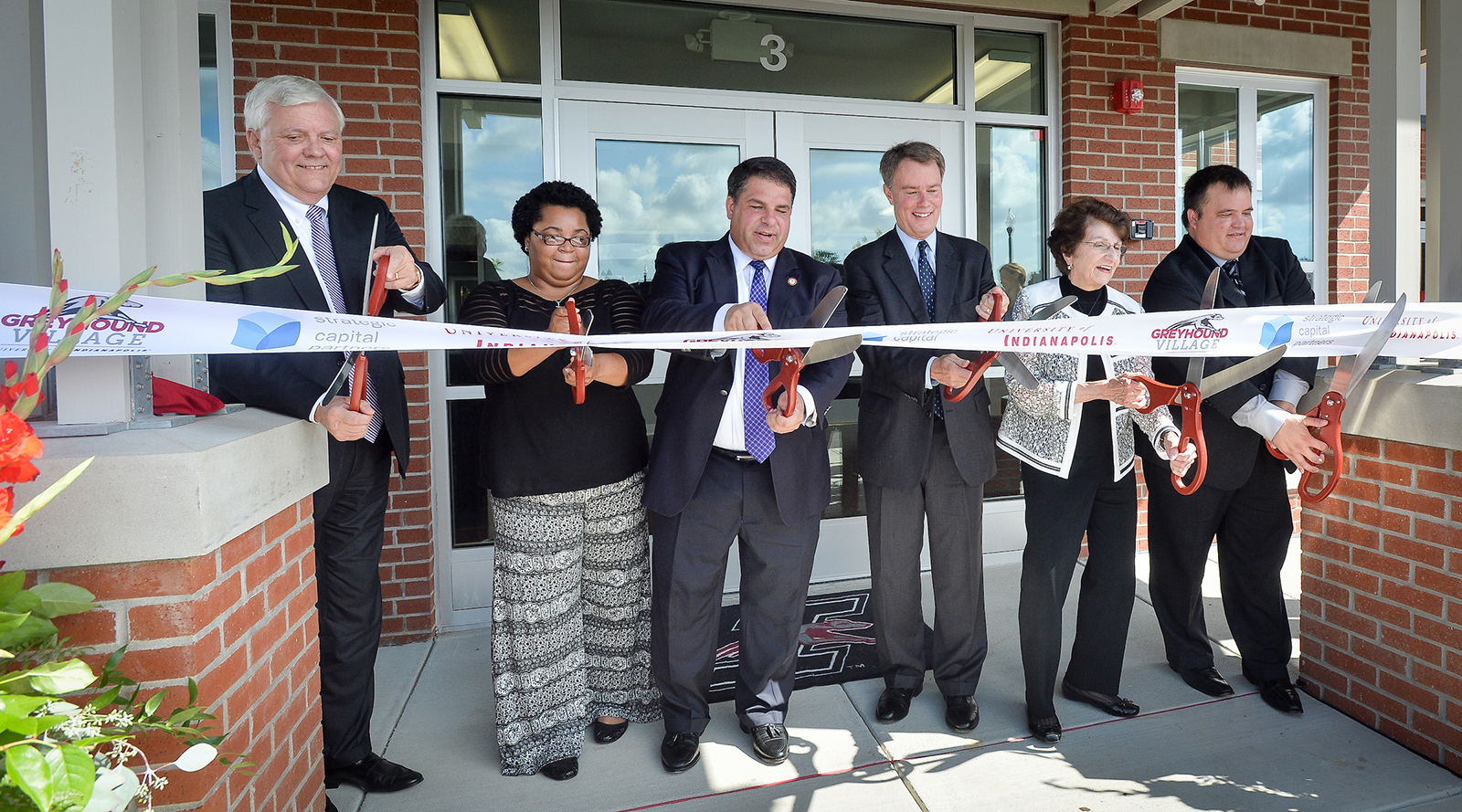
The work continued. In April 2018, the university announced construction of University Lofts, a $20.5 million, 118-unit development designed for 300 residents. Will Zink, Gene’s son and the firm’s construction and development executive, spoke about the partnership. The project was another link between the university and SCP, with a planned rapid-transit connection nearby. Housing, education and access to the rest of the city were again appearing in the same conversation.
A name on an institute
Gene and his wife, Mary Ann, co-founded the Gene and Mary Ann Zink Poverty Institute at the University of Indianapolis. Announced in 2015, it focused on interdisciplinary poverty research. Their involvement extended the relationship with the university beyond property development, giving another institution responsibility for examining the problems that neighborhood projects sought to address.
In 2016, the university awarded him an honorary Doctor of Humane Letters. In 2020, Indiana University’s Maurer School of Law inducted him into its Academy of Law Alumni Fellows, the school’s highest alumni honor. Years earlier, in 2009, he had returned to the law school to speak on real estate, credit markets and the economy. His legal education remained part of the conversation long after he changed professions.
Zink died on March 4, 2026, aged 79. He and Mary Ann had been married for 57 years, and their family included daughter Lisa, son Will and five grandchildren. His professional life left public-company milestones, a second firm and a series of partnerships rooted in Indianapolis. Avondale Meadows gives those achievements a particular address in the imagination: apartments, schools, and the everyday question of how far someone must travel to buy groceries. It is a small question with a remarkably large job attached.