Every promising camping weekend used to begin with an argument. Kevin Long and his wife, Sarah Smith, wanted the uncomplicated things: a patch of ground, a little quiet, perhaps a view that could improve even a cup of instant coffee. What they got was research duty. Campground information was scattered, official descriptions were thin, and photographs from the people who had actually slept there were difficult to find. One of them had to take the job. Neither considered it recreation.
Smith kept a notebook in the car. She wrote down campground details and repeated a phrase familiar to anyone circling a stubborn problem: someone should build this. In 2013, she decided that someone would be her. Long later left a secure position at Cvent to join her. Their complementary partnership would turn the notebook's basic premise - useful knowledge from people on the ground - into The Dyrt.
The origin has the tidiness of a campfire tale, but Long did not arrive as an untested enthusiast with a clever domain name. By then he had spent years building organizations, learning how communities hold together, and watching software companies survive the awkward passage from idea to acquisition. His path to camping technology began far from Portland's startup offices.
The system before the startup
In 1997, Long founded the organization that became Global Deaf Connection. The work followed a volunteer teaching experience in Kenya and centered on a difficult question: how could Deaf education programs in developing countries become locally sustainable? The model connected teachers and mentors, supported Deaf educators, and tried to build a cycle that did not depend forever on visiting volunteers.
An account published in 2004 described the moment that fixed the work in his mind. Long asked a young Deaf student what she wanted to be when she grew up. Her puzzled answer was, “But I'm deaf.” The sentence exposed more than a missing lesson. It showed what happens when a system has not supplied examples of possible futures. Global Deaf Connection sought to train and support the people who could become those examples.
The project brought Long an Ashoka Fellowship and a Reinhard Mohn Bertelsmann Fellowship. More important to the shape of his later career was the operating idea beneath it: a useful system lets participants carry the work forward. Communities are sturdier when the knowledge does not live with a single gatekeeper.
A route drawn in systems
Next came Justmeans, a sustainable news distribution platform Long co-founded in 2007. It was acquired. CrowdCompass followed. Long became vice president of marketing at the Portland mobile event app company and stayed through its acquisition by Cvent in 2012. His work dealt with a prosaic but revealing problem: people at conferences needed current information on their phones, including when venue Wi-Fi behaved like venue Wi-Fi.
The connective tissue is hard to miss. Global Deaf Connection dealt in knowledge transferred through people. CrowdCompass dealt in mobile information that remained useful under imperfect conditions. The Dyrt would eventually ask both problems to share a tent.
“Go spend one night outside and see how you feel.”Kevin Long
Portland, by introduction
Long moved to Portland in 2011 without the benefit of a long local history. So he made one quickly. He started Innovation in Motion, a gathering for the city's mobile and technology community. The relationships helped him land at CrowdCompass. Later, he and The Dyrt team helped organize Portland TechCrawl, where more than 1,300 people moved among local startup offices in 2016.
This is the less photogenic part of entrepreneurship: folding chairs, introductions, permits, and the mild terror that nobody will come. Long's professional network did not appear as a row of blue profile cards. It was assembled in rooms. The habit matters because The Dyrt is also an organized invitation. Campers contribute a photograph, a review, or a tip; the next visitor arrives with less guesswork.
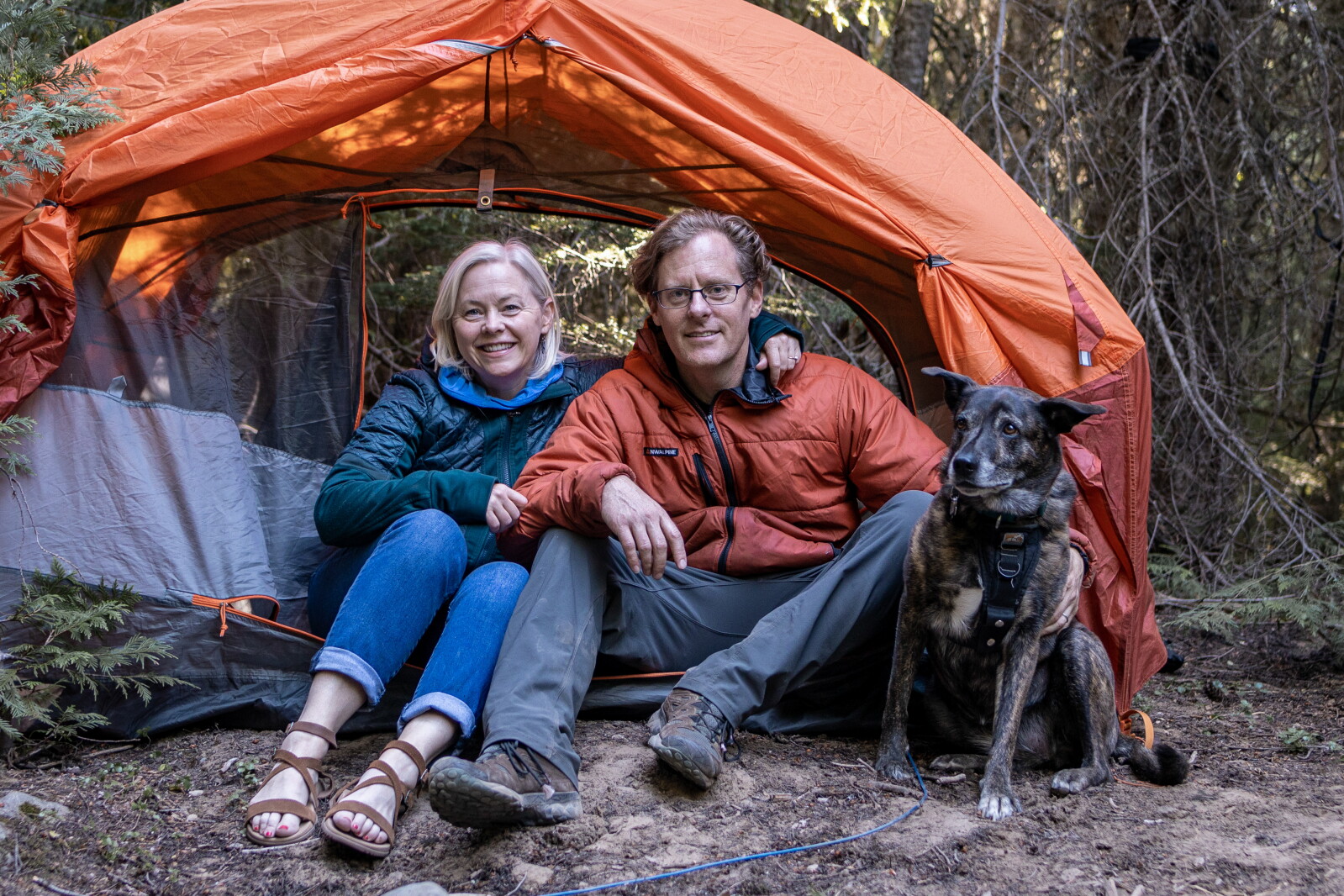
Smith brought the originating idea, deep user empathy, and a childhood shaped by the north woods of Minnesota. Long brought experience in marketing, operations, and scaling mobile products. She has described their skills as opposites, which may be one reason the partnership worked. A map needs both imagination and edges.
The database sleeps outside
The Dyrt's product premise was straightforward: official listings could tell a camper that a campground existed, but another camper could explain what it felt like to arrive. Was the access road manageable? Did the sites have shade? Could a large RV fit? Was the photograph on the official page taken during the same geological era? Reviews, photographs, and practical tips supplied the texture.
The company launched its mobile apps in 2017. Booking, trip planning, offline maps, public-land layers, discount programs, and cancellation alerts followed. The platform now lists 50,000 campgrounds and holds 8 million user-generated reviews, photographs, and tips. The numbers describe scale, but the unit of value remains small: one person leaving a useful note for the stranger arriving next.
The company raised an $11 million Series B in October 2021. It appeared on the Inc. 5000 in 2022 after 87 percent growth over three years and earned later appearances as well. Long's own accounting is generous to the collective. When the first Inc. recognition arrived, he pointed back to Smith's belief, then to everyone who had worked at The Dyrt and the campers who supplied the knowledge.
That stance also explains the company's current vocabulary. Long writes about “verticalized online communities”: focused platforms where the users, businesses, and relevant brands can each add something useful. During 2024, partnerships with Toyota, State Farm, and Danner helped fund new collections and features. The company's advertising sales revenue grew more than 700 percent that year, while The Dyrt reported 130 percent growth over three years.
Signals from 2024
Relative bar lengths compare the two reported growth figures for visual context. They measure different things and are not a financial forecast.
Quality assurance, with weather
In 2021, Long and Smith made the founder advice to “use your own product” inconveniently literal. They left Portland in a camper van and ran their roughly 40-person remote company from campgrounds around the country. The itinerary took them through Wyoming, Colorado, Virginia, Minnesota, and other states. Their tools were the tools they sold: a road-trip planner, campground records, and maps showing cell coverage.
Long called it a chance to immerse themselves in the camping community again. Smith called it immersive quality assurance. Both descriptions fit. A route planner presents differently when it controls where you sleep. A connectivity layer becomes unusually persuasive when the morning meeting begins in seven minutes.
The trip also restored something success had pinched. Long and Smith had once camped nearly every weekend. Building a camping company gave them less time to camp. The van put the founders back among their users and made the contradiction temporarily useful.
“Solo camping is just a massive reset button.”Kevin Long, on a trend The Dyrt tracked in 2025
A map for the next person
Long now spends part of his public work translating camping data into ordinary advice. He has discussed the rise of first-time campers, the stubborn scarcity of bookable sites, fall camping, RV planning, and a surge in people camping alone. In 2025, The Dyrt found that 31 percent of campers had spent at least one night camping solo in the prior year, up from 19 percent in 2021. Long called solo camping a reset button and suggested that pandemic-era self-reliance had settled into a durable habit.
His advice can be disarmingly modest. For National Get Outdoors Day, he recommended favorite areas near Boulder, then reduced the proposition to one night: get in the car, drive, make a memory, see how you feel. No identity change required. No catalogue of equipment. The outdoors is permitted to begin as an experiment.
That idea returns the story to the notebook. The Dyrt did not invent camping, campgrounds, or the desire to leave town on Friday. It organized the details that kept people from acting on the desire. Long's earlier work taught him to notice when knowledge was trapped, when systems needed local participants, and when mobile information had to endure bad reception. Smith noticed the missing campground layer and insisted it should exist.
Together they built a place where the map is never quite finished because someone has just packed up, taken a photograph, and learned the one thing the next camper will want to know. The internet has grander ambitions. Few are as immediately useful at dusk.