Jack Savage had already left Recharge once. In 2021, his small business was using the subscription platform, and he found the experience frustrating. Signing in was awkward. Getting the customer experience he wanted required outside developers. Then he moved to Skio, the company Kennan Davison had founded, and liked it enough to invest. In April 2026, Recharge acquired Skio. Savage greeted the news with congratulations and a wonderfully practical question: was he back at Recharge again?
There is a tidy little business fable here, provided one resists tidying it too much. A founder challenges an incumbent. Customers defect. The incumbent eventually buys the challenger. Everyone can draw an arrow between the beginning and the end. Living through the middle, however, involves considerably more erasing.
Davison, also known publicly as Kennan Frost, has made a career in that middle. Before Skio became subscription software, he had taken another idea through Y Combinator. Before Icon began selling ads filmed by human creators, it introduced itself as an AI admaker. His companies have changed their answers to what customers need. The interesting continuity is his willingness to keep asking.
He supplies plenty of louder material. There is the gaming rank in his biography, the expensive domain name and the unapologetic talk about winning. Those details make a memorable introduction. The customer who liked a billing tool enough to put money into it offers a better place to begin. A little less theatre, a little more checkout.
A different kind of scoreboard
Davison's professional biography includes engineering work at Pinterest and Hulu, along with Wieden+Kennedy, the advertising agency. His old Skio team page placed those names beside a credential rarely required in subscription billing: a top-200 North American ranking in League of Legends. It also listed his Y Combinator batch, Summer 2020. Corporate experience, accelerator membership, competitive gaming. He put them in the same small space.
The juxtaposition is revealing as a piece of self-presentation. He wants the reader to see someone accustomed to being measured. League of Legends provides a rank. Software provides something a customer can use. A startup supplies revenue figures. Each gives ambition a scoreboard, although the games themselves have very different rules.
His account of school is less affectionate. He describes being bored in class and leaving college after a year. The biography is emphatically written from the other side of that decision. It compresses uncertainty into a sequence of work, departure and company formation. The engineering jobs matter because they give the story a practical apprenticeship before the founder titles arrive.
Getting into Y Combinator did not immediately resolve what he ought to build. His own recollection of the batch is blunt about failure and the need to pivot. That admission makes the later success more intelligible. Admission to an accelerator had supplied an opportunity; customers still had to supply a reason for the business to exist.
The password was part of the problem
Skio's eventual answer was subscription management for Shopify brands. This is the machinery behind a repeat order: the payment, the account, the next delivery and the customer's ability to change things. It is an unglamorous place to look for a company until one has tried to run a subscription business with machinery that keeps getting in the way.
Savage's complaint about signing in is useful precisely because it is small. A password problem can sit between a customer and an ordinary request. A developer needed for routine changes becomes another cost and another delay. Skio offered native Shopify checkout and passwordless account access. Those features made sense in the everyday language of getting a task finished.
Another merchant, Angie Tran, described a migration with many steps because of her company's particular setup. What she remembered was the team's responsiveness and patience, followed by continued access to real people as Skio grew. Her account gives customer service some substance. Moving a merchant is a sequence of questions and decisions, and somebody has to keep answering.
The product's effects could be visible in the support queue. In Skio's published MìLà customer story, the frozen dumpling business reported an 80 percent reduction in subscription-related support tickets after migrating. That is a company-published customer result, rather than a promise for every merchant. Still, it is a pleasingly concrete measure: fewer people asking for help with the mechanism, more room to run the business.
The appeal of this kind of software can be easy to miss from outside. Nobody orders dumplings in the hope of admiring the subscription portal. The portal earns its place by letting the dumplings remain the point. Davison's first lasting business was built in that gap between what a brand sells and what its customers must endure to keep buying it.
The rival at the end of the road
On April 30, 2026, Recharge announced that Skio was joining the company. Davison publicly put the transaction at $105 million cash at close, against $8 million raised. Those are his disclosed deal figures; the companies' announcement did not publish financial terms. The distinction matters when a neat pair of numbers starts travelling around the internet.
The sale was a company outcome, with a company history behind it. Aidan Thibodeaux, Skio's CEO, described taking over with Andrew Chen roughly two years earlier. Their approach concentrated spending on product and support. They joined merchant calls themselves and shipped small fixes daily. Davison had founded the business; other people had important work to do in making it the business Recharge acquired.
Thibodeaux's explanation of the combination centred on data and merchant outcomes. The two companies could see more together than either could independently. Recharge said their combined platforms served more than 20,000 merchants and processed over $20 billion in annual gross merchandise value. Those are combined platform figures, a measure of the proposed partnership's scope.
For Savage, the transaction contained an irony. For the businesses involved, it contained a new calculation about what customers would need next. An incumbent could be the company to leave at one stage and the company to join at another. The trick is explaining that change to the people whose renewal payments must continue working on Monday.
The AI admaker hires people
Icon brought Davison back to the same broad population of brands, this time with a different expense in view. Selling a product repeatedly requires a supply of advertising. Somebody has to decide what to say, find footage, assemble a video and make another version when the first idea falls flat. The output is visible; the coordination behind it is less photogenic.
In March 2025, Davison appeared on TBPN to discuss Icon, AI admaking and raising from Founders Fund. The positioning was explicitly technological. By 2026, Icon's own account of its history acknowledged a turn from that original AI proposition toward human-made user-generated-content ads. The acronym is UGC. The work includes actual people holding actual products in front of actual cameras.
The current offer is six human creator ads for $1,000, with scripts available to review before payment. Icon says it finds creators, ships products, writes scripts, coaches filming and edits the results. Software remains part of the operation through Admaker 2.0, supporting review, campaign work and creator management. The service has acquired more responsibility for the finished result.
That makes an interesting second act for an engineer. A tool can hand the next task back to its user. An agency has to arrange for somebody to do it. The distinction runs through everything from finding a willing creator to making sure a product reaches the right address. A video cannot demonstrate a package that is still at the depot.
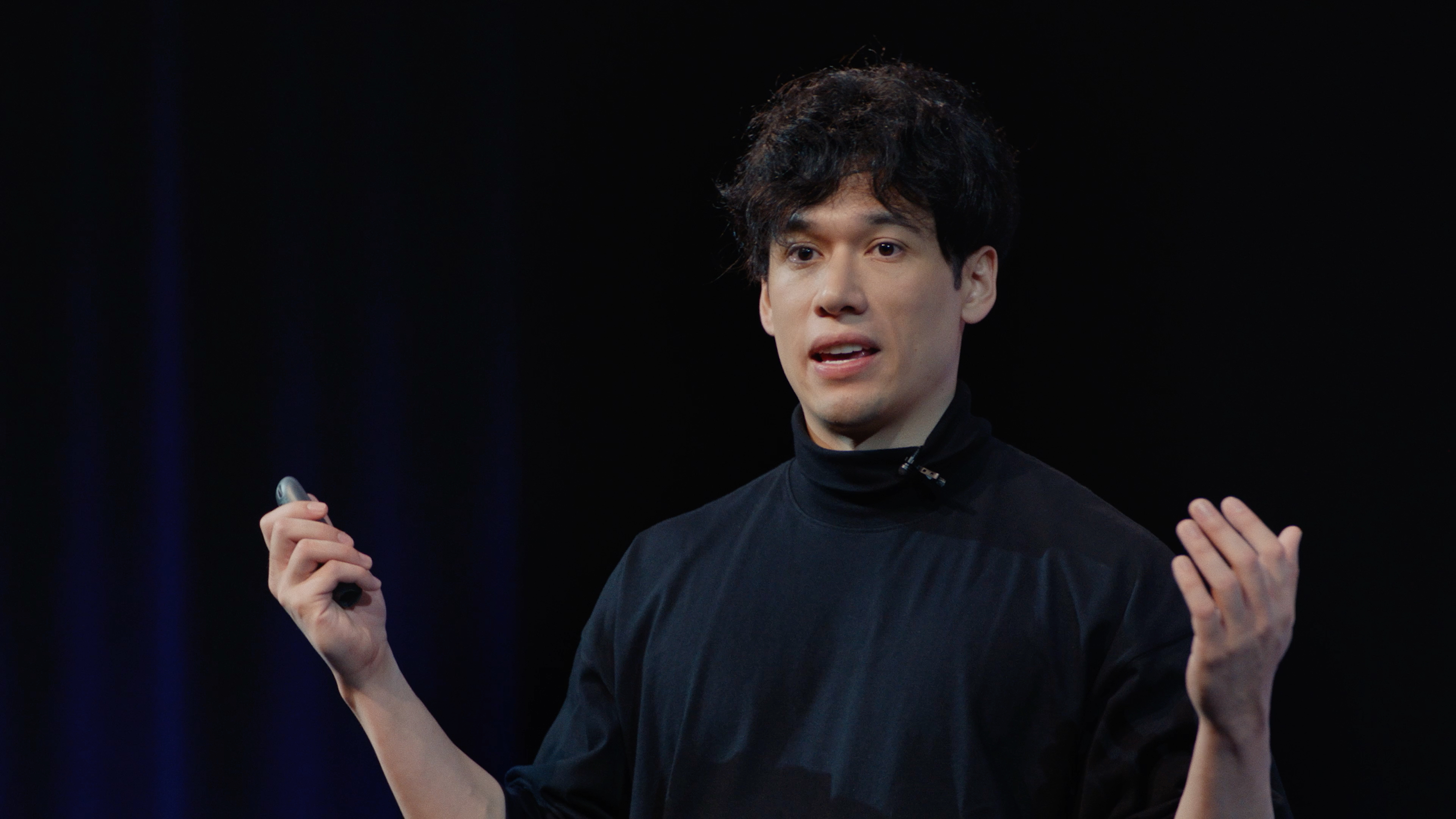
The keynote photograph catches him with a clicker in one hand, presenting the agency. It is an appropriate image for this stage of the story: another explanation of the business, another revised answer. A founder can spend a surprising amount of time telling people what the company has become since the last time they looked.
Twelve million dollars, four letters
The icon.com domain supplies the extravagant footnote. Davison says he spent $12 million on it. That claim is now part of Icon's marketing, including partner prompts encouraging people to discuss the price and the website. The address doubles as a conversation starter. Most domain names merely ask to be remembered; this one arrives with an invoice attached.
There is a more methodical side to his public writing. In a March 2025 thread about Balaji Srinivasan's idea-maze framework, Davison urged founders to study market history, existing competitors, failed approaches and technological change. He wanted a map with alternative routes and dead ends. It is a useful corrective to the polished founder biography, which usually makes every road look inevitable.
He has also described wanting to race from zero to $100 million in annual recurring revenue. An aspiration of that size is a statement of intent, with all the uncertainty that implies. It belongs beside the completed Skio transaction, rather than being mistaken for another completed achievement. One concerns what has happened. The other concerns what he hopes to make happen.
His present business makes the next test fairly tangible. A brand needs ads it wants to run. A creator needs a workable assignment. Editors need footage worth cutting. The customer decides whether the whole arrangement is worth buying again. Four letters on a domain can attract an audience, but an audience does eventually ask to see the goods.
The through-line in Davison's career is a founder returning to the plan with an eraser. Skio found a purpose after an earlier idea failed. Its team built something merchants wanted, and its rival became its buyer. Icon changed how it proposed to get ads made. The next chapter will be measured in the ordinary customer decisions that gave the earlier ones their shape.
“But keep updating your map as the landscape changes.”Kennan Davison, March 2025