At the founding dinner for Moelis & Company, Ken Moelis wanted photographs. He imagined somebody studying them years later, amused by the clothes and haircuts, trying to picture the beginnings of an old financial institution. The firm had barely begun. Its founder was already thinking about how it would look in a history book.
The date makes that ambition rather more interesting. Moelis started his firm in 2007, after leaving the presidency of UBS Investment Bank. By the following year, the financial system was coming apart. Starting a bank on the eve of a banking crisis sounds like a scheduling error. For an adviser with experienced colleagues and no inherited mountain of troubled loans, it also created an opening.
He was willing to improvise. In a November 2008 interview, he described working with a succession of five-day plans. That flexibility sat beside an unusually long ambition: create something whose founding photograph would eventually need explaining. Eighteen years later, when he handed the CEO job to co-founder Navid Mahmoodzadegan, the photograph acquired another chapter.
A Wall Street career, viewed from Los Angeles
Moelis entered investment banking at Drexel Burnham Lambert in 1981. He had completed a Wharton economics degree in 1980 and an MBA in 1981. Drexel was the beginning of a career spent inside firms whose names carried considerable weight - and whose futures proved less permanent than they looked.
From 1990 through 2000, he worked at Donaldson, Lufkin & Jenrette, becoming head of corporate finance. He then worked at UBS from 2001 to 2007, ultimately as president of its investment bank. These were years of learning to advise companies while also managing the organisations that employed their advisers.
The geography mattered. Much of his working life unfolded in Los Angeles, away from the street that supplies his profession with its shorthand. He credited that distance with helping him think differently. By 2010, his young firm was headquartered in New York while he and many of its co-founders worked in Los Angeles. An international bank could have more than one centre of gravity.
- 1981Drexel Burnham Lambert
- 1990Donaldson, Lufkin & Jenrette
- 2001UBS
- 2007Moelis & Company
The rule book had become too thick
When Moelis explained his departure, he described the distance between the small partnership he remembered at Drexel and the large organisation he had come to inhabit. He missed the chance to be creative. The independent firms whose cultures appealed to him had been absorbed elsewhere. Starting again offered a way to choose the working environment.
His early career had nearly taken another route. With a father and brother who were lawyers, he applied to law school and was accepted. He deferred after finding a job at Drexel. The legal profession lost a prospective recruit; investment banking gained somebody who would spend decades explaining why the occupation still interested him.
Building his own firm required more than a preference for smaller meetings. By 2014, the firm used discretionary compensation rather than a fixed commission on each banker's revenue. That arrangement was intended to encourage colleagues to work together across the business. A compensation policy is a fairly dry place to put a philosophy, but it is where employees tend to look for the small print.
The firm offered advice on acquisitions, recapitalisations, restructurings and other corporate finance questions. That range matters: a company may need help buying a rival in one year and negotiating with creditors in another. An adviser hoping for a long relationship needs to remain useful through both conversations.
Then the adviser became the client
In April 2014, Moelis & Company went public. For somebody accustomed to presenting recommendations to boards, choosing the banks to handle his own offering meant an unfamiliar turn on the receiving end. Goldman Sachs and Morgan Stanley led the IPO. Years of relationships now had to work in the opposite direction.
The offering was priced at $25 a share, below the initial $26 to $29 range, and its size was reduced. Moelis treated the choice as a practical decision involving people the firm expected to keep doing business with. There was little value in squeezing the last possible dollar from investors and then spending years living with the result.
Euromoney named him its Banker of the Year in 2014. A listing and an award supplied public milestones. The underlying test was less photogenic: whether an advisory business could keep attracting people and clients after the founder's original circle had done its work.
An institution is made of other people
The numbers today suggest how far the firm travelled. By October 2026, its team operated across 24 locations in 13 countries, with more than $5.9 trillion in transactions advised on since 2007. That last figure is transaction value across the firm's work, rather than revenue or money owned by Moelis. It measures the size of the situations in which its advisers have participated.
The range of locations also gives substance to a founding ambition. Cross-border advice requires people who understand different markets and can work with colleagues elsewhere. Opening an office puts a name on a door. Making that office useful to a client thousands of miles away is the continuing job.
For 2025, the firm reported $1.5168 billion in GAAP revenue and $1.5359 billion on an adjusted basis. It promoted 12 advisory professionals to managing director during that year, followed by 13 in early 2026. Those promotions offer a more intimate measure of an institution: people who joined somebody else's firm reaching positions where they can shape it.
The statistics class that Julie won
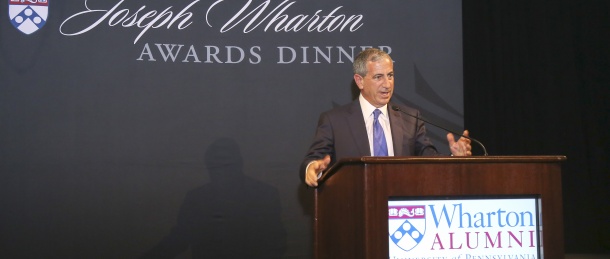
Wharton runs through Moelis's life with the persistence of a family surname. He met Julie Taffet there. Julie recalled taking statistics with him and getting the better result. Even a career advising corporate boards apparently leaves room for a household league table.
The relationship with the school continued through recruiting and philanthropy. In 2008, Ken and Julie gave $5 million to the Wharton Sports Business Initiative. The programme brought together research, education and work with the sports industry, including helping NFL players prepare for careers after playing. Their interest reached beyond the familiar route from business school to a financial firm.
In 2017, they committed $10 million to create the Moelis Advance Access Program. Its original design allowed admitted undergraduates to work for two to four years before returning for an MBA. Students could explore fields that interested them with a future place at Wharton already arranged.
There is a pleasing connection between that design and his own story. Moelis finished his degrees in quick succession, then found a career he had initially approached while considering law school. The programme gave younger people a different sequence: secure the educational opportunity, take some time in the world, and arrive at graduate school with experience of their own.
undergraduate→Work for
2-4 years→Return to
Wharton
An oval room, and a complicated inheritance
Moelis had firm ideas about architecture, too. When designing his Los Angeles home, he wanted an oval library. Construction presented difficulties; he kept the design. The room became the opening anecdote in a formal resolution appreciating his service. University trustees are not usually called upon to review floor plans.
He and Julie met at Penn and later served on its Parent Leadership Committee while their children were undergraduates. Moelis served ten years as a university trustee. His relationship with the institution extended from student to recruiter, donor, parent and governor.
His own institution produced a more contentious question about authority. A stockholder agreement adopted alongside the 2014 IPO gave his affiliated holders extensive approval and governance rights. A shareholder challenged provisions of that agreement years later, and Delaware's Court of Chancery invalidated several of them.
On January 20, 2026, the Delaware Supreme Court reversed. It held that the challenge had come too late and vacated the lower court's judgment. The justices did not decide whether the disputed provisions were substantively valid. The distinction matters. The outcome resolved that challenge through its timing, while leaving the broader question of founder power plainly visible.
“The world is getting better every day.”
Ken Moelis · Bloomberg interview · June 25, 2025
A different chair at the same table
The leadership change took effect on October 1, 2025. Mahmoodzadegan became CEO and joined the board; fellow co-founder Jeff Raich became executive vice chairman. Moelis became executive chairman, with a continuing focus on advising clients on strategic decisions. These were colleagues from the firm's beginnings taking different responsibilities within it.
The transition had been planned over several years. In 2026, Mahmoodzadegan described the value of his continuing partnership with Moelis. The founder's name remained over the business, but another executive was now responsible for leading it. That is a consequential adjustment for any company built through personal relationships.
Moelis's public outlook remained expansive. In June 2025, he said, “The world is getting better every day.” His optimism concerned the longer view, including opportunities in Europe and the Middle East. It was a forecast, with all the uncertainty that attaches to one, from somebody whose career had already crossed several market cycles.
He could also be sceptical. At the FII PRIORITY Summit in 2026, he warned that private markets could conceal volatility through the absence of daily prices. Removing the constantly changing quotation does not remove the underlying risk. The observation fits an adviser still interested in what clients might miss while looking at reassuring numbers.
The founding photographs now belong to a firm with public shareholders, a global network and its second CEO. Moelis has his place in the picture. Whether the institution keeps earning its place in clients' decisions will depend on people who were never at that first dinner.
Continue the conversation
- Moelis & Company: official biography ↗
- Ken Moelis on LinkedIn ↗
- Moelis & Company on LinkedIn ↗
- Moelis & Company on X ↗
- Moelis & Company on YouTube ↗
- Watch: inflation, technology hiring and M&A (2023) ↗
- Listen: What Matters with Andrew Pridham (2025) ↗
- The 2008 Wharton conversation ↗
- The Wharton Club interview (2016) ↗
- The Los Angeles perspective (2010) ↗
- His career before the founding: 2021 proxy ↗
- The firm’s 2014 annual report ↗
- The IPO and Euromoney award (2014) ↗
- The Wharton family profile (2014) ↗
- The $5 million sports business gift (2008) ↗
- The $10 million MBA commitment (2017) ↗
- Penn’s 2023 tribute ↗
- The leadership announcement (2025) ↗
- The 2026 CEO letter ↗
- The January 2026 court decision ↗
- Bloomberg’s June 2025 interview ↗
- FII PRIORITY Miami report (2026) ↗
- The firm’s 2025 financial results ↗
- The firm’s current global footprint ↗