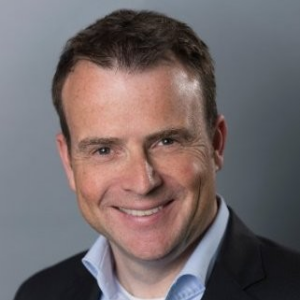
Acquired into an empire. Still building it.
When Microsoft paid $1.45 billion for Danish ERP firm Navision in 2002, the deal made headlines for its price tag. What went unnoticed was a Dutch product director named Kees Hertogh who walked through the door with the acquisition and never left. Twenty-two years later, he is Vice President of Public Sector and Healthcare Marketing at one of the world's largest technology companies - overseeing the global push to put AI into the hands of every clinician on the planet.
That is the short version. The long version is far more interesting.
Hertogh grew up in the Netherlands, trained at what is now Inholland University of Applied Sciences in Haarlem, and found his footing in the late 1990s Dutch enterprise software scene - first at Exact Software, then at Navision. His name is a classic Dutch given name, a diminutive of Cornelis, unusual enough outside the Netherlands to stand out at any conference badge check. In Redmond, it has become recognizable.
"We're at an inflection point. AI breakthroughs are changing, augmenting how we work and live. The integration of AI into healthcare has significantly enhanced patient care and is rekindling the joy of practicing medicine for clinicians."
- Kees Hertogh, 2024His two decades inside Microsoft track almost perfectly with the company's own transformation. He arrived managing an ERP product. He stayed to build an industry cloud. He is now the VP whose name appears on every major announcement about how AI is going to change hospitals, schools, and governments.
The career arc from Dynamics AX product manager to healthcare VP looks linear from the outside. From the inside, it reflects a steady accumulation of product knowledge, marketing fluency, and organizational patience. Microsoft does not promote fast. The people who reach VP level at its scale tend to have earned it over a very long runway.
The ERP years: learning the language of enterprise
Hertogh spent his first decade at Microsoft embedded in the world of Microsoft Dynamics AX - the industrial ERP platform that grew from Navision's product line and became Dynamics 365 for Operations. He ran product management through multiple major versions: AX 2009, AX 2009 SP1, AX 2012, AX 2012 R2. These are not glamorous product names. They describe unglamorous software - the kind that runs factory floors, manages supply chains, and keeps accountants employed. Knowing it deeply matters.
By the time he appeared at Convergence 2013 - Microsoft's flagship Dynamics conference - Hertogh was Director of Product Management and had something pointed to say. He declared, with the confidence of someone who had watched large enterprises struggle for years, that "the world of big bang ERP replacements is gone." Enterprise customers, he argued, wanted distinct projects with distinct ROI. They wanted to build on a single infrastructure, not juggle competing best-of-breed vendors. At the time, Dynamics AX had 18,000 customers globally, and North America had just posted 50% growth in a single quarter. He had data behind the position.
That year, he cited Teck Resources - a major mining company - as the kind of customer using Dynamics AX to track equipment maintenance via GPS and rugged device interfaces. No abstractions. Specific, deployable, measurable.
Navision acquisition
versions managed
authored
Vice President
From product to market: the pivot that defined him
Around 2013 to 2016, Hertogh made the transition from product management into product marketing. This is not a lateral move that everyone survives. Product managers often resist it - they prefer the specification to the story. Hertogh leaned into the story. He took on the Senior Director of Technical Product Marketing role for Dynamics 365 and later the General Manager of Global Industry Product Marketing, where he became the architect of go-to-market strategy for two things Microsoft was betting heavily on: the Power Platform and the Microsoft Cloud for Industry.
The Power Platform - which bundles Power BI, Power Apps, Power Automate, and Power Virtual Agents - became one of Microsoft's fastest-growing product families. The Microsoft Cloud for Industry represented the company's attempt to package Azure, Microsoft 365, and Dynamics 365 into vertical-specific solutions for healthcare, financial services, manufacturing, and retail. Hertogh's team defined how those packages would reach the market and what story would be told to buyers in each sector.
He announced the general availability of Microsoft Cloud for Manufacturing in 2021. He co-led the Resilient Retail initiative in 2023. Each announcement was a proof point that the industry clouds strategy - contested internally and externally when it was proposed - was gaining real traction.
"Success will be determined not by technology alone, but by how effectively organizations prepare their foundations and empower their people to work alongside digital colleagues."
- Kees Hertogh, NEJM / Health Management Academy Research, 2026Dragon Copilot: the product that changed the equation
When Hertogh stepped into the VP role in 2021, Microsoft's healthcare story was still largely about Azure compliance, data infrastructure, and EHR interoperability. Necessary. Not exciting. The launch of Microsoft Dragon Copilot at HIMSS 2025 changed the surface area of the conversation entirely.
Dragon Copilot is an AI-powered clinical workflow assistant that handles documentation, charting, and administrative tasks that eat into a clinician's day. Within its first year, it reached more than 100,000 clinician users and expanded to nine countries: the United States, Canada, the United Kingdom, Ireland, France, Germany, Austria, Belgium, and the Netherlands - the last one a quiet coincidence for a Dutch-born VP.
Hertogh has been the primary public voice on every major Dragon Copilot announcement - HIMSS 2025, HLTH 2025, HLTH Europe 2025, HIMSS 2026. His messaging is consistent: clinician burnout is real, workforce shortages are worsening, and AI that takes administrative burden away from clinicians is not a luxury - it is a structural fix.
He is careful about what he promises. At HLTH 2024, he described Microsoft's platform capability as something that lets health systems build their own copilots and AI agents beyond what comes out of the box. He speaks about what systems can do, not what Microsoft will do for them. The distinction matters to chief information officers evaluating vendors.
The governance voice in a room full of enthusiasm
Hertogh's public body of work in 2025 and 2026 is notable for what it keeps saying. The word "responsible" appears in almost every major blog post he authors. The phrase "appropriate human oversight" is not boilerplate. At conferences where other vendors are selling speed, Hertogh keeps steering the conversation back to foundation.
He co-authored a piece of research in early 2026 with The Health Management Academy, published in association with the New England Journal of Medicine, that quantified the gap between healthcare's enthusiasm for AI and its actual deployment. The finding: only 3% of surveyed health executives had deployed AI agents in live clinical workflows. But 60% believed agentic AI would meaningfully improve the provider-patient experience. That gap - between believing and doing - is where Hertogh has positioned Microsoft's value proposition.
His line from that research: "Success will be determined not by technology alone, but by how effectively organizations prepare their foundations and empower their people to work alongside digital colleagues." It is not a sales pitch. It is a warning to customers who want to skip the foundation work.
At HLTH Europe 2025, held in Amsterdam - a short train ride from where he grew up - he described the systemic pressure on healthcare systems with characteristic directness: "Workforce shortages, clinician burnout, and lack of access to essential health services are placing increasing pressure on healthcare systems." No hedging. No industry jargon. Just the problem stated plainly.
The public sector dimension
Hertogh's title covers more than healthcare. Public Sector and Healthcare Marketing means his team's remit also includes education and government - two sectors where Microsoft has substantial business through Microsoft 365 for Education, Azure Government, and a portfolio of compliance-certified cloud infrastructure. He appeared at Microsoft Ignite 2025 in a segment specifically covering public sector AI, and has published on Microsoft's AI Tour appearances covering government use cases. His scope is genuinely broad.
The common thread across healthcare, education, and government is that all three sectors operate under strict governance requirements, handle sensitive data at scale, and face workforce challenges that technology is being asked to help address. Hertogh has spent enough time in regulated industries to understand that speed-to-market is not the primary value for these buyers. Trust, compliance, and demonstrated outcomes are.
What colleagues say
LinkedIn testimonials from former colleagues describe a manager who "encourages and guides people to perform to their full potential," someone whose "strategic thinking capabilities and ability to achieve greatness through others" set him apart, and a leader who "clearly articulates the rationale for his decisions." These are not the superlatives of a LinkedIn endorsement written under social pressure. They describe a pattern: clarity, delegation, and patience.
Hertogh operates in one of the most internally competitive environments in corporate technology. Microsoft's industry cloud organization sits at the intersection of multiple product teams, each with their own roadmaps and priorities. Staying coherent across that landscape for 22 years requires a particular kind of organizational intelligence - the ability to translate product into strategy and strategy into the terms that matter to a hospital CIO or a state government IT director.
"The question is no longer whether AI belongs in healthcare. It's how quickly organizations can operationalize it - safely, responsibly, and at scale."
- Kees Hertogh, 2026Kees Hertogh is not the kind of executive who makes headlines for bold predictions or public controversy. His version of influence runs through conference sessions, industry blog posts, research co-authorships, and the product announcements that reach 100,000 clinicians. It is quiet influence. It scales.
He joined a company via an acquisition in 2002. He has been there long enough to watch three generations of enterprise technology arrive, peak, and give way to whatever came next. He is now mid-stride in what may be the most consequential one yet. The question he keeps posing to health systems - not whether to adopt AI, but how - is also the question he has answered for himself across two decades of building.