There is a fine absurdity in asking a restaurant operator to admire a dashboard while the walk-in needs counting, Tuesday’s labor is running high and a delivery invoice has arrived with ideas of its own. Katie Fairchild has made a career out of closing that gap between the software and the shift. In April 2026, Buyers Edge Platform appointed her its first Chief Marketing Officer, putting brand strategy, demand generation and customer engagement under one leader. The title is new. The problem is familiar: make complicated systems legible, useful and worth trusting.
Fairchild comes to the assignment after nearly two decades in B2B technology marketing. Her path begins plainly enough, with a marketing internship at Fox Development Corporation in 2005 and 2006. It then moves through executive advisory, recruitment software, retail analytics and restaurant operations technology. Look closer and it resembles a progressive course in translation. Every company sold something consequential that could sound bloodless in a brochure. Every customer wanted the consequence, not the category.
She brings an unusual academic pairing to the work. Fairchild studied business administration and marketing at the University of Illinois Urbana-Champaign, then earned a Master’s degree in mathematics from DePaul University. Creative judgment and quantitative discipline are often presented as quarrelling cousins. In her career, they appear to share a desk.
A career built in useful increments
After Fox Development, Fairchild joined FPL Advisory Group in 2006. She advanced from marketing associate to vice president of marketing, staying until 2011. CareerBuilder followed, where she moved through marketing manager, senior manager and director posts. Then came a year as director of marketing at ShopperTrak, whose retail traffic analytics business later became part of Sensormatic Solutions.
These were not glamorous products in the ordinary sense. They dealt in judgment, hiring and footfall: services and systems that help organizations decide what to do next. The common currency was evidence. By the time Fairchild joined Hireology as a director in 2016, she had spent a decade learning how to turn evidence into a reason to act.
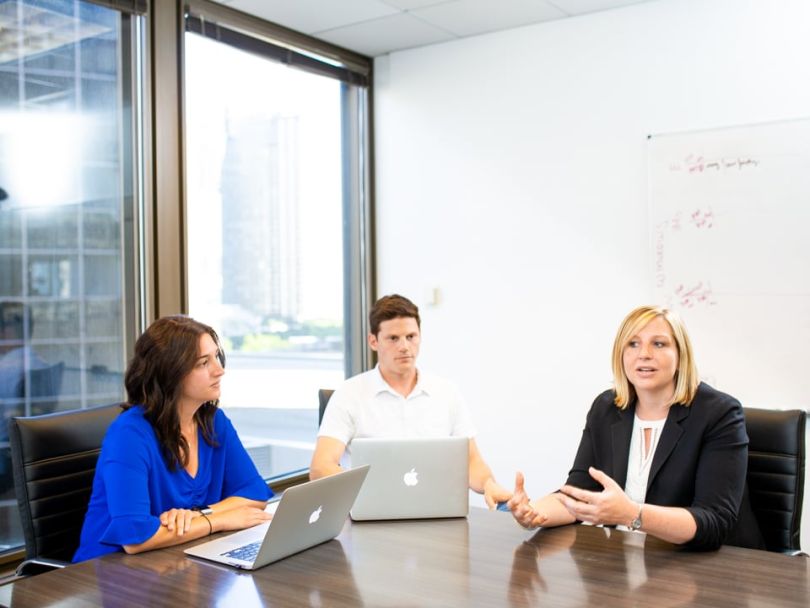
Hireology gave her a longer runway. She rose from director to vice president, then senior vice president of marketing. In a 2018 interview, she explained that rapid growth had made hybrid leadership essential. The best leaders, in her view, supplied strategic structure, coaching and hands-on support. It is an appealingly unceremonious description of management. The leader draws the map, helps the team read it and still carries a bag.
“The best leaders not only provide the framework for the strategy, but the coaching and hands-on support needed to ensure successful execution.”Katie Fairchild, on scaling at Hireology
Her hiring criteria were similarly compact: drive, grit and curiosity. Product expertise could be taught. Those intangibles were harder to install. During that period, she said Hireology had promoted 13 people into new roles while adding more hires. The detail matters because “building a team” is a phrase that can hide almost anything. Promotions are visible proof that the building occurred inside the building, too.
The long route to a first CMO role
The restaurant years get bigger
Restaurant365 hired Fairchild as senior vice president of marketing in October 2021, when restaurant operators were rebuilding amid labor pressure and economic uncertainty. She was given communication, positioning and brand strategy. Her own explanation focused on actionable business intelligence and on helping operators return to growth. Here, marketing was not merely about attracting attention. It had to connect accounting, inventory, scheduling, payroll and human-resources software to the lived economics of a restaurant.
She became CMO in 2023. That year Restaurant365 crossed $100 million in revenue, powered more than 40,000 restaurant locations and announced a $135 million funding round that put its value above $1 billion. In 2024 it raised another $175 million after 12 consecutive quarters above sales targets. These are company milestones, not solo medals. Fairchild’s documented part was to lead more than 50 marketers and run full-funnel strategies that supported year-over-year growth.
The machinery behind those words was broad: integrating brands after acquisitions, scaling sales development, introducing advanced attribution frameworks and aligning programs with revenue goals. She also helped create a more human form of infrastructure. Restaurant365’s first national two-day user conference sold out in Austin in 2023, with training, workshops, networking and a conversation with Chicago chef Stephanie Izard. Fairchild described it as a chance to connect with users “on a new level.” A software company had built a room, not just a funnel.
A software company had built a room, not just a funnel.
Her public writing from the Restaurant365 years reveals the practical side of her marketing mind. She wrote about keeping first-time guests, measuring limited-time offers, turning social food trends into sensible menu decisions and managing inventory tightly. The subjects move easily between the guest’s appetite and the operator’s margin. A viral dish is amusing until it wrecks prep time. A loyalty program is charming until nobody checks whether people return.
Consider her 2024 treatment of limited-time offers. Fairchild began with a market signal: the number of restaurant LTOs had risen 53 percent in four years. But she did not recommend novelty for novelty’s sake. An offer had to fit the restaurant’s brand, suit its audience and be tracked after launch. Dynamic pricing could create urgency. A pairing or combo could raise the average ticket. The promotion was temporary; the learning was meant to last. That is the mathematics-and-marketing combination in miniature. Curiosity proposes the special. Measurement decides whether it deserves an encore.
Her earlier essay on customer retention made the same turn from headline to operating habit. Get the guest through the door, she argued, then give that person reasons to become a regular: service, rewards, community involvement and a consistent experience. Her article about serving alcohol ended without a universal verdict. Operators should examine the fit with their brand, control inventory and compare gross profit with popularity. The recommendation was judgment supported by reports. Even a cocktail, in Fairchild’s hands, eventually meets a spreadsheet.
That instinct was visible before restaurants entered her résumé. At Hireology, she said her team needed to understand its industry, trends, competitors, buyers and users, as well as the value the product created inside and out. It is a demanding sequence. It also explains why her career has traveled so well across vertical software. The category changes. The questions hold.
That balance makes her move to Buyers Edge Platform coherent. The company operates a foodservice procurement network serving operators, distributors and manufacturers through purchasing, supply-chain, software and fresh-food businesses. If Restaurant365 asked her to translate the back office, Buyers Edge asks her to translate an ecosystem. More audiences enter the sentence. So do more data, contracts and competing definitions of value.
Four races, one operating principle
The most revealing line in Fairchild’s older company biography sits outside work. She had completed four marathons and improved her time in every race. The sequence matters more than any single clock reading. The point is not how fast she was compared with a stranger. The point is that each version of Fairchild had to beat the previous one.
Four starts. Four finishes. Each one faster.
The progression runs in one direction: race one through race four.
The progression also gives her résumé its rhythm. At CareerBuilder, she moved through three jobs. At Hireology, three more. At Restaurant365, senior vice president became chief marketing officer. The organizations changed, but the method kept returning: learn the category, make the customer’s problem vivid, build the team, measure the result, take on a wider course.
Fairchild’s public biographies add domestic counterweights to all this disciplined motion. She enjoys exploring Chicago’s dining scene and traveling, and spends time with her husband, two daughters and their dog. The dining detail is especially apt. It places the foodservice technologist on the other side of the transaction, where a restaurant’s elaborate operating system arrives at the table as one simple question: was the evening good?
Now, the network
At Buyers Edge Platform, Fairchild’s mandate brings together brand strategy, demand generation and customer engagement, all tied to company-wide revenue goals. She will work across divisions and enterprise functions. The appointment itself signals that marketing has become an executive operating concern for the company, not an ornamental layer applied after product and sales have finished speaking.
The work ahead is less tidy than a marathon route. Buyers Edge Platform serves multiple sides of the foodservice economy, and each side sees a different advantage in procurement data. Operators want savings and control. Distributors want stronger relationships and efficient networks. Manufacturers want clearer opportunities. Fairchild’s job is to make one platform credible to all three without sanding away what each actually needs.
Her history suggests she will approach that problem with a curious combination: the patience of a distance runner, the exactness of a mathematician and the willingness of an operator to get her hands on the work. Marketing loves a finish-line photograph. Fairchild’s career is more interested in the watch. There is always another split to read, another system to explain and, if the pattern holds, another gear waiting to be found.