The expense report has a peculiar talent for making intelligent adults behave like forgetful schoolchildren. A receipt vanishes. A manager sends a reminder. Someone reconstructs a Tuesday lunch from a calendar and a credit-card line. The money is rarely dramatic. The ritual is. Karim Atiyeh has spent much of his career staring at this sort of nuisance and asking a rude, productive question: why is a person doing any of it?
Atiyeh, the co-founder and co-CEO of Ramp, does not measure a business product only by the work performed inside it. He is interested in the time a customer never has to give it. A form that arrives prefilled is better than an elegant blank form. A receipt collected automatically beats a cheerful notification asking for one. Software, in this view, succeeds when it becomes less visible.
This is a modest-sounding ambition with immodest consequences. Most enterprise software is bought by one person and endured by everyone else. Atiyeh describes the result as a small paper cut delivered every day. Ramp's counterproposal has been to polish the daily interaction until, ideally, there is no interaction at all.
“How can I figure out the answer to that question myself without asking the customer?”Karim Atiyeh on product design
Before the card, there was the receipt
He was born and raised in Beirut near the end of Lebanon's civil war. At sixteen, in 2006, he travelled to MIT for the Research Science Institute, an intensive summer program that became important for more than its curriculum. He has said that some of his closest friendships began there. The experience also pulled a young builder into a network where research, engineering and ambition were ordinary topics of conversation rather than distant professions.
Harvard followed. Atiyeh studied electrical and computer engineering, completed a master's degree in computer science, became a Siebel Scholar and spent a term teaching CS50. Then he did what many technically trained graduates do when the available road looks respectable: he joined a consulting firm. Oliver Wyman brought him to New York. It also clarified what he missed. He wanted to write code and build software again.
The first consequential problem arrived wrapped in the mild injustice of online pricing. Atiyeh and Eric Glyman were young professionals buying much of what they needed online. Glyman noticed that the price paid for a flight could differ from someone else's price for the same trip. Retailers sometimes honored price adjustments, but only if a buyer noticed the drop and asked. The customer had to remember, monitor and negotiate. In other words, the task was perfectly designed never to happen.
Paribus, founded in 2014 with Glyman and Gene Lee, did the remembering. It connected to an inbox, identified receipts, extracted purchases, watched for price drops and contacted stores on a user's behalf. Before the current enthusiasm for agents, Paribus behaved rather like one. Within roughly a year it was approaching a million users; at its peak, Atiyeh has written, it helped about 10 million customers save millions of dollars annually.
It was also a wonderfully awkward engineering education. Paribus sat on top of retailer websites it did not control. Pages changed constantly. Receipts that once arrived itemized in email were replaced with links requiring a login. The incentives pointed against the company: the better Paribus became at winning refunds, the more reason retailers had to make its work difficult. Elegant architecture had to coexist with scraping, repair and improvisation.
Y Combinator accepted Paribus into its Summer 2015 class. Capital One acquired the company in 2016. Atiyeh and Glyman stayed for roughly two years, learning how cards, regulation and a large financial institution actually worked. The sale was an ending, but the central idea had survived intact: read the evidence, understand the transaction and do the tedious work for the customer.
Paribus, only for companies
Ramp began in 2019 as the business-sized version of that thesis. Corporate cards were the entry point, not the whole plot. A card showed what a company bought. From those transactions, software could collect receipts, control purchases, spot waste, automate accounting and eventually reason about financial policy.
The timing was comic in the way history can be comic when one is not the person paying the office lease. Ramp launched its product in February 2020, about a month before the pandemic emptied offices and disrupted company spending. Yet the mission held: help businesses save time and money. The company grew by making that promise visible in details, while incumbents generally competed on points, rewards and the hope that customers would spend more.
Atiyeh wanted business software with the ease of Instagram. The comparison can sound frivolous until one considers the audience. A corporate finance system may be selected by a finance leader, but it is touched by salespeople, engineers, managers and anyone who buys lunch for a client. Each extra question is multiplied across a company. A five-second irritation acquires a payroll.
“You solve one person's problem, but you give everyone else at the company just a small paper cut every day.”Atiyeh on the old enterprise-software bargain
His remedy is both aesthetic and mathematical: ask only necessary questions, infer the rest, and keep counting the steps. As more customers use the system, Ramp can learn which details are predictable and remove further prompts. The odd success metric is less engagement. Consumer apps compete to hold attention. Atiyeh's finance software would prefer to return it.
Atiyeh's map of asymmetric risk
Small downside, large possible gain
A single error can erase many wins
Speed, with a map of the cliffs
Atiyeh is an advocate for large bets, but not a romantic about risk. He explains asymmetric outcomes with a coin toss: losing one unit for the chance to win ten can be sensible if the loss is survivable. The same logic reverses in lending. If a company's revenue is a small fraction of the credit extended, one bad account may require many good customers to repair the damage. Experiment on the interface. Exercise discipline where money moves.
That division helps explain Ramp's culture of speed without reducing it to impatience. Small teams receive autonomy over a problem. Colleagues are accountable to one another rather than merely upward to a manager. Hiring favors exceptional ability in one area over the fantasy of a candidate with no defects. Nik Koblov, Ramp's head of engineering, has described Atiyeh and Glyman as low-ego founders who let data and customers redirect the road map.
There is even a pleasingly unserious footnote to the serious business of fundraising. Before Ramp formally existed, Atiyeh played Fortnite with his brother and friends, some of whom happened to belong to the startup world. One was Delian Asparouhov, who was moving toward Founders Fund. The game helped create an early relationship in Ramp's investor network. Apparently a virtual island can be useful for more than surviving a storm.
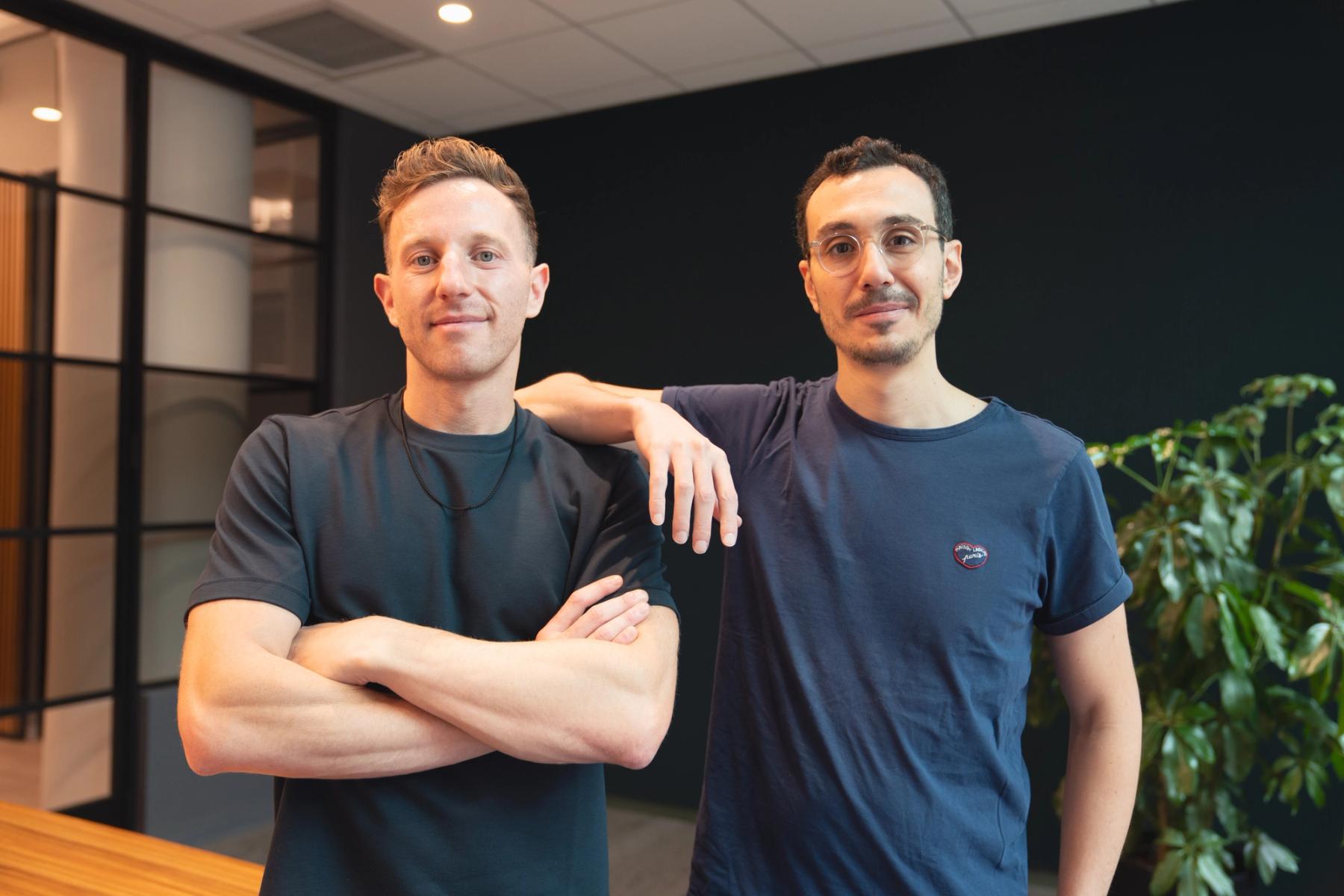
The operating brief gradually expanded beyond technology. Atiyeh managed risk, operations and marketing as well as engineering. In June 2026, Ramp made the arrangement explicit: he and Glyman became co-CEOs, and Rahul Sengottuvelu moved into the CTO role. The announcement framed technology not as one department but as the method of the whole company. Systems have inputs and bottlenecks whether they are made of code, people or approval meetings.
Paribus begins automating price-drop refunds.
Capital One acquires Paribus.
Atiyeh, Glyman and Lee co-found Ramp.
Ramp introduces finance-focused AI agents.
Atiyeh becomes co-CEO; Ramp later launches in the UK.
The software that calls only when needed
The next version of the idea is autonomous finance. Ramp's agents can read a company's expense policy, examine transaction context, approve routine cases, flag outliers and explain a decision. The aspiration is not a talking dashboard draped over old chores. It is a system in which routine judgment happens continuously, with people summoned for the small share of cases that genuinely require them.
Atiyeh sees large language models moving from assistant to product infrastructure. In his compact description, the code becomes “the LLM plus instructions and an infinite loop.” Ramp has followed that view into policy agents, internal development tools and AI-spend intelligence that connects model usage to invoices and card charges. The field changes quickly enough that even choosing the right model can become its own administrative task, which naturally creates another task for Atiyeh to try to delete.
There is a consistent temperament beneath the expanding company. He likes the engineer's question - what can the system know without bothering the user? - and the operator's restraint - where would a mistake become ruinously expensive? One removes friction. The other respects consequence. Together they form a practical philosophy for building in finance, where convenience without control is a trap and control without convenience becomes bureaucracy.
Ramp's September 2026 launch in the United Kingdom widened the stage, but not the premise. Cards, bills, expenses and accounting still produce their procession of small demands. Atiyeh's wager is that software can absorb most of them, leaving the humans to make the decisions worth making. The best outcome would be strangely hard to photograph: no one hunting for a receipt, no one filling a form, no one noticing that a machine had already done the decent thing.