A visitor to Karan Bakshi’s trade-show booth brought a problem large enough to be faintly absurd: tens of millions of valuable assets, scattered across locations, with too little visibility into how they were performing. Bakshi was demonstrating asset-tracking technology. The visitor, who would become a major customer, was describing the business hiding inside it.
There is something wonderfully unglamorous about the opportunity. A drinks cooler is unlikely to inspire a founder’s commencement speech. Yet somebody owns it, somebody stocks it, and somebody needs to know whether it is earning its place on the floor. Multiply that uncertainty across a retail network and a refrigerator becomes a rather serious information problem.
Bakshi, the founder and CEO of Vision Group Retail, has built his working life around such problems. His company’s territory is the physical shop: equipment, products, shelves, and the distance between a plan drawn at headquarters and the arrangement a customer actually sees. His story begins well before anyone was putting AI on the shop door.
Before the cooler, there was the calendar
In 1998, Bakshi started a software-development business helping manufacturers prepare for Y2K. The work included rewriting FoxPro- and DBase-based applications in Visual Basic. These were practical assignments with a deadline the entire planet had agreed upon. Software that had served a business for years suddenly needed someone to understand it closely enough to change it.
It is a useful opening chapter for a retail technology founder. Both jobs involve entering an existing operation, respecting what already works, and finding the place where old systems have become a constraint. A manufacturer cannot suspend business while its software catches up. A retailer has much the same objection. Customers have a habit of arriving during transformations.
His subsequent career included co-founding Insigma in 2007. His education spans mathematical sciences at Delhi University and computer science at the University of Illinois Urbana-Champaign and SUNY Polytechnic Institute. Those credentials sit behind a career that has crossed software services, connected equipment, and retail applications. The recurring subject is how technology behaves once somebody has to use it.
Manufacturing software. FoxPro and DBase. A worldwide deadline.
A refrigerator needs a reporting line
Vision Group’s company history begins with a cooler-tracking solution in 2014 and a Coca-Cola Hellenic pilot in 2015. Bakshi established Vision Group in 2016. The sequence matters: the operating problem and early product work came before the organization took the shape associated with his founder role.
Connected equipment asks deceptively simple questions. Where is the asset? Is it working? What is happening inside it? Vision IoT’s Harbor platform was built to bring remote assets into view, giving field representatives and management information they could act on. A piece of equipment could become part of a shared operating picture instead of remaining an expensive object somewhere else.
By December 2020, the ambition had moved beyond individual devices. eBest IoT became Vision IoT, and Austin Groves returned as CEO while Bakshi became president. Bakshi described the two of them as the company’s first employees. He backed Groves to lead the next stage as the business concentrated on its device-agnostic Harbor platform.
That detail complicates the familiar founder portrait in a useful way. Building a group means making room for other people to run parts of it. The platform also needed to accommodate equipment from different manufacturers. In both the organization and the product, growth involved allowing more than one way of doing things to coexist.
The shopping list behind the acquisitions
Bakshi’s next moves widened the view from equipment to the shelf itself. Vision Group records the acquisition of Maxerience in 2018, adding image-recognition capabilities. In 2021 came SMSB’s category-management capabilities. The businesses brought different parts of the retail problem into the same organization.
At the center of the SMSB argument was a surprisingly basic ingredient: good product pictures. Image recognition needs something reliable to recognize. A current catalog of packaging and attributes helps connect a photographed object to the product a retailer actually sells. The catalog and the recognition system therefore have a working relationship; neither becomes useful simply by being large.
Bakshi described SMSB’s image catalog and space-management expertise as a missing piece in the group’s development. It is an acquisition rationale with less theatre than the customary promise to transform everything. Before a machine can tell you whether the right bottle is on the shelf, it needs to know which bottle you mean.
Hivery extended the logic further. Vision Group announced its acquisition in January 2025, bringing Curate’s store-level assortment simulations into the portfolio. The question could now move from identifying a shelf’s contents to testing what a different selection and allocation of space might do.
“Hivery’s expertise in space-aware assortment optimization perfectly complements our current offerings.”
Karan Bakshi · January 2025
A shelf has fixed dimensions and an unreasonable number of candidates for admission. Giving more space to one product takes it from another. Simulation makes those trade-offs available for examination before a team starts moving boxes. For Bakshi’s group, planning and observing were becoming neighboring activities.
Two ways to rescue a plan
The product names are almost comically literal. PicToPOG turns a shelf photograph into an editable planogram, the diagram showing where products belong. PDFtoPOG converts a retailer’s static PDF into a working layout. One starts with what exists in the store; the other starts with what somebody intended.
Each tackles a small administrative indignity: having the information in front of you and still needing to recreate it by hand. PicToPOG identifies product positions from an image. PDFtoPOG extracts an existing layout so it can be changed and compared. The names might never win a poetry prize, but a busy category manager can probably forgive that.
EZPOG supplies a browser-based place to build, edit, and share layouts, using shared product libraries. These tools give Bakshi’s broader strategy a tangible form. The group is connecting jobs that people already perform, often with awkward handoffs between files, photographs, and specialist systems. Each handoff is an opportunity to waste time or lose context.
A bouquet, a suitcase, and four offices
In February 2023, Bakshi visited Vision Group’s Ahmedabad office. A photograph from the welcome shows him receiving flowers, with luggage still beside him. It is a pleasingly ordinary image of international management: the arrival, the greetings, the bag that has yet to find a room.
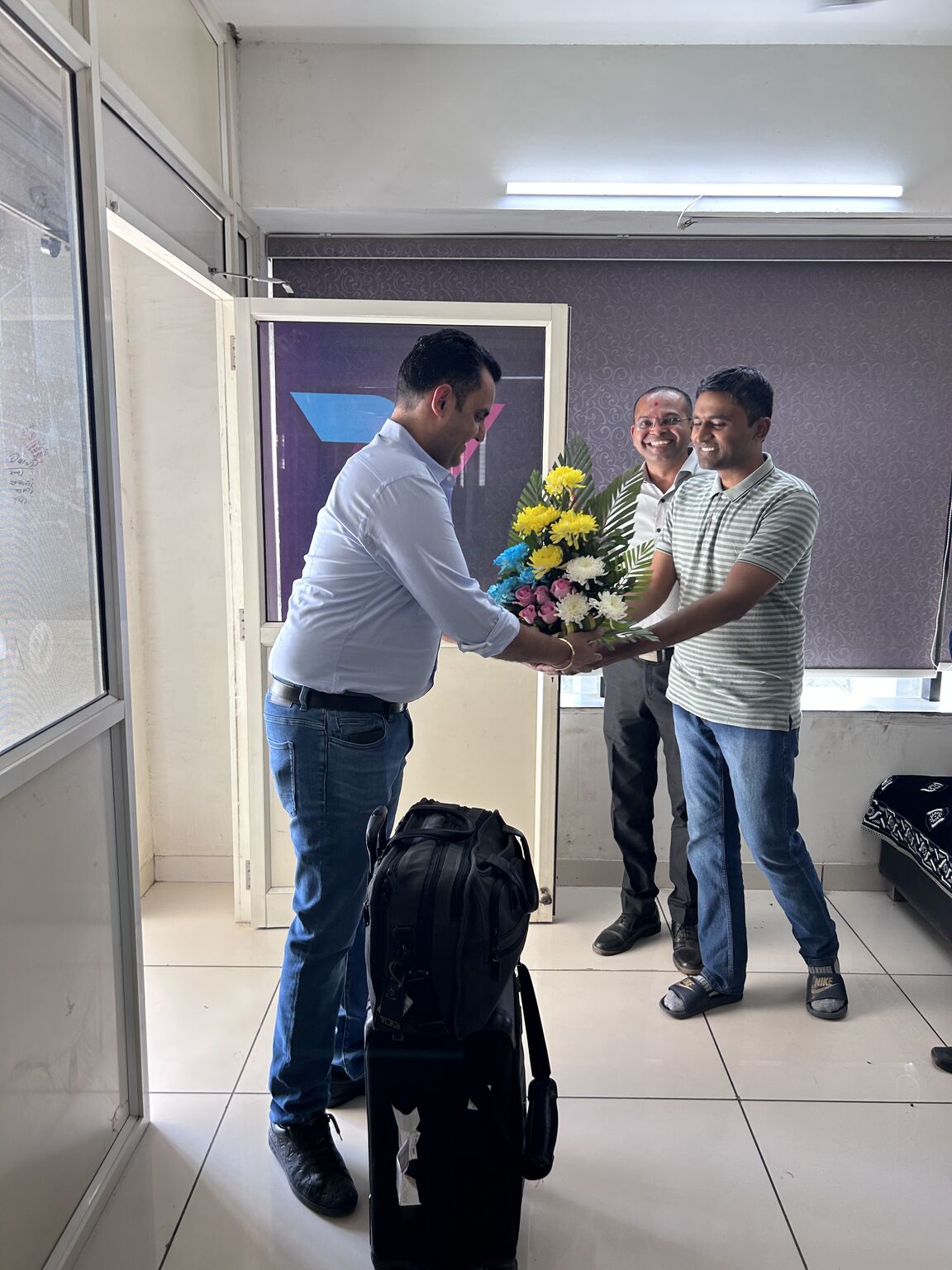
Vipul Patel, who shared the photograph, described Bakshi as a friend, guide, and well-wisher as well as the company’s founder and president. The company’s account of its annual meet records visits to Delhi/NCR, Bangalore, Nagercoil, and Ahmedabad by Bakshi and other senior leaders. After remote working and separation, the itinerary was an exercise in being physically present.
A business that sells visibility has its own version of the same obligation. The people writing software and supporting customers need to see the people setting direction. Office visits cannot carry a company culture by themselves. They do, however, turn a name on a call into someone standing in the doorway.
The gap that looks perfectly tidy
In January 2026, Bakshi published a piece about an empty shelf space filled with a neighboring product. The aisle looks orderly. Yet the substitution can alter what shoppers buy, and that changed purchase pattern can then enter planning systems as if it expressed their original preference.
His concern is the journey of a small workaround. A reasonable decision during a busy shift may become misleading evidence elsewhere. Read as an operating philosophy, the argument asks headquarters to understand the conditions behind the numbers. A tidy shelf and an accurate account of demand are different achievements.
The argument brings his early tracking work into focus. Equipment scattered across locations and shelf changes hidden inside sales reports share a difficulty: a distant decision-maker sees the outcome without enough of the circumstances. Bakshi’s business keeps returning to the job of supplying those circumstances while there is still time to respond.
Still a work in progress
Bakshi’s preferred framework for Vision IoT has three parts: people, process, and technology. Away from work, he and his wife enjoy exploring countries and cultures with a rich history. It is a small personal detail, but a welcome one in a career otherwise described through software, operating roles, and acquisitions.
His remarks about balancing work and family are similarly unpolished. “I’m still a work in progress.” There is no elaborate productivity system attached to that admission. It gives the founder a human scale: someone whose job has expanded geographically without adding any hours to his day.
In December 2025, Vision Group brought its retail solutions under a refreshed single brand. Connecting the acquired capabilities became an explicit company proposition. For Bakshi, the continuing assignment is familiar: make different pieces work together closely enough that the person using them has less to untangle.
The trade-show visitor had asked for a better view of valuable objects scattered around the world. Years later, the work still starts with something concrete: a cooler, a product image, a shelf that looks fine. Bakshi has made a career of asking what is happening just beyond that first impression.