Breaking - Blockit AI exits stealth with $5M seed Sequoia's Pat Grady leads the round 200+ companies onboard - Brex, Together.ai, Rogo "An AI social network for time" Harvard idea, shelved a decade, revived $1,000/yr individual - $5,000/yr team Breaking - Blockit AI exits stealth with $5M seed Sequoia's Pat Grady leads the round 200+ companies onboard - Brex, Together.ai, Rogo "An AI social network for time" Harvard idea, shelved a decade, revived $1,000/yr individual - $5,000/yr team
The Profile - Vol. 06 / Issue 30

Kais
Khimji

He spent six years writing checks at Sequoia. Then he picked up a phone, made three announcements in one breath, and started building the thing he'd been sketching since freshman year.

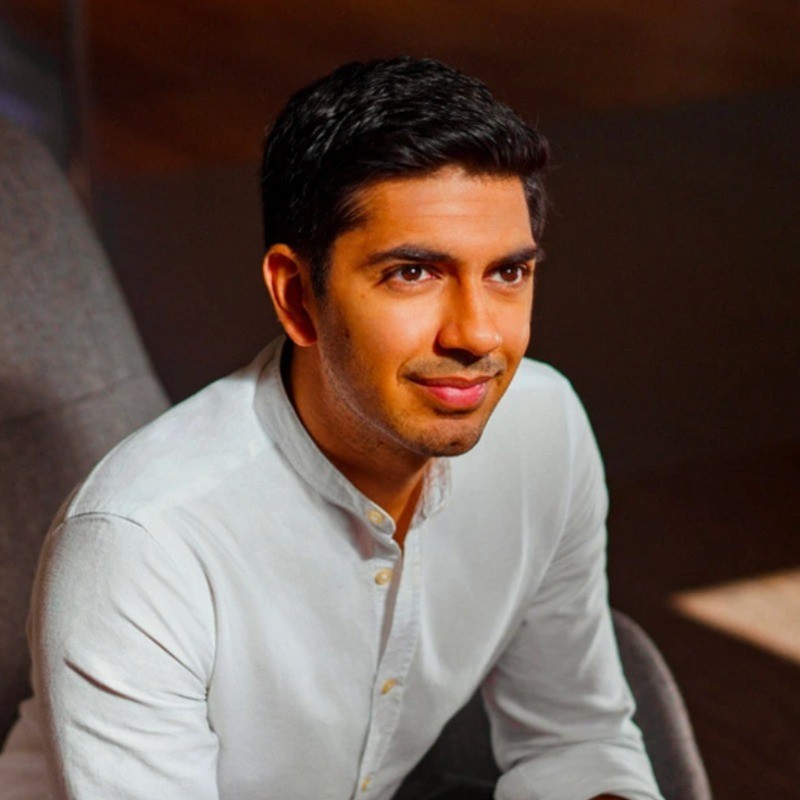
Kais Khimji portrait
The calendar whisperer, off the clock.
// The Story

A database problem disguised as a polite email

Most calendars are written in the same language and still can't understand each other. Kais Khimji noticed this in a Harvard dorm room around 2015, filed it under unsolved, and went off to do other things for a decade.

He went to Insight Partners. He went to Sequoia. He spent six years there, eventually as a partner, sitting in rooms with founders pitching the future of software while quietly mailing himself notes about a calendar problem that wouldn't quit.

"I have a time database - my calendar. You have a time database - your calendar, and our databases just can't talk to each other." That's the founding sentence of Blockit AI, the company he and co-founder John Han launched out of stealth in January 2026 with $5M led by Pat Grady at Sequoia. The shortest version: an AI agent that lives in email and Slack, hears a meeting request, and books the meeting. No Doodle poll. No three-day thread titled "Re: Re: Re: works for you?" No "looping in my assistant."

The product is the kind of thing every founder in the last fifteen years has tried to make work. Khimji's co-founder, John Han, personally tried it three times - he built calendar features at Timeful, Google Calendar, and Clockwise before coming back for one more swing. Calendar startups are where good founders go to be humbled. Blockit is the bet that the agent layer is the part that was missing.

Pat Grady, who led the seed, said Blockit "has a chance to become a $1Bn+ revenue business." On a calendar product. That sentence is itself a small fact about how the AI agent thesis has changed what people will underwrite.

"Persistent, not stubborn." - Aashay Sanghvi, Haystack, on Khimji
$5MSeed raised - Jan 2026
200+Paying companies
6Years at Sequoia
~10Years from idea to launch
I have a time database. You have a time database. They just can't talk to each other. - Kais Khimji to TechCrunch, January 2026
// Anecdotes

Three small scenes

The forced demo, 2020

Before Blockit was a company, before there was a logo or a price page, Khimji shipped a prototype to friends. One of them, Aashay Sanghvi at Haystack, was made to schedule with it. Aashay had, by his own admission, "substantial feedback." Khimji didn't argue. He went back and built more. The friendship survived. So did the idea.

The three-announcement phone call

When Khimji finally left Sequoia, he called his first outside investor and made three announcements in one breath: he was getting engaged, he was leaving Sequoia, and he was starting a company. The investor committed on the spot. Some pitches are about the deck. This one was about the cadence.

The investors who use the product

Among Blockit's paying customers: a16z, Accel, Index, and yes, Sequoia. The same people who fund Khimji also schedule with him. It's an unusual customer list - and a feedback loop he probably won't replicate twice in a career.

Where the time goes

Anatomy of an old-school meeting request
Email volley
~3 days
Doodle poll
~2 days
Assistant CC~1 day
Blockit agent
~3 min
Indicative timing per Blockit's product framing. Your inbox may vary.

The Co-FounderJohn Han

A three-time calendar veteran. Built at Timeful (acquired by Google). Then Google Calendar. Then Clockwise. The kind of resume that should make you skeptical of calendar startups - and curious about this one.

// Timeline

From Harvard sketchbook to seed announcement

~2015
A Harvard undergrad sketches a scheduling agent. It's clever. It's early. It's not ready.
Pre-2019
Growth investing at Insight Partners.
November 2019
Joins Sequoia Capital as a Partner.
2020
Quietly ships an early Blockit prototype to friends. Tests it on real meetings. Listens.
2022
Board observer at Grafana Labs and Clipboard Health.
2025
Leaves Sequoia, gets engaged, co-founds Blockit AI with John Han - in one phone call.
January 2026
Public launch. $5M seed led by Sequoia. 200+ paying customers on day one.
// Fun & Insightful

Things worth knowing

1

His first outside investor said yes during a phone call that also contained an engagement announcement and a resignation.

2

The same VC firms that funded Blockit - a16z, Accel, Index - use Blockit on their own calendars.

3

The product reads tone. A polite "happy to find a time" gets treated differently than "we need this on the books by Friday."

4

His Harvard major was Social Studies, focusing on Politics, Philosophy, and Economics. Calendars turn out to be all three.

5

Pat Grady's underwriting line - "a chance to become a $1Bn+ revenue business" - is on a calendar app. Read that sentence twice.

6

Co-founder John Han has worked on three calendar products before this one. The phrase "founder graveyard" applies. He came back anyway.

// The Thesis

Why a calendar, why now

The interesting thing about Blockit isn't that it schedules meetings. Lots of things schedule meetings. The interesting thing is that Khimji thinks the calendar is a missing protocol - the equivalent of email before SMTP, or payments before Stripe. A calendar entry is a tiny contract: who, when, where, why. Currently those contracts are negotiated by humans copying lines from one inbox into another. Blockit's bet is that the negotiation moves to agents and the contract stays.

That framing - "an AI social network for time" - is a Khimji line. It's also a tell. He doesn't talk about meeting scheduling. He talks about time, plural, as if everyone's calendar is a node in a graph and Blockit is the gossip layer. If that sounds grand for a tool that books coffees, it is. But it's the kind of grand that gets a Sequoia partner to leave the partner track.

What's verifiable so far: 200+ paying companies, including Brex, Together.ai, and Rogo. Pricing at $1,000/yr individual and $5,000/yr team. A team built from Retool, Waymo, and Notion alumni. A co-founder who has touched every previous serious attempt at solving this problem. And an investor base that uses the product, which is a quieter form of conviction than the term sheet.

What's still to be proven: whether agents can negotiate inside the messy social contract of work without irritating people more than the old system did. The polite calendar email exists for a reason - it's a soft place where humans hedge. An agent that says "Tuesday at 3, confirmed" without that hedge has to be very, very good at reading the room. Khimji thinks tone-detection is the unlock. The next twelve months will tell.

One more thing to notice. He named the company Blockit. Not Calendar.ai. Not Scheduler.something. Blockit - as in time-block, as in the protective act of carving an hour out of the chaos. The name doesn't promise more meetings. It promises fewer.
// Pass It On

Share this profile

Twitter / X LinkedIn Facebook Instagram Copy URL
// The Rolodex

Where to find him