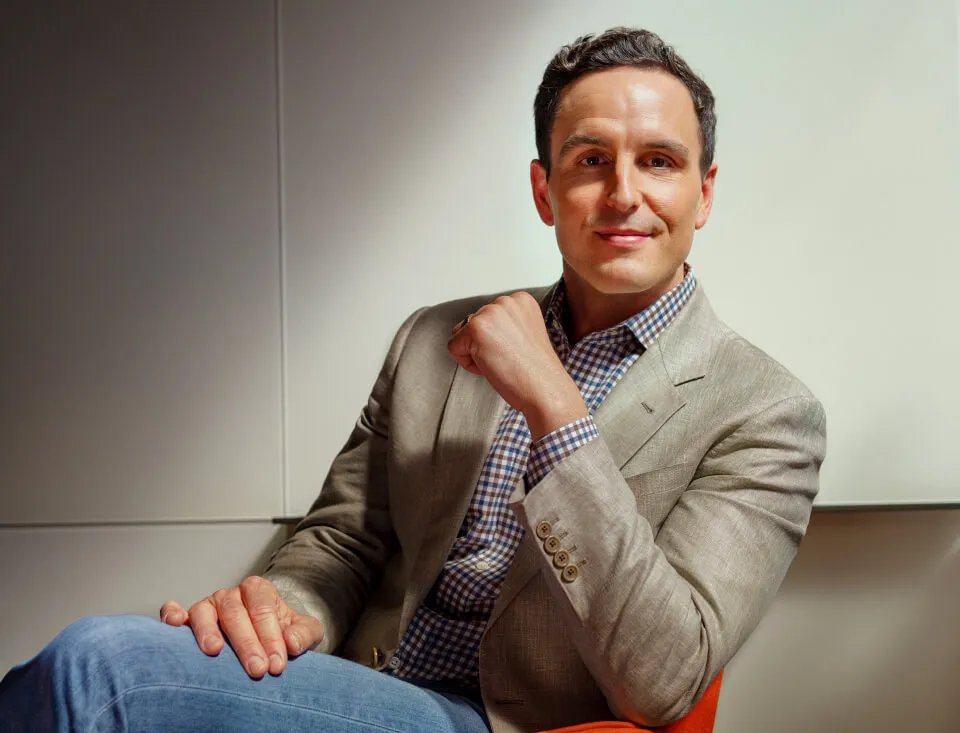
The Man Who Bet the Farm (and Won)
Pat Grady's first job was nailing shingles to roofs in Wyoming's Powder River Basin, where summer temperatures hit triple digits and the nearest Starbucks was a two-hour drive through sagebrush. Today he sits in Portola Valley, California, deciding which companies get billions of dollars and which founders get told to come back when they're ready. The transition took less than two decades. The work ethic never changed.
When Sequoia Capital hired Grady in 2007, he was 24 years old. The youngest person the legendary firm had ever brought on. Not from Stanford. Not from Harvard Business School. From Boston College, on a Presidential Scholarship, with a mathematics concentration and a summer tan from roofing work. He joined Summit Partners first, learned growth equity, then Sequoia came calling. At an age when most finance types are still fetching coffee and building Excel models, Grady was evaluating billion-dollar opportunities.
"When I meet a new person, I try to think, what's special about this person?"
- Pat GradyThe question reveals everything. Not what's impressive. Not what's credentialed. What's special. This is a man who grew up in Gillette, Wyoming - a coal mining town where cattle outnumber people and ambition means getting out. Grady got out. Then he spent 19 years proving that meritocracy still works in Silicon Valley, if you're willing to work 18-hour days and ask better questions than everyone else in the room.
His track record reads like a greatest hits album of the cloud computing era. ServiceNow, worth $177 billion. Snowflake, $86 billion. Zoom, $25 billion. OpenAI, valued at $300 billion and climbing. HubSpot. Notion. Okta. Qualtrics. Harvey. The combined market capitalization exceeds $250 billion. That's more than the GDP of Finland. All from a guy whose partners joke that his first ServiceNow investment wasn't some brilliant SaaS thesis - it was just a company, and his job was to find companies.
Grady demonstrated pattern recognition before pattern recognition became a Silicon Valley buzzword. Large addressable markets with incumbent on-premises solutions ready for cloud disruption. Founder-CEOs with deep domain expertise. Product experiences measurably superior to existing alternatives. He didn't invent the playbook. He just ran it better than almost anyone else on Sand Hill Road.
In November 2025, Sequoia named Grady co-steward alongside Alfred Lin, succeeding Roelof Botha after his decade-long tenure. The announcement surprised no one who'd been paying attention. Grady had led Sequoia's growth-stage practice since 2015, building relationships with founders who'd become household names and companies that would define the next decade of enterprise software. Lin handled early stage. Grady handled growth. Together they'd deliver the future.
"Long-horizon agents are functionally AGI, and 2026 will be their year."
- Pat Grady, January 2026The prediction matters because Grady doesn't make predictions lightly. When he says 2026 is the year for long-horizon agents - AI systems that can plan and execute complex tasks over extended timeframes - he's not speculating. He's observing. He sits on the boards of Harvey (legal AI), Hugging Face (AI infrastructure), and a dozen other companies building the future of artificial intelligence. He sees what's coming before the rest of us read about it in TechCrunch.
In April 2026, Grady and Lin raised $7 billion for a new expansion fund, nearly doubling Sequoia's 2022 vehicle of $3.4 billion. The capital targets late-stage investments in the US and Europe, with a sharp focus on AI giants like OpenAI and Anthropic. Both companies are eyeing 2026 public listings. Both are Sequoia portfolio companies. The math isn't subtle.
"The capabilities today are enough to build trillions of dollars worth of new businesses," Grady said at Sequoia's AI Ascent event in May 2025. Not millions. Not billions. Trillions. He wasn't being hyperbolic. He was being specific.
Grady's philosophy centers on two variables: the founder and the market. "Exceptional founders can overcome modest markets," he's said, "while average founders struggle even in large markets." It's a deceptively simple framework that requires exceptional judgment to execute. Knowing which founders are exceptional requires asking the right questions. Knowing which markets matter requires seeing around corners. Grady does both.
His Instagram bio calls him the "lesser half" of his wife Sarah and "lucky father" to Kinsley and Noe. The humility is genuine. When he first joined Sequoia, he worked 18-hour days until he realized he "probably wasn't the most interesting person in the world." The lesson stuck. "Our business is about amplifying strengths, not mitigating weaknesses," he's said. "I learned to concentrate on the handful of things that really matter rather than trying to be perfect across every dimension."
In high school, his greatest fear was boredom. Today, it's irrelevance. The shift reveals a mind that understands time horizons. Boredom is a juvenile concern - what will entertain me today? Irrelevance is an adult fear - will I matter tomorrow? Grady structured his career to ensure the answer stays yes.
He grew up in Wyoming's Powder River Basin, a landscape of coal mines, cattle ranches, and vast empty spaces. His first job paid for college and taught him that building something durable requires working piece by piece, layer by layer, until the structure stands the test of time. Roofing in triple-digit heat prepared him for Sequoia better than any MBA program could have. You learn to focus when the sun is cooking your brain and one mistake means starting over.
"Data is the new oil," Grady has said, channeling both the obvious and the overlooked. Everyone agrees data matters. Few people structure their entire investment thesis around which companies can collect, process, and monetize data better than incumbents. Grady did. It explains ServiceNow. It explains Snowflake. It explains why he's betting billions on AI companies that treat data pipelines as competitive moats.
He's predicted the return of the apprenticeship model in venture capital - junior investors learning from senior partners over years, not months. "We're only as good as our next investment," he wrote when announcing the co-steward transition. "It's also true that we're only as good as our next generation." The comment reveals a long-term thinker who understands that Sequoia's 52-year track record depends on training people who'll run the firm in 2040.
Grady serves on the boards of Amplitude, Attentive, Cribl, Harvey, Hugging Face, Notion, Snowflake, and Zoom. Each board seat represents hundreds of hours of advice, strategy sessions, crisis management, and quiet conversations that never make the news. Being a good board member requires showing up when things go wrong, not just when things go right. Grady shows up.
At Sequoia's AI Ascent event, he advised founders to "go at maximum velocity, all of the time." Not most of the time. All of the time. The counsel reflects someone who's seen what happens when companies hesitate during platform shifts. They die. Or worse, they become irrelevant - that fear again, driving decisions.
Grady attended Boston College from 2000 to 2004, graduating summa cum laude with a B.S. in economics and finance with a concentration in mathematics. The math background matters more than the economics training. Venture capital is probability theory dressed up in pitch decks. Understanding distributions, outliers, and expected values separates good investors from lucky ones. Grady is good.
He interned at Citigroup's Healthcare team before graduation, learned the basics of financial analysis, then joined Summit Partners in 2004. Three years later, Sequoia called. He's been there ever since, building relationships that compound over decades. Fred Luddy at ServiceNow. Frank Slootman at Snowflake. Eric Yuan at Zoom. Sam Altman at OpenAI. These aren't transactional connections. They're partnerships built on trust, judgment, and showing up when it matters.
The Sequoia steward role is one of the most prestigious positions in venture capital. Michael Moritz and Doug Leone ran the firm as co-stewards. Roelof Botha took over solo. Now Grady and Lin return to the co-steward model, betting that two heads are better than one when navigating the AI revolution. So far, the market agrees. Sequoia's latest fund raised $7 billion in a climate where most VCs are struggling to close commitments.
Grady's story matters because it's remarkably un-Silicon Valley. No Stanford degree. No family money. No co-founder from a previous startup exit. Just a kid from Wyoming who worked hard, asked good questions, and built a track record that speaks louder than any credential. In a world increasingly dominated by pedigree and connections, Grady represents the idea that talent and judgment still win.
He lives in Portola Valley with Sarah, Kinsley, and Noe. The town sits in the hills above Palo Alto, close enough to Sand Hill Road but far enough to remember there's a world beyond term sheets and board meetings. On weekends, he's not networking at Rosewood. He's with his family, building something more important than any portfolio company.
Grady's 2026 AGI prediction will either look prescient or premature by year's end. His $7 billion fund will either generate outsized returns or become a cautionary tale about betting too big on AI hype. His co-steward partnership with Lin will either define Sequoia's next decade or give way to solo leadership. The outcomes remain uncertain. What's certain is that Grady will keep asking the question that's served him for 19 years: What's special about this person? What's special about this company? What's special about this moment?
The roofer from Wyoming learned that the work never stops. You finish one project, then start the next. You build piece by piece until the structure stands. And if you're lucky - if you're very, very good - the thing you build lasts longer than you do.