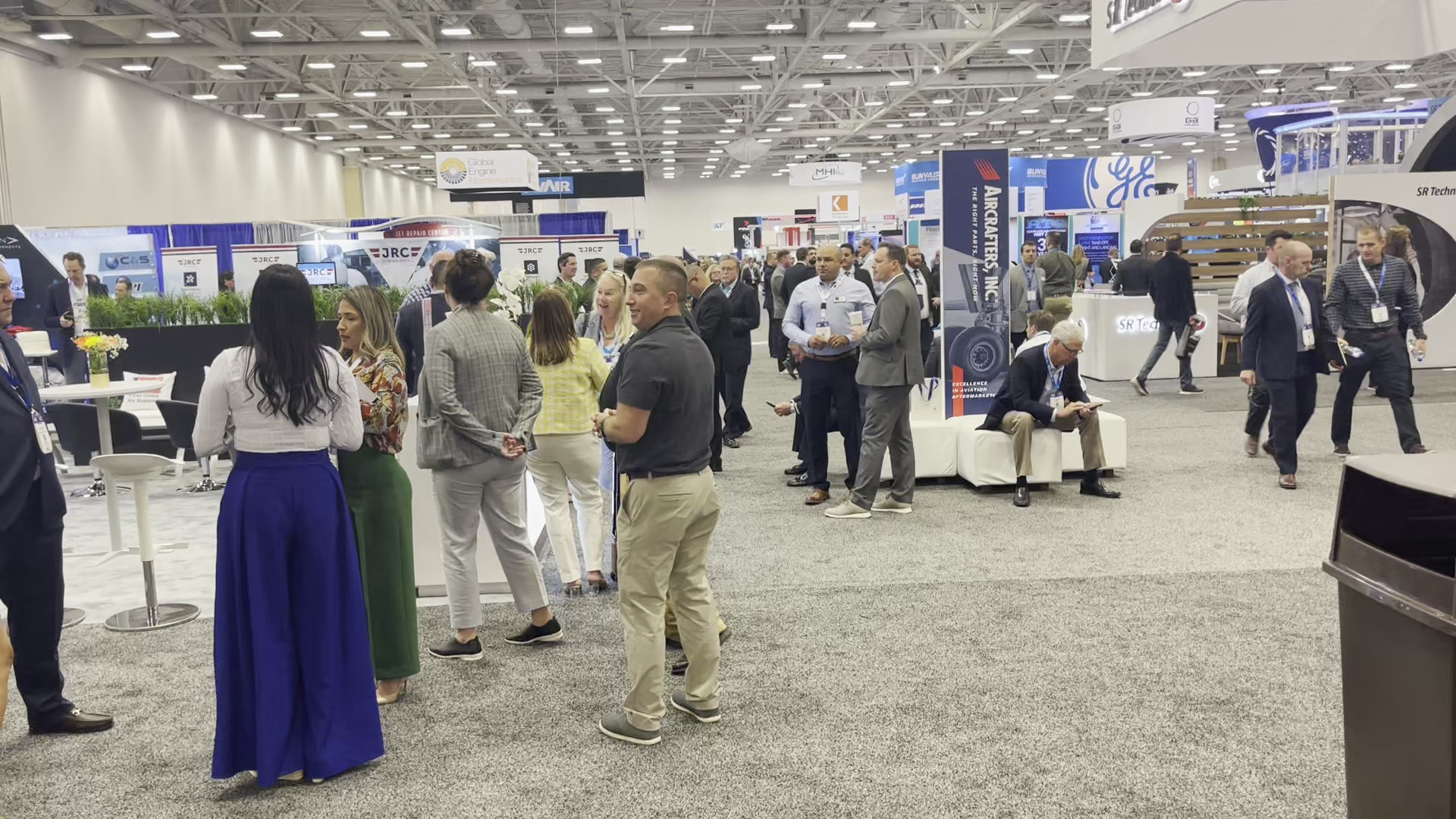
The photograph is full of things competing for attention: suspended signs, bright display walls, flowers, aircraft-parts branding, and people wearing the inevitable lanyard. Then there is the man on the white sofa, looking at his phone. It is a useful reminder of what an exhibition actually needs to accommodate. Some visitors want a demonstration. Some want a conversation. Sometimes, somebody just needs somewhere to sit.
That photograph, featured on JWI’s website, offers a better introduction to the company than a glossy slogan. The Santa Ana business designs exhibition stands and supports the machinery around them. Its customers operate in aviation, aerospace, defense, and technology. They arrive with something complicated to sell. JWI’s assignment is to help give that business a functioning address for the duration of a show.
The booth is the visible part
JWI groups its offer into booth design, exhibitor services, chalet design, and event planning. It advertises fabrication, printing, shipping, installation, dismantling, audiovisual sourcing, and furniture rentals. That scope puts the attractive object and the practical arrangements in the same assignment. Hotels, transportation, lunches, and receptions can join the brief, too.
The commercial logic is straightforward. An exhibitor can commission individual suppliers and manage the connections itself, or give a broader brief to a company offering coordinated delivery. JWI sells the latter approach. Its value proposition depends on how much work disappears from the client’s own to-do list, as well as what appears on the exhibition floor.
Consider a hypothetical display screen. Someone must decide where it goes, what it plays, how visitors see it, and who makes sure it works. A drawing answers only some of those questions. Treating them as one assignment is the practical appeal of a full-service brief. It also gives the buyer a useful test: ask who owns each decision before approving the picture.
- 01DefineAudience + purpose
- 02DesignSpace + identity
- 03DeliverFreight + installation
- 04OperatePeople + support
Editorial illustration of a project brief, not a measured timeline.
A website, a rebrand, then the show
A public recommendation for Jennie Wright, JWI’s president, supplies a more specific example of the company’s reach. Alex Thagard describes Wright working with Aero Turbine on website creation and rebranding, then extending that work into social media and trade show marketing. The account places JWI inside a connected marketing assignment, with the exhibition as one expression of the business.
“She brought a new focus and perspective,” Thagard writes. The useful detail is the sequence. A company deciding how to explain itself online has already begun making decisions that will affect its physical presentation: what to emphasize, how to describe its work, and what a prospective customer should remember.
For a buyer, that suggests a question worth bringing to an exhibit briefing: which brand decisions are already settled? If the website and sales material tell different stories, a stand designer inherits the disagreement. Sorting it out early gives the physical space a clearer job. This is an editorial lesson from the described assignment, rather than a claim about a measured sales result.
“Every detail will be considered with a keen eye on the budget.”
Ben Lamb, public recommendation for Jennie Wright
Another recommendation, from Ben Lamb, emphasizes organization and attention to cost. Both testimonials describe the working relationship. Their most concrete contribution is to show what these customers valued: guidance across connected tasks and someone paying attention to the details. That is a more useful purchasing signal than simply admiring a finished wall.
The small things have their own storefront
JWI also maintains a LinkedIn showcase for its online store. The offer includes custom branded products, company stores, and product and logo management. An exhibition stand and a promotional item occupy very different amounts of space, but both carry a company’s identity into somebody else’s field of view.
That connection makes the merchandise business relevant to the broader story. A marketing team may want the same approved identity on a display, a handout, and something visitors take home. Managing those decisions together can be useful even when the physical products come from different production processes. Consistency begins with an agreed brief.
The sensible buying question is what each item is supposed to accomplish. A product that helps explain the business has a different purpose from a gift intended to thank an existing customer. Before ordering either, decide who receives it and why. A cupboard full of branded objects is an inventory, not evidence that the event worked.
Follow the calendar, find the customer
The company’s public calendar gives its market focus a geography. Its September 2026 listings include GSE Expo Europe in Lisbon, CAMX in Atlanta, and MRO Asia-Pacific in Singapore. These are calendar entries, not a list of confirmed client contracts. Read together, however, they describe an orbit around industrial audiences with specific equipment, materials, and operational interests.
The Lisbon listing concerns airport ground-support equipment. The Singapore entry concerns aircraft maintenance, repair, and overhaul. CAMX brings composites and advanced materials into the picture. A ground-equipment supplier and a materials specialist may both buy exhibition space, but a useful conversation at their stands starts with different questions. Industry familiarity has value when it helps a brief recognize that difference.
Published listings. Attendance and client assignments are not implied.
Later listings sharpen the defense connection. C-130 TCG concerns the operation, maintenance, and modernization of a particular aircraft fleet. The Airlift/Tanker Association Convention centers on air mobility. I/ITSEC brings modeling, simulation, training, and education technologies into the schedule. For an exhibitor, the relevant audience is more precise than the broad label “business travelers.”
There are signs of a wider industrial remit, too. JWI lists SEMA, the specialty automotive show, alongside its aviation and defense events. The calendar therefore supports a reading of the company as a specialist with adjacent markets, rather than an operation confined to a single kind of aircraft gathering.
Its own recent updates add evidence of activity: JWI reports supporting exhibitors at the 2026 DLA Supply Chain Alliance event, customers at NATE UNITE, and brands at MRO Americas. Those accounts emphasize work on the ground. They fit the company’s position between marketing and event delivery, where a client needs both presentation and execution.
A chalet changes the assignment
Chalet design is a distinctive part of JWI’s offer. The company describes custom structures intended for event hospitality and brand presence. For a prospective buyer, the word should prompt a functional discussion: what happens inside, who is invited, and how the space serves the meeting?
Imagine two briefs. One calls for quick introductions and a demonstration visible from an aisle. Another calls for scheduled discussions with guests who need somewhere to spend time. Those are different uses of space. Choosing the form before defining the encounter risks solving the wrong problem beautifully.
The same reasoning applies to the less architectural parts of an event. A reception can extend a conversation; transportation can help a guest reach it. Each addition should earn its place in the brief. The useful discipline is to connect an expense to a purpose rather than treating hospitality as a collection of impressive extras.
Buy the responsibilities, then judge the result
The practical comparison for a JWI prospect is between buying a broad assignment and assembling one internally. A custom exhibit builder, an event agency, and a team managing separate suppliers may overlap in what they offer. The important distinction for a particular purchase is the responsibility each accepts. Similar-looking renderings can conceal very different scopes.
A buyer can make that comparison concrete with a written schedule of deliverables: the approved design, materials, shipping arrangements, installation responsibilities, event support, and removal. For budgeting, ask which charges are included, which depend on venue or supplier requirements, and how changes are approved. This is purchasing guidance, not a description of JWI’s contract terms.
The brief should also name the person who can approve a change. In an illustrative situation where a display needs a different layout, someone must balance the visual preference against the agreed purpose and budget. Giving that decision an owner helps keep a routine adjustment from becoming a committee meeting. A buyer can copy that discipline whether it chooses JWI or manages the project itself.
There are circumstances in which a narrower assignment makes sense. A team with established suppliers, a simple display, and enough internal time may need only one missing service. A more complicated program can justify broader coordination. The decision turns on the buyer’s capacity and the work required, rather than on whether the phrase “turnkey” sounds reassuring.
Evaluation deserves the same specificity. If the purpose was scheduled customer meetings, count those meetings and record what should happen next. If the purpose was explaining a product, ask whether visitors understood the explanation. These are suggested ways to judge an assignment, not performance figures reported by JWI. They put the buyer’s intended use ahead of the temptation to measure success entirely through photographs.
JWI’s proposition is most intelligible in those practical terms. Bring the company a destination, an audience, a purpose, and a clear allocation of responsibility. Then judge the result by whether the space supports the conversations it was commissioned to host. The photograph may capture the booth. The people using it supply the point.
Explore its services, follow the show-floor updates, or start an event brief.