Julie Wainwright’s friend went to the back of the boutique. There was consignment there: designer goods with previous owners, offered inside a shop the friend already trusted. She bought them. Wainwright, who had never known her to shop that way, began asking questions. Would she use eBay? No. Would she go to a conventional consignment store? Also no. Yet here she was, perfectly pleased with her purchase. The clothes had acquired a different reception without acquiring a different past.
The distinction caught Wainwright’s attention. Her friend worried about counterfeits and disliked the back-and-forth of other resale options. In this shop, the surroundings were attractive, the owner was trusted, and the price made sense. Buying something previously owned could feel like good judgment. The vocabulary of secondhand shopping had changed simply by moving the rack.
Wainwright had been looking for an opening in commerce that Amazon would have difficulty occupying. Luxury was on her map, but she had no intention of designing a luxury label. This purchase supplied something more useful than a clever name: an example of a customer changing her mind under the right conditions. The RealReal would begin in 2011. First, there was the question of how to make that little pocket of confidence work across the internet.
A conceptual sketch of the boutique encounter that inspired The RealReal.
An eye for objects, a head for business
Long before there was a marketplace, there were objects worth keeping. Wainwright grew up in South Bend, Indiana, with artist parents who appreciated beautiful things that had already belonged to somebody. Her mother might admire a rug in someone’s house and offer to buy it when its owner was ready to sell. Ownership could change while beauty remained quite comfortably in place.
Her father’s work brought another kind of lesson home. A commercial artist who designed packaging, he showed the family his projects and explained the problems behind them. A child could see that a visual decision had a practical job to do. Years later, Wainwright would build a company whose appeal depended on presentation and whose survival depended on everything happening behind it.
At Purdue, she initially considered pre-pharmacy before switching to business. She graduated in 1979. The curriculum gave her finance, accounting, statistics and consumer psychology; art classes supplied another outlet. There was also a summer on a General Motors assembly line, riveting bumpers for Chevrolet Monte Carlos to help pay for college. It is an unusually literal entry in a founder’s education: before building a business, she helped assemble the merchandise.
Clorox gave her training in consumer marketing and profit-and-loss statements. Then she saw an Apple II running VisiCalc turn laborious calculations into quick scenarios. The appeal of software was immediate and concrete. Here was a way to do work differently. She moved into the young software industry, later leading Berkeley Systems and, in 1997, Reel.com. Her career crossed from household products to computer software to online commerce. Each move put her closer to the customer’s decisions.
The sock puppet that followed her home
In 1999, she became CEO of Pets.com. Its sock puppet mascot made a memorable appearance in the national conversation, including a Super Bowl advertisement. The business went public in 2000 and closed later that year during the dot-com collapse. For Wainwright, its recognition was an unpleasant advantage. People could remember the joke long after they had forgotten the balance sheet.
She has described reporters turning up at her home and following her car. On the morning the company was to close, her husband asked for a divorce. The professional failure and the personal rupture arrived together. Any tidy account of reinvention ought to leave enough space for the time when there was no replacement company, no new milestone, and no convenient ending in sight.
A recruiter later told her that her prospects were exhausted. Wainwright’s account of that exchange is blunt. She had skills, she wanted to work, and the opportunities being offered were unappealing. Eventually she decided to create the job she wanted. It took years to get from the collapse to The RealReal. The gap matters: a comeback sounds brisk when the calendar is edited out.
She also came away with a changed relationship to public failure. Having endured it, she found it less frightening to risk it again. That did not make the next venture certain. It did give her room to try something whose oddness required explanation. Someone who had already been dismissed could spend less time making herself look plausible to the people doing the dismissing.
- 2000Pets.com closes
- 2011The RealReal begins
- 2019Nasdaq debut
- 2022Leaves leadership
- 2025Publishes memoir
Sixty pieces and a difficult promise
The boutique purchase landed on prepared ground. Wainwright had been examining competitors, markets and the kinds of products that might resist an easy copy. After seeing her friend buy consignment, she tested existing resale platforms and investigated the market. She also looked in her own closet. There were 60 designer pieces she had never worn or had stopped wearing. The proposed business had a supply problem, and part of its supply was already hanging at home.
Her observation was straightforward: “If she’ll do it in the right environment, anyone will.” The work hidden inside that sentence was considerable. A shop owner can reassure a regular customer face to face. A website has to give people reasons to trust an item they cannot touch, sold by a person they will never meet. A photograph can show a bag. It cannot, by itself, settle all the questions a buyer has about the bag.
The RealReal offered to handle the sale: take possession of consigned goods, assess them, present them and send them to buyers. For a seller, that removed chores as well as uncertainty. A wardrobe full of unused pieces does not automatically become a shop. Someone has to do the photographing, describing and pricing. Wainwright built a business around the distance between wanting an item gone and wanting to become its retailer.
The company began at her home in Marin County and shipped its first orders in June 2011. Its first venture investor arrived after an initial period backed by angels. She was returning to e-commerce with experience of how quickly a business could become famous. This time, the unfamiliar proposition needed to be tested through transactions. Getting somebody to consign mattered as much as getting somebody to click.
“Don’t let others define your success or your life.”
Julie Wainwright
The clothes had to move
A resale marketplace accumulates physical differences. One coat comes in a particular size and condition; another has a different history. A watch asks different questions from a handbag. The RealReal’s model required expertise alongside storage, photography and shipping. The business sold convenience, but it had to manufacture that convenience out of many separate tasks.
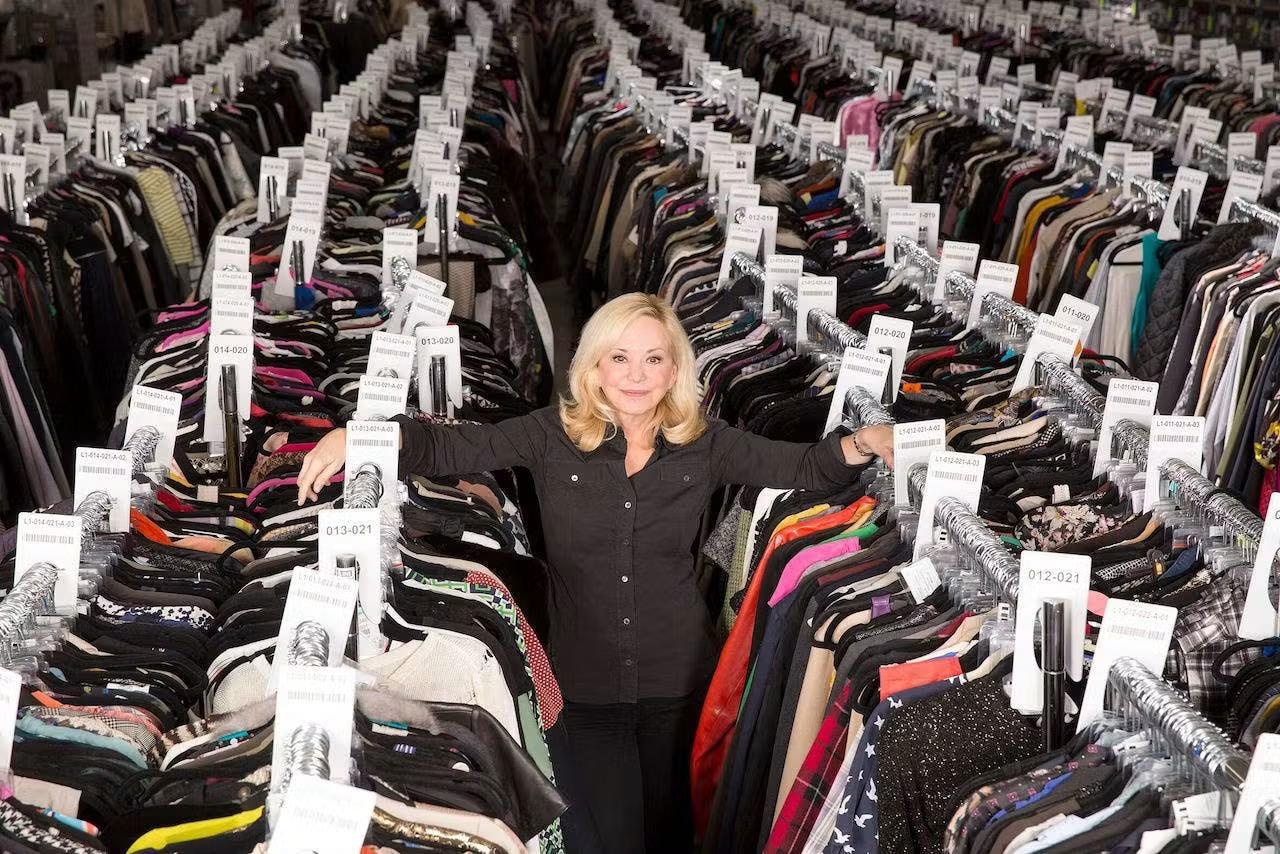
The photograph of Wainwright among the racks is a useful corrective to the word “online.” There are rows of clothes, hangers and labels. Every object has to be located and handled. The attractive image on a screen is the visible end of work that takes place in a building. The web address was short; the rows of hangers were long.
Authentication made the undertaking more demanding. The company employed specialists in brands, jewelry, watches and art. At the time of its 2019 listing, the company acknowledged the possibility of missing counterfeit goods. That tension belonged to the original promise. Trust had brought the friend to the boutique; trust now had to survive the volume and variety of a growing business. It could be damaged by an individual item.
The financial picture carried a similar complication. In 2018, The RealReal reported $207.4 million in revenue and a $75.8 million net loss. Sales growth and profitable operations were separate achievements. A company could prove that customers wanted the service while still having work to do on the cost of providing it. The numbers make the story more interesting than a procession of larger wardrobes.
Wainwright also needed relationships with an industry accustomed to selling new things. In 2017, The RealReal announced a partnership with Stella McCartney. Here was a designer openly supporting customers who resold her products. The relationship gave resale an ally inside luxury fashion and connected the company’s commercial work to a longer life for clothes. Persuading people to release their possessions required persuasion in more than one direction.
Bar lengths show reported magnitudes on the same scale. Net loss is shown as a positive magnitude; these are different accounting measures.
A bell, a board, and unfinished business
The RealReal began trading on Nasdaq on June 28, 2019. Wainwright had taken the company from a home-based start to a public listing in eight years. That is a milestone with an excellent photographic vocabulary: a bell, a ticker, people celebrating. The next part of running the company was considerably harder to put in a frame.
Her later reflections spend time on hiring and boards. She has argued that a startup needs people who can collaborate, accept responsibility and solve unfamiliar problems. She has also said that, when recommending new board members, she failed to apply the same attention to shared values that she used when hiring employees. In her account, expertise alone did not ensure that directors understood the company’s way of working.
Those are her retrospective judgments, and they complicate the familiar founder story. Building an organization also means deciding who gets authority inside it. A person can know a function well and still disagree with the culture in which that function operates. For Wainwright, the lesson extends beyond recruitment: choosing the people who oversee a company deserves the care given to choosing the people who run it.
She stepped down as CEO, chairperson and director on June 7, 2022, remaining an executive adviser through the end of that year. The company she founded continued without her at its head. In 2025, she published Time to Get Real, combining memoir with lessons about building businesses. The title suits someone whose career has provided plenty of occasions when a polished version would have been easier to tell.
Objects keep their value. People can, too.
The later chapter reaches beyond resale. Wainwright supports scholarships, including at Purdue and Parsons, and has invested in Bay FC, the women’s professional soccer club. She joined the Museum of Contemporary Art’s Board of Trustees in January 2024. These interests follow recognizable lines through her life: education, opportunities for women, and the value of looking closely at things.
She continues to speak publicly about entrepreneurship. A March 2026 podcast appearance returned to her childhood, work, failure and the start of The RealReal. Her own public presentation now makes room for the author and speaker alongside the founder. There is a practical ambition in passing on what happened, especially the decisions that looked different after their consequences arrived.
The boutique scene remains the useful place to return. Her friend already wanted beautiful clothes. She already liked a good price. The change came from a setting and a seller that made the purchase feel dependable. Wainwright noticed the conditions around the transaction, then spent years building an organization to reproduce them. A piece could keep its appeal after someone else had worn it. A career could keep its usefulness after someone else had written it off.