A handbag is an awkward sort of asset. It can cost more than a car, inspire more conversation than a painting, and still arrive at the secondhand counter without the ordinary courtesy of a dependable price. The boutique knows what it charged. The owner remembers what she paid. The next buyer has opinions. Between them sits a fog of taste, condition, scarcity and nerve.
Charles Gorra saw the fog and reached, almost reflexively, for a spreadsheet. He had the correct résumé for such an impulse: HEC Paris, mergers and acquisitions at Goldman Sachs, private equity at TPG Capital, then an MBA at Harvard Business School. He did not come to handbags through sketching or styling. He came through valuation - the useful, unromantic business of deciding what something is worth.
The curious part is that luxury itself was not foreign territory. Gorra was born and raised in Monaco, where the supply of Hermès, Chanel and Louis Vuitton can make Fifth Avenue look restrained. He later joked that there were probably more of those bags there than anywhere else in the world. Monaco taught him the customer; finance taught him the arithmetic. Rebag would eventually join the two.
01 · The useful detourThe unpaid job that changed the expensive one
In 2012, Gorra paused the banker’s life and moved to the United States for Harvard. The timing was helpful. Uber and Airbnb had made access, sharing and temporary possession sound less like compromise and more like progress. Through the business school network, he met Rent the Runway founders Jennifer Hyman and Jenny Fleiss. Then he took a summer role there. It was unpaid.
For a person who had spent years around elaborate financial incentives, the arrangement had one excellent feature: a clear view. Gorra watched customers embrace circular consumption, and he watched the machinery required to make it work. Clothing rental meant sizes, returns, repairs and a formidable cleaning operation. The dress had glamour; the dry cleaner had the invoice.
The lesson was not that reuse failed. It was that the object mattered. Handbags were high in value and low in logistical drama. They had no sizes. They were easy to ship. Classic models moved slowly through fashion’s weather, and age could add appeal rather than merely wear. For a second-year Harvard project, Gorra built a prototype resale site and tried digital marketing. The school exercise acquired a name in 2014: Rebag.
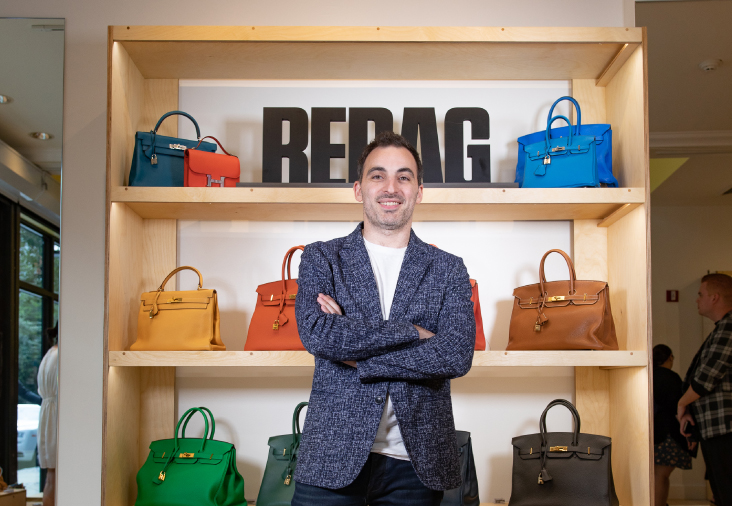
02 · The wagerBuy the bag before finding the buyer
Rebag’s original proposition was not simply another place to list a used accessory. The company would purchase the item, authenticate it, photograph it, price it, hold it and sell it. A customer did not need to manage messages or wait for a stranger’s decision. Rebag offered an immediate route to cash and assumed the inventory risk itself.
That distinction made the experience simpler and the business more difficult. Peer-to-peer platforms can let sellers carry the waiting. Consignment businesses can pay after a sale. Rebag put its capital on the counter first. Each bag was a separate SKU; each needed inspection; each occupied shelf space and money until someone wanted it. Gorra later described the operation with a financier’s candor: low margin, high effort.
He was not complaining. He was naming the puzzle. Trust is expensive to manufacture and difficult to automate, especially when the average order was about $2,000 in 2021. A handbag may be small, but its transaction contains a crowd: seller, buyer, authenticator, photographer, warehouse worker, customer-service agent and the algorithm asked to give all of them a sensible number.
Why bags worked · an editorial reading of Gorra's category logic
03 · The machineClair makes the private haggling public
The company’s most characteristic product is called Clair, short for Comprehensive Luxury Appraisal Index for Resale. Rebag introduced it in 2019 after years of collecting information about brands, models, demand and sale prices. A seller could identify a bag and receive an estimated value without beginning the old ritual of sending photographs into the void and waiting for a person to answer.
Clair AI added image recognition; Clair Trade let shoppers apply the value of what they owned toward what they wanted next. In 2021, Gorra said the software could handle roughly 80 percent of inquiries for handbags, with watches and jewelry still being developed. One in five users had tried the trading feature. The numbers change as products do, but the intention has remained consistent: turn a closet into legible purchasing power.
There is something faintly comic about subjecting the aura of a Birkin to a valuation engine. There is also something inevitable. Cars have reference prices. Houses have comparable sales. Financial markets print a number every second. Luxury resale had long treated uncertainty as part of the décor. Gorra treated it as a customer problem.
04 · The distribution yearsFrom a private doorway to everybody else's mall
Rebag expanded from bags into accessories, watches and fine jewelry in 2020. It raised a $33 million Series E at the end of 2021. Then its model grew less doctrinaire. Consignment arrived in 2023, giving sellers another choice beside immediate buyout and trade. Rebag+ followed in 2024. The company that had made its name by managing the whole transaction began assembling more ways into it.
The larger strategic shift concerned where customers found the inventory. Physical shops had supplied confidence and convenience, but excellent retail addresses are excellent at charging rent. Gorra has spoken plainly about the expense, staffing and security complications. Rather than plant a Rebag store on every desirable corner, the company began borrowing doors that were already open.
Bloomingdale's adds an integrated Rebag buying and selling experience in selected stores and online.
Walmart launches Luxe Resold with Rebag inventory on its marketplace.
Rebag announces new outlet stores and placement in five Walmart locations.
Nearly 30,000 Rebag items enter Amazon's Luxury Stores.
The sixth Clair Report tracks value retention amid tariffs and changing luxury demand.
Bloomingdale’s offered the department-store customer. Walmart offered a mass-market audience and tens of thousands of listings. Amazon approached Rebag about bringing nearly 30,000 pieces to Luxury Stores. The direct business remained central, but these partnerships supplied a new kind of scale: Rebag could meet shoppers inside larger habits instead of insisting that every shopper first acquire a Rebag habit.
This is less a retreat from exclusivity than a distinction between product and process. A rare watch may stay rare when listed on Amazon. The path to it need not be. Gorra’s recurring phrase, “making resale ubiquitous,” sounds grand until translated into operations. It means accurate catalogs, synchronized inventory, authentication, quick shipping and a return policy that does not panic when the object costs five figures.
05 · The quiet ambitionMake secondhand ordinary, keep luxury peculiar
Gorra has described his mission as making secondary behavior the standard for luxury goods. The word “behavior” is revealing. He is not merely asking people to admire circular fashion; he wants them to act differently. Buy with future value in mind. Check the number. Trade one object for the next. Regard the closet not as a final resting place, but as a portfolio with handles.
His own career has the same practical restlessness. Paris and London finance gave way to a New York startup. A rental internship became a resale thesis. A handbag buyer became a technology builder, a consignment service and a supplier to much larger retailers. The company has changed its methods more readily than its question.
The question remains: what is it worth? In luxury, this can sound almost vulgar. Worth is meant to shimmer somewhere above price, protected by heritage, scarcity and a very patient sales associate. Gorra’s contribution has been to insist that romance and arithmetic can occupy the same shelf. The bag may carry a story. It also carries a market value, and somebody ought to say it aloud.
That candor may be the most personal thing about the company. Gorra speaks readily about the hard parts: inventory consumes cash, shops are costly, every item demands individual labor, and the American market offers enough room without the decorative distraction of overseas expansion. The ambition is large, but the sentences are usually operational. Even his sustainability case begins with convenience. People are more likely to extend an object’s life when doing so is easy, quick and financially intelligible. Virtue helps; a prompt quote helps more.