Julia Nimchinski remembers an early startup job beginning with a collection of bewildering email threads. She had expected to be the lead marketer. Then she discovered there was already a CMO, in Greece. The organization chart, apparently, had been keeping a little something to itself.
It is a small workplace comedy with a useful consequence. The employee was expected to perform before the company had explained the performance. For Nimchinski, who built her career in B2B marketing, that distance between responsibility and instruction became a business problem worth pursuing. Her eventual company, Hard Skill Exchange, would offer people access to practitioners who could help them work through the particulars.
Today, her LinkedIn profile places her in New York and describes her as the founder and CEO of an AI-native marketplace. The subject matter around her has changed: autonomous agents, enterprise architecture, the future of revenue teams. The original predicament remains recognizable. Somebody has a difficult job to do. The available advice needs to survive contact with it.
A qualification is only the beginning
Nimchinski holds a master’s degree in interpretation. Her professional credentials also trace a sustained interest in learning: HubSpot’s inbound certification in 2015, a Google Analytics qualification in 2017, and several Reforge programs in 2021 and 2022. These are separate pieces of her education, acquired at different points, rather than a single founding credential.
Her account of entering marketing involves teaching herself to write B2B content and moving into senior product marketing work in the Salesforce ecosystem. By 30, she had become a CMO. The achievement belongs alongside the friction that preceded it. She had learned enough to advance, while becoming increasingly aware of how much effort went into finding usable instruction.
That distinction matters for the business she went on to build. A person can understand a concept, pass an assessment, and still face a problem whose messy details were absent from the lesson. The practical question is who can help when the assignment arrives with its own customer, deadline, politics, and exceptions.
Her public writing keeps returning to that practical level. As founder and editor of GTM Mag, she published work on revenue growth, sales enablement, and coordination across the executive team. Go-to-market, usually shortened to GTM, covers how a business reaches customers and turns its offering into revenue. It is a field with plenty of vocabulary. Nimchinski’s work repeatedly asks what people actually do with it.
- 2022GTM Mag writing and a Wiley book
- 2023GTM Games and practitioner-led learning
- 2025AI practice sessions and GTM testing
- 2026AI methodology and enterprise architecture
Please step into the other department
With Justin Michael, Nimchinski developed GTM simulations under the HYPCCCYCL name. Sales and marketing leaders could cross-train, with venture capitalists participating in the format. The setup gave familiar arguments between departments somewhere more productive to go. Participants had to apply their thinking, while other people could examine the result.
Marcus Cauchi’s February 2023 podcast introduction described the GTM Games as a competitive exercise involving coaching, judging, and disqualification. That last word gives the format some bite. A webinar lets an audience member remain elegantly uncommitted. A simulation asks for a move, which can be discussed, challenged, or rejected. The learning has something visible to attach itself to.
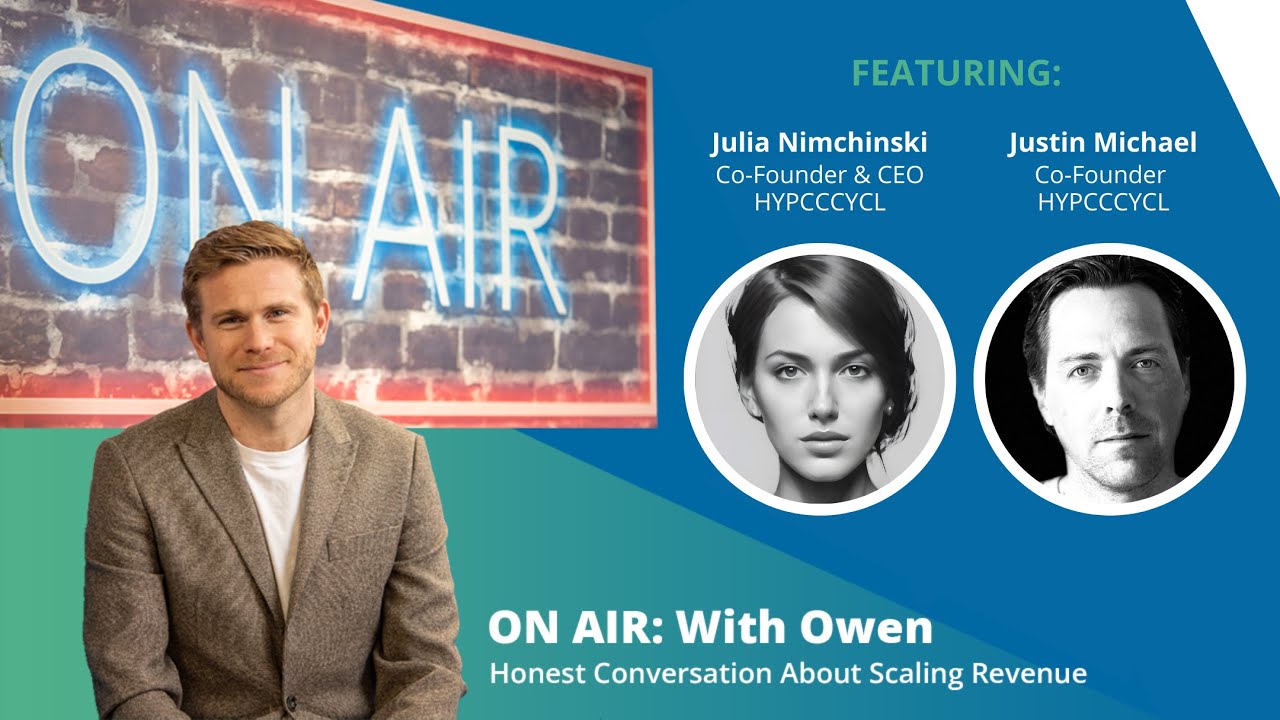
When Nimchinski and Michael appeared on Owen Richards’s ON AIR in February 2023, the conversation included salespeople learning from marketers and marketers learning from salespeople. Their agenda covered collaboration, customer-centered events, and generating business through virtual gatherings. It reflected a recurring concern in her work: the departments may have different names, but they are trying to reach the same customer.
The pair also put their event thinking into a book. Wiley published Reinventing Virtual Events in December 2022. Its subtitle promises a route from ghost webinars to hybrid go-to-market simulations. Even without the subtitle’s enthusiasm, the premise is clear: give an audience a reason to participate. A registration form is a modest beginning for a relationship.
The marketplace behind the microphone
Hard Skill Exchange gives the learning idea a commercial structure. Its current website lays out a sequence: identify a skill, work with an operator who has deployed it, then apply the insight and contribute knowledge back. Coaching, mentorship, consulting, and strategic review are among the ways it describes that work. The problem a participant brings is meant to shape the encounter.
There is a useful editorial parallel here. An editor commissions someone because that person knows something specific. Nimchinski’s marketplace similarly places weight on experience with the task. The value depends on the fit between a person’s question and another person’s working knowledge. Access by itself is only the opening of the door.
Her August 2023 Markigy appearance explored market research through conversations and human connection. The episode’s description framed her ambition around learning from capable professionals, rather than selecting teachers through social popularity alone. For a founder whose business involves assembling people, that is a consequential distinction: a large audience and a useful answer are different measurements.
Her attention also extends to how the work looks. In Reinventing Virtual Events, the authors credit Nimchinski with choosing a stark black-and-white identity, extending it to video highlights. The detail is pleasingly concrete. A founder concerned with making participation work also cared about the visual experience around it. Even an argument against forgettable webinars needs a recognizable jacket.
“Make your skills your greatest asset.”
Hard Skill Exchange’s slogan, as described by Nimchinski
Five questions before the launch
In January 2025, Nimchinski published a GTM testing article organized around five questions. Who is the customer? What problem does the product solve? How is its value communicated? Which channels reach that customer? How will performance be evaluated? The questions are ordinary enough to be easy to underestimate.
Together, they require a team to connect its assumptions. A claim about the customer should have consequences for the message. The message should affect the choice of channel. The measurement should reveal whether the whole effort is working. A beautifully answered question can still sit beside four unanswered ones.
This is also a useful way to read her interest in simulations. A test gives an argument some resistance. It creates an occasion to discover that colleagues mean different things by the same word, or have different ideas about what success would look like. Finding that out before a launch is an economical form of embarrassment.
For Nimchinski, the teaching, publishing, and event work can be read as related attempts to bring those assumptions into view. That is an interpretation of the pattern across her projects, rather than a claim that every project has followed an identical plan. The shared concern is practical judgment: how someone chooses a course of action when a framework leaves room for doubt.
When the learner becomes an agent
By March 2025, her event conversations were addressing AI’s effect on the business of marketing. In a session with Sangram Vajre, she pressed on distribution, network effects, and the difficulty of maintaining consistent positioning while technology changes. Those questions go beyond producing another piece of content. They ask how a business keeps reaching people and remaining recognizable.
Another practice session, with Jonathan Milne of Demand Spring, used live examples for marketers to try. The agenda included search, advertising, and sentiment analysis. A demonstration can go wrong in public, which is part of its usefulness. It exposes steps that disappear when a finished outcome is presented on a slide.
Her 2026 foreword to In Pursuit of AI Methodology sharpened the commercial question. AI could create value in separate business functions, she argued, while still failing to become a repeatable engine of growth. She called for a method of entering markets that could carry experimentation toward sustained adoption. The aspiration had moved from helping an individual execute a skill to helping organizations understand how new capabilities become viable business.
The events continued in that direction. HSE’s calendar records the Agentic OS summit in March 2026, Agent-to-Agent GTM in June, and Agentic Harness in September. The changing titles trace an expanding set of questions about the systems around AI. They are event milestones, rather than evidence that every forecast discussed onstage has come true.
In June 2026, Nimchinski joined Art Robbins’s Leadership Art Podcast for a conversation about AI and leadership. The episode centered on vision, guardrails, and the need for organizations to find an approach suited to their own circumstances. For someone selling access to expertise, the idea leaves room for an honest complication: expertise still has to be applied by the person receiving it.
At September’s summit, she introduced a discussion with Foundation Capital’s Jaya Gupta, moderated by Seth Marrs, about context graphs and enterprise learning. The conversation examined the reasoning behind decisions that ordinary business records can miss. It brought her original interest in working knowledge into a new setting: how organizations preserve the explanations that make an action intelligible.
Her own conversation with Floodgate’s Mike Maples Jr. that month explored differentiation and durability as AI makes capabilities easier to reproduce. She asked how startups could stand apart from both new rivals and established companies. These were questions to a guest, not a claim that she had already solved the problem. Her role was to keep the discussion moving toward the difficult part.
“2026 marks the transition from creative chaos to methodology.”
Julia Nimchinski, In Pursuit of AI Methodology
The young marketer faced email threads without instructions. The founder now convenes discussions about systems that might carry out increasingly complicated work. Across that distance sits a persistent interest in the explanation behind the result. Nimchinski has built a business around making people available to give it. The software has become more capable. The next question has become more interesting.