Josh Ginsberg remembered the room: ten young staffers, televisions, Google News searches, TweetDeck. They could find mentions of a candidate or a company. Then came the emails. What they could not reliably supply was the answer to his next question. Was this story gathering force? Should anyone do something about it?
There is a peculiar inconvenience to being well informed in that fashion. You know enough to interrupt your afternoon, but perhaps too little to improve it. A mention arrives dressed as an emergency. Another follows. The inbox becomes an extremely diligent colleague with no sense of proportion.
That frustration sits at the beginning of Zignal Labs, the company Ginsberg co-founded in 2011. It also gives his career a through line. Before software, there were presidential campaigns and public affairs. After running Zignal came Facebook, now Meta. Across those jobs, the same practical concern keeps appearing: how does an organization understand the conversation around it in time to make a useful decision?
A field organizer’s education
Ginsberg studied political science at Vanderbilt University, attending from 2001 to 2005. His early career included work on the Bush-Cheney presidential campaigns of 2000 and 2004. He later became national field director for Mitt Romney’s 2008 presidential campaign, managing a grassroots operation spanning more than 30 states.
The field director’s job puts a different meaning on the word audience. People are scattered across places, schedules, and loyalties. Reaching them involves organization as well as persuasion. A message that looks handsome at headquarters must survive contact with people who have errands to run and their own reasons for caring.
His political work also included serving as Arnold Schwarzenegger’s political director and managing Chris Dudley’s 2010 campaign for governor of Oregon. He worked in public affairs, including at Mercury Public Affairs. The progression brought national campaigns, a California political operation, and a statewide Oregon race into the same professional education.
A campaign supplies an unforgiving test of communications. Its calendar has an ending. An explanation delivered after the decision may be perfectly eloquent and perfectly useless. Ginsberg’s later business can be read as an attempt to make information arrive while there is still something to decide.
A war room with a business model
Ginsberg founded Zignal with Adam Beaugh and Jim Hornthal. Their starting territory was political media tracking; the business expanded into organizations that needed to understand public conversation across traditional and social media. The war room had found customers beyond the campaign.
The company’s proposition made sense of an awkward division. Television, digital coverage, and social posts might be discussing the same subject, while the people monitoring them worked from separate views. Bringing those streams together offered a way to inspect the whole conversation rather than whichever part happened to be nearest.
In October 2014, Zignal announced a $10.7 million Series B funding round. Existing investors Andy Ballard, Mitchell Cohen, and Hornthal led it. The announcement formalized Ginsberg as chief executive and Beaugh as president and chief product officer, with the money intended to expand leadership, sales, and engineering.
By February 2018, another financing brought $30 million in additional capital, including new investors Blum Capital Partners and North Atlantic Capital. Its customers then included IBM, NVIDIA, Airbnb, Uber, and the Sacramento Kings. That list placed a technology company, a travel platform, and a basketball team within the same commercial argument: their reputations were being discussed in public, and someone needed to understand the consequences.
Company financing, not personal wealth. These are separate rounds, not a claim about total funding.
The public gets a dashboard
In June 2015, Zignal partnered with The Washington Post to support real-time news analysis. The arrangement brought its tools into reporting, where a moving conversation could become part of the explanation offered to readers. Editors working on PowerPost and The Fix were already using the data when the partnership was announced.
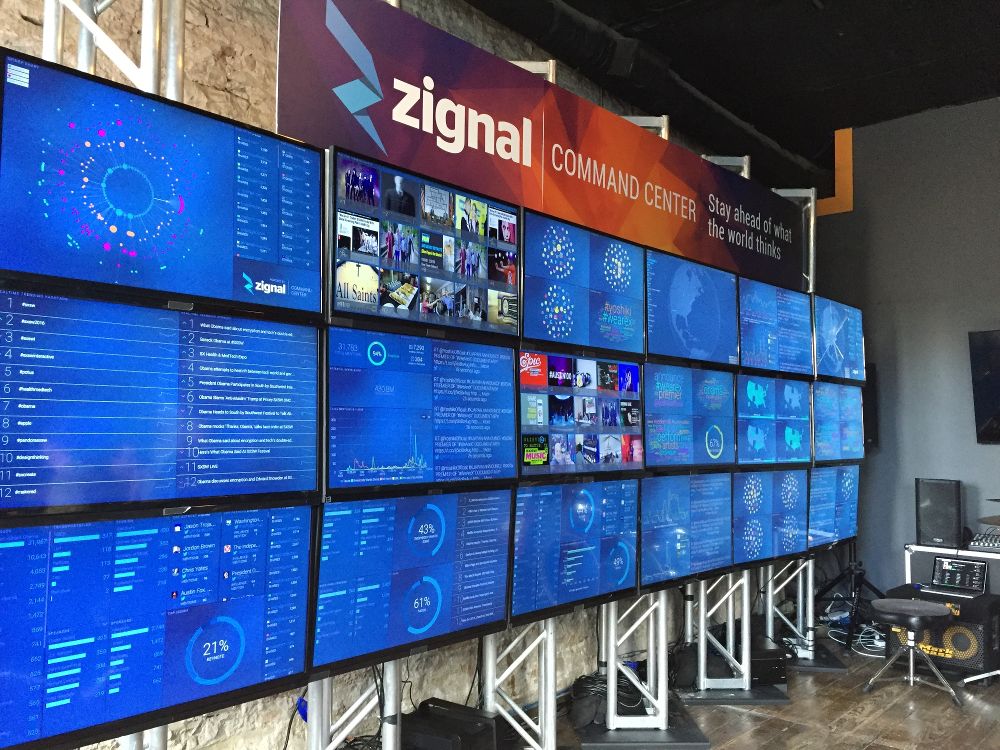
Then the screens acquired a public address. Zignal worked with CNN and the Newseum on an interactive exhibit following the 2016 presidential campaign. Visitors could explore campaign information through touch controls. A process normally associated with offices and campaign rooms became something museum visitors could inspect.
In an April 2016 CNN appearance, Ginsberg discussed the candidates’ share of conversation. Donald Trump accounted for 35 percent in the week he described; Bernie Sanders was at 30 percent. Trump had previously occupied a much larger portion of that attention. Even the commanding presence in the discussion could lose ground as another candidate’s mentions increased.
Those figures describe a particular moment and a particular measure. They are not vote shares. The distinction matters because an attention chart is wonderfully easy to read as a scoreboard. Politics invites that mistake, and a colorful screen can make it more inviting still.
Share of voice in the week discussed on CNN, April 17, 2016. Media attention, not an election forecast. Bars use a 0-50% scale.
The danger of a convenient number
Ginsberg’s published advice contains a complication for anyone hoping the software will do all the thinking. In a 2017 essay, he warned against confirmation bias: using media intelligence to support the conclusion a team already favors. He also cautioned against sounding an alarm simply because conversation volume has risen.
That is a useful admission from someone selling analytics. A tool can organize the evidence, but the person reading it can still choose the flattering part. The old habit of hearing what you wish to hear survives quite comfortably in a new interface.
His advice asked communications professionals to investigate who was speaking, why the discussion was happening, and what action followed from it. The executive needed a recommendation with reasons. A rising line could begin that work. It could not finish it.
The essay makes his approach more interesting than a simple enthusiasm for speed. Fast information can reward a premature response. Good analysis may instead justify waiting, watching, or asking another question. For a profession paid partly to speak, restraint can require its own confidence.
“Define your own narrative. Don’t let other people do that for you.”
Josh Ginsberg
His invitation to contribute an organization’s story also raises a practical tension. Listening means accepting that the public may have already formed a view. A company can supply an explanation, challenge an error, or change its behavior. It cannot assume that an audience owes it the ending it prefers.
When brands enter the campaign
By 2019, Ginsberg was discussing how election arguments could pull companies into the spotlight. Candidates’ criticism of wages, corporate power, and business conduct gave brands a place in political debate whether their communications teams had requested one or not. The campaign calendar could become a corporate concern.
His earlier experience now had another use. A campaign is built to answer political attacks; a consumer business may have customers on several sides of the dispute. Responding requires an understanding of that audience, not merely a crisp sentence approved by the people in the room.
In a July 2019 conversation with Shep Hyken about customer experience, Ginsberg emphasized quick action, authenticity, and consistent communication during a crisis. He placed trust alongside response time. An organization’s conduct before trouble arrived would affect whether customers believed its assurances afterward.
“Be authentic, transparent, consistent, and quick.”
Josh Ginsberg
The word consistent does considerable work here. A company can produce a polished statement in an afternoon. A record of behaving credibly takes longer. Analytics helps an organization see the discussion; the substance of its answer depends on choices made away from the screen.
He also joined the inaugural episode of the As Far As We Know podcast in September 2019 to discuss deepfakes, misinformation, and business. The subject broadened the question again. An organization might need to understand a conversation built around material that was misleading in the first place. Visibility and reliability had to be considered together.
Into the company everyone talks about
On November 11, 2019, Ginsberg joined Facebook as vice president of public affairs marketing. His initial remit included marketing about privacy controls, election security, and enforcement of community standards. Beaugh succeeded him as Zignal’s chief executive, while Ginsberg remained involved as a strategic adviser.
The move gives the career an intriguing turn. He had helped build a company that examined public discussion. He was now working inside a company whose products hosted much of that discussion, and whose own decisions generated plenty of it. The professional questions had become close to home.
Recent professional listings and advertising production credits identify him as vice president of corporate marketing at Meta. The title places his work within the company’s explanation of itself, extending the public affairs role he took in 2019.
Seen together, these jobs suggest a career organized around the space between a message and its reception. Ginsberg has worked on the campaign trying to persuade, the company trying to observe, and the platform trying to explain. Each setting supplies a different view of how little a speaker can take for granted.
The beginning remains a good place to leave him: a room full of people capable of finding the news, and a question their alerts could not answer. A useful communications tool earns its place when it helps someone make the next decision. Otherwise, it has merely found a more elaborate way to say that somebody, somewhere, is talking.