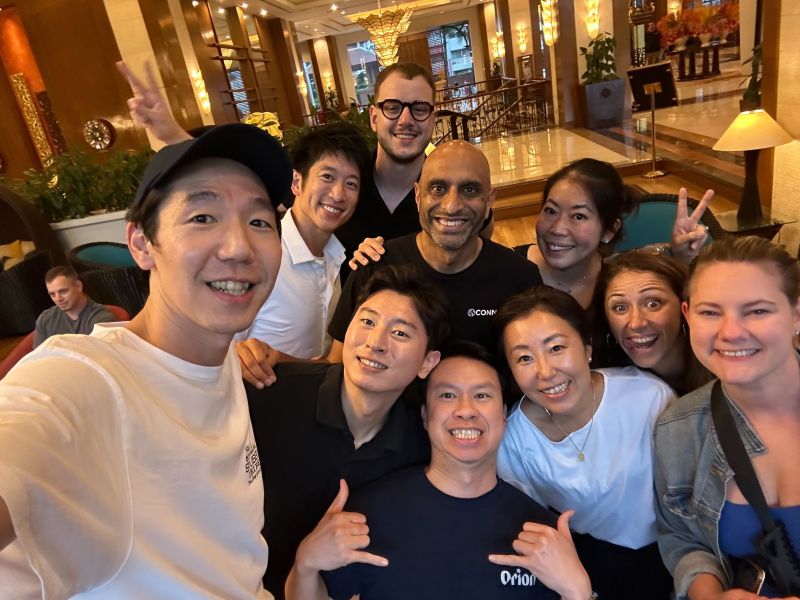
Viresh Chana is in the middle of a group photograph, wearing a black Connor T-shirt. Around him, colleagues lean toward the camera, smile and raise their hands. The setting is a company gathering in Chiang Mai. The picture could accompany a hundred corporate updates. What Chana chose to remember about the week gives it a little more substance: conversations with junior colleagues and people who had only recently joined.
After the gathering in September 2024, he described a firm whose culture extended across 22 countries. He was particularly pleased that employees could express ideas, opinions and concerns. For someone whose businesses deal in the precision of contracts, this was a different sort of accounting. He was taking stock of whether people felt able to speak.
There is a useful way into Chana’s career here. He has built businesses around agreements, data and the people who interpret both. A contract establishes expectations between organizations. A workplace establishes expectations between people. His public reflections suggest that he pays attention to both kinds of promise.
The work after the signature
Chana worked at EY before starting Connor. His professional territory was contract compliance, a specialty that asks what happens after the signatures are collected. A license has terms. A business uses technology or intellectual property. The work is to understand how closely the activity matches the arrangement.
It is an unshowy place to build a career. The vocabulary includes royalties, entitlements, deployments and audits. None would make an especially seductive name for a yacht. Yet each describes something a business needs to understand if it wants its agreements to work as intended. Chana chose the machinery behind the transaction.
Connor began in 2009. The business developed specialist audit and advisory services for enterprises dealing with intellectual property and software. Its remit includes the interests of organizations receiving royalties and those trying to manage the software they buy. There is a practical problem on each side: knowing what the agreement means in daily operations.
In a 2019 joint interview with Rich Reyes, then executive vice president of Software Advisory Services, the founding rationale was unusually concrete. Experienced professionals needed to be closer to clients. The pair described a market where less experienced consultants handled engagements while senior expertise was harder to access. Their alternative was to give clients regular contact with people who knew the terrain.
That is a service design decision with consequences for a founder. Expertise must be available when the problem occurs, rather than remain an impressive line in a proposal. The interview also described investing in tools and technology partnerships. Connor’s answer combined professional experience with ways to gather and interpret information.
Putting the evidence in one place
Chana also founded Ruvixx. The platform addressed a related difficulty: intellectual property teams needed to collaborate, share data and turn information into useful analysis. His work now included the systems through which specialists could investigate a problem, alongside the advisory business that supplied experienced people.
The distinction matters. A specialist can understand a licensing question and still struggle with information scattered across teams and external partners. Ruvixx’s early platform description put that fragmentation at the center of its purpose. Organizing data and projects was part of making the work manageable.
One documented example was the Entity Search application developed with Scalio. The engineering partner worked with Ruvixx’s product and technology teams on an application inside the wider platform. Its case study described a system serving licensing, brand protection and compliance teams, including those at Dolby and HDMI.
Chana’s comments about that engineering relationship emphasized process, communication, quality and creative responses to difficult problems. It is a revealing list because none of those qualities is supplied merely by writing code. They concern how people work together when a technical project becomes awkward.
In May 2016, Ruvixx announced an integration with iTRACE Technologies. The arrangement connected product tracking data with Ruvixx’s incident and case management capabilities. Chana explained the commercial need in terms of understanding product movements inside and outside authorized supply chains, and the connections behind gray-market and counterfeit activity.
A tracking record becomes more useful when someone can place it beside other evidence. An incident becomes more useful when the team can investigate it. That integration gives a concrete example of the kind of business Chana was building: technology to help professionals move from collected information toward a decision.
- 01 AgreementWhat was promised?
- 02 EvidenceWhat happened?
- 03 InterpretationHow do they compare?
- 04 ActionWhat follows?
Conceptual illustration, not a product workflow.
Expertise needs company
Chana’s professional connections extend into the rooms where licensing practitioners compare experience. In August 2018, he appeared on the faculty of an intellectual property and technology licensing seminar in Seattle. His session, shared with StoneTurn partner Neil Zoltowski, concerned managing compliance.
The agenda covered counting royalties, tracking work product, audit rights and other provisions that need attention after an agreement takes effect. Those topics give his career a particular texture. He was working among specialists concerned with the durability of arrangements, the procedures that support them and the questions that appear during enforcement.
Later that year, Connor launched an advisory board and appointed Conroy Shum. Shum brought experience from license compliance work at Dolby, Adobe and Oracle. Chana described the board as a way to bring industry knowledge into the company’s strategic direction. The decision put another circle of experience around the business.
For a specialist firm, advisers can widen the view beyond the immediate engagement. Someone who has run a compliance program inside a large company brings a different perspective from someone examining it from outside. Connor’s announcement made that exchange part of its development.
In November 2019, Connor announced a partnership with Revulytics. The combination linked infringement analytics with Connor’s auditing services and automated engagement processes. Chana described the aim as helping software vendors use infringement data commercially and improve the operation of their compliance programs.
The arrangement continued a pattern visible in his Ruvixx work: find a connection between technical capability and professional practice. Data does not settle its own meaning. A useful business must arrange for someone to examine it, ask the appropriate questions and carry the resulting conversation forward.
A partnership, and a personal thank-you
On May 13, 2025, Connor and The Acacia Group announced a strategic growth partnership. It involved new capital and operational collaboration, with technology and customer experience among the stated priorities. By that announcement, Connor described its team as operating across five continents.
Chana connected the investment to expansion, customer-focused innovations and professional development for employees. Those are commitments rather than completed outcomes. They also show how he framed the opportunity: resources for the business, and possibilities for the people working inside it.
His own announcement included a personal acknowledgment. He said he had started the business with his wife, Sharon Cheng, and credited her contribution to its culture. He called her the “unifying force behind our people.” In an update about an investment transaction, the founding partnership remained part of the story.
“unifying force behind our people”Viresh Chana on Sharon Cheng, May 2025
That acknowledgment adds detail to a familiar founder narrative. The business was built with someone whose contribution he described through the relationships within the organization. A transaction announcement naturally identifies capital providers and financial advisers. Chana also made room for the person with whom he began.
It would be easy to reduce his public priorities to a slogan about culture. The more useful details are smaller: thanking Cheng, remembering conversations with new employees, gathering colleagues together. They show the activities he chooses to emphasize when he talks about what the firm has become.
The next question
Chana’s current work continues at Connor, where he is listed as CEO. Ruvixx’s present leadership page names Ling Xiao as chief executive. The company Chana founded now presents marketing and anti-piracy services as its two principal offerings, retaining an emphasis on combining technology with human judgment.
In June 2026, Chana turned his attention publicly to AI and the changing IP licensing market. He described opportunities for faster service outcomes and pointed to Connor colleagues Tomas Geerkens and David Gettelman ahead of IPBC Global in San Diego. The question had moved with the technology: how could the tools help the work produce a useful result sooner?
His interests outside work include cycling, travel, current affairs and politics, along with time spent with family and friends. The list provides a modest human scale for a career otherwise described through multinational clients and technical services. There are agreements to examine, and there is a life around them.
The photograph in Chiang Mai brings those dimensions together without needing to explain very much. A founder stands among colleagues. The formal subject of their work is compliance. The moment he chose to remember concerned whether people could tell him what they thought. For Chana, the promises made inside the company seem to deserve attention alongside the ones his clients sign.