The idea came on a train. In 1993, travelling from Milan to Genoa and back, Joseph Shamir and Eugenio Cornacchia decided to start a company. Its subject was the sort of problem that rarely improves a dinner party: how to keep the right goods in the right places when nobody knows quite what will happen next. ToolsGroup would spend decades working on it. A return ticket proved an economical starting point for a very long undertaking.
Shamir, also known as Joe or Yossi, became the company’s CEO. Cornacchia brought mathematical and industrial experience to the partnership. They were interested in the uncertainty inside supply and demand, the awkward variations that make a confident forecast less reassuring once an actual customer places an actual order. Their business would help companies decide what to stock, produce and replenish while acknowledging that the future had several plausible versions.
That qualification mattered. A warehouse can contain an impressive amount of merchandise and still be missing the item someone wants. Money and availability are related, but the relationship is hardly romantic. Shamir’s career developed around making it work better.
An education in things that have to arrive
His route into software passed through physical goods. After graduating from Tel Aviv University in solid-state physics, he worked in his family’s spare-parts production and distribution business. He later became an engineer at the Swiss shipping company Norasia, optimizing container lines and logistics. At ITP Group’s Automation division, he held senior management positions including sales director and chief operating officer.
ITP also brought him together with Cornacchia. Their work included industrial automation systems for manufacturers such as Olivetti and Electrolux. Before there was a planning product to commercialize, there were factories, containers and parts to think about. The subsequent software business grew out of those operating settings.
The distinction between the two founders’ contributions is useful. Cornacchia had developed modeling technology through work connected with Draper Labs and Fiat. Shamir helped turn the resulting approach into a business and commercialized Service Optimizer 99+, usually shortened to SO99+. The partnership joined a mathematical account of how demand behaves to the recurring business question of what to do about it.
The trouble hiding inside an average
By 2014, Shamir could describe that question with considerable precision. ToolsGroup took detailed demand information, modeled flows through distribution, production and transportation, and produced operating instructions. What should be replenished? When should it be made? What inventory belongs at each location? These were decisions with trucks and stock behind them.
His explanation gave prediction and uncertainty separate jobs. Estimating demand helped establish what might happen. Understanding the statistical uncertainty around it helped a business prepare for the ways that estimate might fail. A neat number could be part of the answer. It needed company.
Conceptual illustration. The curve shows an idea, not company or customer data.
That is the appeal of service-driven planning. Start with the availability the customer needs, then work through the inventory and flows required to support it. There is a practical discipline here: a forecast becomes useful through the decisions attached to it. Its elegance offers little consolation to someone standing in front of an empty shelf.
Shamir also argued for treating the supply network as a connected system. In a 2010 video discussion of multi-echelon planning, he questioned the habit of modeling locations as independent islands. The demand reaching one end of a network has consequences elsewhere. Separate local plans can obscure the relationship. The map needs the connections as well as the dots.
The promotion has to reach the shelf
Marketing provided a particularly revealing example. In his 2014 conversations with entrepreneur and interviewer Sramana Mitra, Shamir described using detailed promotion information to improve demand modeling. Discounts, dates, channels and the distribution of flyers could all matter. A promotion was a collection of attributes with consequences for what people bought.
The first difficulty was establishing a baseline: what would demand have looked like without the promotion? Only then could the additional demand be separated out and studied. ToolsGroup used historical promotions and machine learning to model the uplift associated with different combinations of attributes. An attractive offer needed a supply plan capable of keeping up.
New products supplied another test. Shamir described an operation introducing roughly 5,000 items a month, with eventual winners accounting for only 4 percent of them. The challenge was to identify those winners early enough to act. His example combined information from earlier launches with web activity before introduction and sales during the first week. He reported 80 percent accuracy in identifying the winners. It was a specific claim about that application, made in 2014, rather than a promise for every new product. The important operational detail was timing: discovering demand after the opportunity had passed would leave a planner with an excellent explanation and an inconvenient pile of merchandise.
His account crossed a boundary that companies often draw between commercial activity and operations. Sales and marketing shape demand; supply chains have to fulfill it. He saw detailed demand analytics becoming useful to both groups. The same information could inform the offer and the replenishment behind it. A flyer is light enough to deliver anywhere. Its consequences may require a truck.
Shamir’s writing had already been pushing in that direction. In 2012, he urged manufacturers to begin using more of the demand data they already possessed, rather than wait to use everything. In 2013, he described forecasting systems struggling to absorb the richer information becoming available through digital commerce, promotions and connected equipment. The opportunity began with making existing information useful.
In 2019, ahead of a supply chain summit where ToolsGroup would present with Lennox, Shamir returned to the probability of demand and the factors shaping it. The setting suited the argument: a customer implementation, an inventory specialist and a discussion of distribution costs and service. He kept tying the model back to an operating result. A planning conversation had to survive contact with the people responsible for making the plan happen.
The phone gets permission. The planner hesitates.
For all the mathematics, Shamir kept returning to organizational behavior. In 2014, he observed that people were willing to delegate more decisions to their phones and mobile devices than companies were prepared to delegate within their operations or marketing. Technological adoption could move from private life into the corporation. The employee’s pocket was ahead of the employer’s process.
Asked to predict the pace of that change, he allowed himself a small escape from the forecasting business. Understanding the technology was one thing; putting a date on the behavior of organizations required another kind of expertise.
“You have to be a social guru for that.”
Joseph Shamir, on predicting the pace of automation, 2014
He nevertheless saw an opening for young e-commerce businesses. Established retailers had routines and a tendency to override automated processes. Newer companies could build automated replenishment into their operations from the beginning. Their comparative freedom came partly from having fewer inherited practices to defend.
He was attentive to the terms of delegation, too. Machine learning, he argued, needed to express the logic behind what it extracted from data if it was to support semi-automatic or automatic decisions. Trust needed an explanation. The conversation placed a human negotiation alongside the technical work: how much authority would an organization give a system, and on what grounds?
Waiting for the customer to catch up
The company’s own history required patience. In April 2014, more than twenty years after its founding, Shamir described ToolsGroup as fully bootstrapped. It had about 85 people and revenue above €11 million. He spoke of surviving difficult market periods and of technology developed years earlier finding a more receptive audience.
Shamir’s figures from his 2014 interview. Historical figures, not current company metrics.
“It’s fully bootstrapped,” he said. The scale is worth pausing over. This was an international enterprise software company being financed through its own work, rather than a new idea awaiting its first customer. His account makes the years between invention and market demand visible.
Outside capital arrived later. In 2018, ToolsGroup received growth equity investment from Accel-KKR. Shamir described the funding as a way to invest in advanced analytics and talent as the business expanded. The financing followed a long operating history.
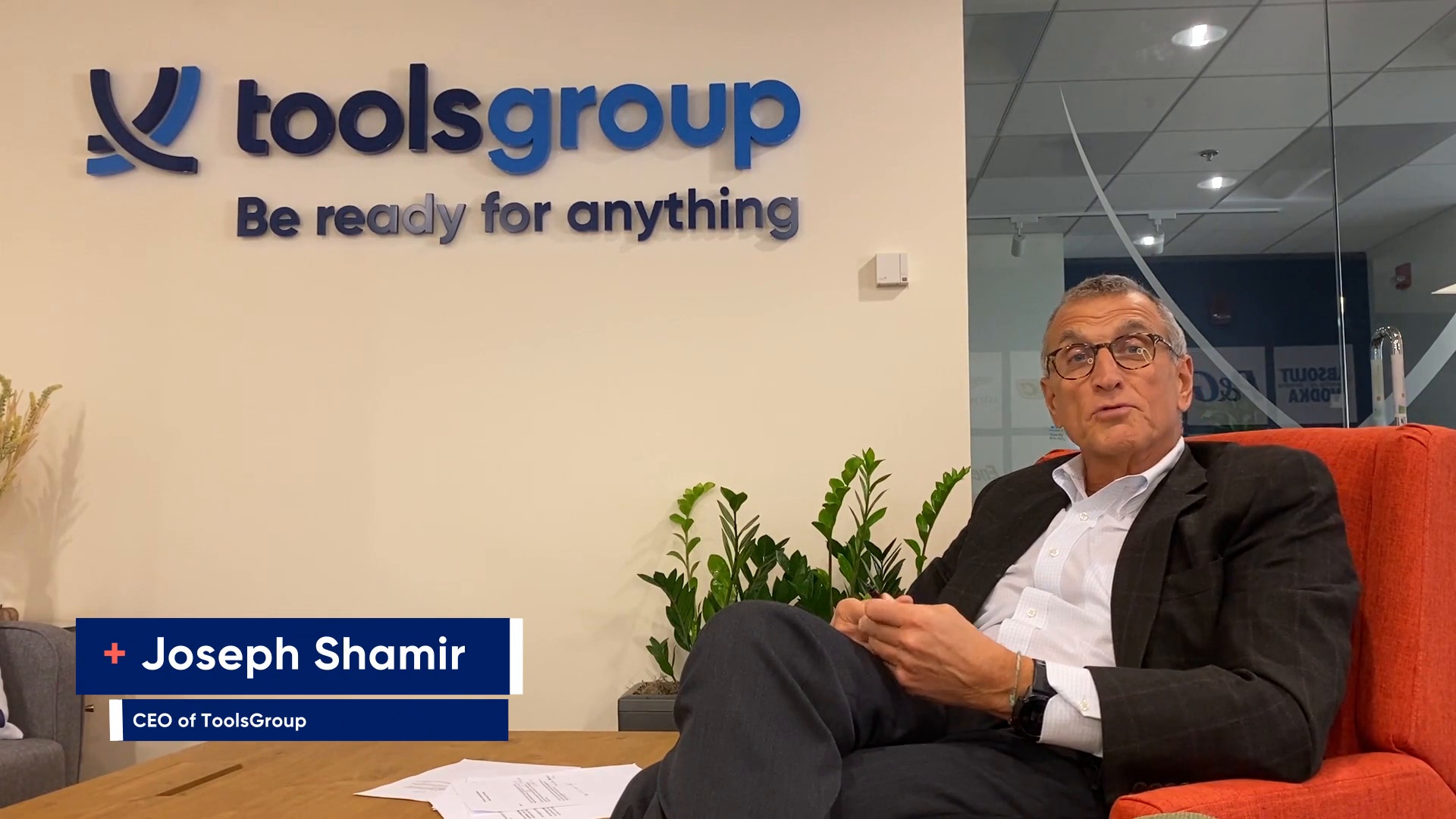
In November 2021, he appeared from ToolsGroup’s Boston offices to explain another expansion: the acquisition of Mi9 Retail’s Demand Management business, previously known as JustEnough. He described the addition in terms of retail planning, multichannel complexity and the connection between upstream supply and the point of purchase. The business was broadening the range of decisions it could help customers make.
A company beyond the founder’s desk
Shamir’s departure as CEO was announced in May and June 2022. Inna Kuznetsova succeeded him, and he continued as a board member and advisor to investor Accel-KKR. “I am grateful to have had nearly 30 years with ToolsGroup,” he said. His public farewell credited the team and welcomed his successor.
The business has continued changing. Sean Elliott became CEO in February 2025. ToolsGroup now describes a customer base of more than 400 across over 45 countries, and its Decion platform carries the company’s probabilistic planning approach into decision intelligence. Those developments belong to the company’s continuing story, beyond Shamir’s tenure in the executive chair.
His own story holds together through a less fashionable continuity. Spare parts, container routes, factory automation, promotional demand: each setting asks how a model can help people make a workable commitment. The calculations become consequential when goods have to arrive. The train journey supplied a beginning. For nearly three decades, Shamir’s work was to make an uncertain future a little easier to stock for.
Read, watch & follow
- Joseph Shamir on LinkedIn
- ToolsGroup
- The founding journey: ToolsGroup at 30
- The 2014 conversation with Sramana Mitra
- Data, Data, Everywhere · 2012
- Machine learning in the supply chain · video, 2017
- Multi-echelon planning · video
- The Digitizer · ToolsGroup interview, November 2021
- ToolsGroup’s YouTube channel
- The 2022 CEO handover