Jose Lozano’s office contains evidence of several competing enthusiasms. There is aviation memorabilia, a Houston Texans helmet, family photographs and a nod to Secretariat. Musical theater shares the room with horror movies. In a video tour, Gravity Global’s CEO happily supplies jazz hands. The corporate biography has wandered into a prop department, and seems quite comfortable there.
The eclectic shelves make a useful introduction to someone whose professional life has involved bringing different kinds of people into the same enterprise. Advertising has plenty of specialists. Getting their abilities to meet at the right moment is another matter. Lozano has returned to that problem through digital ventures, acquisitions, changes of name and changes of job.
On October 6, 2025, Gravity Global announced his promotion from president to CEO. Founder Mark Lethbridge became executive chairman. The succession followed a planned transition, giving Lozano responsibility for the agency’s next stage of growth. A title can change in a sentence. The habits of a business take rather longer.
His story is therefore best followed through the arrangements he has tried: who gets to contribute, how offices share work, what clients are actually buying. Along the way come a televised pitch, an argument about marketing’s shrinking authority, and an exceptionally shiny act of revenge.
Houston, a digital start and a television test
Born in Puerto Rico, Lozano moved to Houston at five, before he spoke English. He graduated from Baylor in 1993 and began in sales and marketing at his father’s tire and automotive service business. Later came consulting and Mo7, his digital and mobile marketing venture. Mo7 merged with FKM in 2007; he became FKM’s CEO in 2011.
That combination brought a newer communications discipline into an established advertising business. Lozano and his colleagues organized FKM around Innovation, Interaction and Transaction, using teams drawn from different specialties. The labels described what a client needed to accomplish rather than which department owned the assignment. It was an early expression of a concern that would keep appearing in his career.
In May 2012, FKM won a Clockwork Home Services assignment on AMC’s The Pitch. The work brought together Benjamin Franklin Plumbing, Mister Sparky and One Hour Heating & Air Conditioning under the campaign platform “+Help.” The idea drew on an ordinary truth: people tend to call home-service companies when something has gone wrong. The resulting campaign included television, digital and print.
For an agency, televised competition adds an audience to a situation that already has enough observers. Yet the interesting part here was the shared assignment. Three service brands needed a common idea without surrendering their individual usefulness. The work became a national campaign, taking the exercise beyond the pleasure of winning an argument in a room.
There was also a less dignified collaboration at FKM. Creative chief Scott Brown put silver furniture in Lozano’s office while he was away. Lozano’s retaliation enlisted five colleagues to wrap Brown’s office in aluminum foil. About 750 square feet later, the joke had become an environment. Some agency disagreements require a meeting. This one required more foil.
“I’m not affecting a person with a job position; it’s a family.”
Jose Lozano, reflecting on leadership in 2013
The collection needed a name
By 2018, Lozano had assembled complementary agencies under a collective called The Company. The partners could collaborate and held interests in one another’s businesses. Prospective clients liked the people and capabilities. They were less comfortable commissioning a collection of separate shops. The structure that made sense to its builders was proving awkward for its buyers.
Lozano responded by consolidating the collective into 9thWonder. At launch it had seven offices, 250 staff and more than 100 clients. Houston was joined by Dallas, Denver, Los Angeles, New York, Buenos Aires and Nha Trang. The change made one agency responsible for an offering that had previously required clients to understand several.
A business can explain its internal arrangement beautifully and still leave the customer with homework. Who owns the answer? Who makes the decision? Who fixes a missed handoff? Those questions become more insistent as the assignment gets larger. The 9thWonder reorganization addressed the practical difficulty of buying specialist expertise in pieces.
The financial structure mattered too. In 2019, the agency tied bonuses to both local and overall performance, with global success accounting for 65 percent. Local operations retained equity while participating in the broader enterprise. Collaboration had a place in the compensation calculation. The person helping another office could share in the result.
Money cannot manufacture trust on command. It can, however, make a promised way of working easier or harder to sustain. Lozano was trying to preserve the initiative of a local agency while giving its people a reason to care about work elsewhere. The arrangement treated the internal border as something management had to address, rather than something colleagues should simply overcome.
An advertisement cannot set the price
Lozano’s critique extended to the client’s organization. In 2019, he argued that marketing leaders had become too closely identified with advertising while losing influence over product, price and distribution. A communications department could be held responsible for growth even when other departments controlled much of what produced it.
His instruction to agencies was compact: “We need to start at the business not the brief.” He advocated bringing additional expertise into the work, including pricing and product development, and using data to connect marketing decisions with commercial outcomes. The ambition was to help marketing leaders recover influence by demonstrating that wider contribution.
It is an uncomfortable argument for an industry that enjoys a beautiful advertisement. A campaign may be memorable while the product is difficult to obtain or priced beyond its audience. The creative department cannot settle those questions alone. Following Lozano’s logic means asking harder questions before accepting the assignment exactly as it arrives.
A Phillips 66 assignment in 2019 gave that thinking a concrete setting. The agency was appointed for business-to-business marketing, building on an aviation-fuel relationship dating to 2007. Lozano described an ambition extending beyond customer acquisition to helping customers’ businesses operate more efficiently. The commercial relationship itself became part of the marketing problem.
That changes the conversation between an agency and its client. A new message remains useful, but so does a clearer understanding of the service being sold and the people expected to use it. The appeal of this approach is also its difficulty: more questions bring more colleagues into the decision. Someone has to keep the discussion connected.
The people inside the audience
In October 2019, Lozano introduced Consumer X, a specialty led by multicultural marketing executive Maria Twena. Its focus was on audiences businesses knew existed but had not understood closely enough. Bicultural, bilingual Hispanic consumers were one example. The initiative sought opportunities across marketing, including product development and communication.
The proposition was specific: a familiar demographic label could conceal customers with different cultural experiences, preferences and influence. Treating them as one undifferentiated audience left useful knowledge on the table. For Lozano, looking more closely at those customers belonged in a discussion of business growth.
Inside the agency, growing reach brought a similar demand for attention to differences. In June 2019, managing directors were named for the Houston, Los Angeles and Denver offices: Lisa Parker, Sara Hoerner and Lisa Hillmer-Poole. Their remit included strengthening daily collaboration across locations as the agency expanded.
The symmetry is worth considering. A company asking clients to see customers more carefully needs a way to see its own colleagues more carefully too. An office is full of people with local knowledge, client relationships and accumulated judgment. A shared name gives them a common introduction. Working together still requires people who know how to make the introductions count.
- 2007Mo7 merges with FKM
- 2018The collective becomes 9thWonder
- 20239thWonder joins Gravity Global
- 2025Lozano becomes global CEO
A bigger map, the same practical question
Gravity Global acquired 9thWonder in 2023. The combination brought consumer-marketing experience into a business known for complex markets and business-to-business work. Lozano became president, having already served as U.S. CEO after the earlier sale of 9thWonder’s B2B unit. The full transaction expanded the combined agency to more than 500 specialists across 14 locations.
Gravity described the acquisition as a 40 percent expansion. Its model deployed several disciplines around a client through one agency. For Lozano, the deal carried forward a familiar operating question at a different scale: how can a larger collection of capabilities be available as a coherent service? The map had grown. The client still needed an answer.
When his global CEO appointment arrived in 2025, the agency said it had acquired and integrated 12 businesses. Acquisition history makes an impressive list, but each entry also adds relationships, routines and expectations. Integration is the work of making those additions useful to colleagues who were already there.
One later organizational decision concerned media and analytics. In December 2025, Gravity named Kyle Allen executive managing partner, connection + media analytics, and Andy Blotner SVP, head of media. Allen’s remit connected media, research, data, analytics and digital experience, with Blotner reporting to him. The structure placed related functions within a coordinated leadership arrangement.
For a CEO who has argued for broader business thinking, those connections deserve attention. Creative work, media choices and the interpretation of results affect one another. Their leaders need room to exercise expertise and a route into the same discussion. Otherwise the client receives several competent answers to slightly different questions.
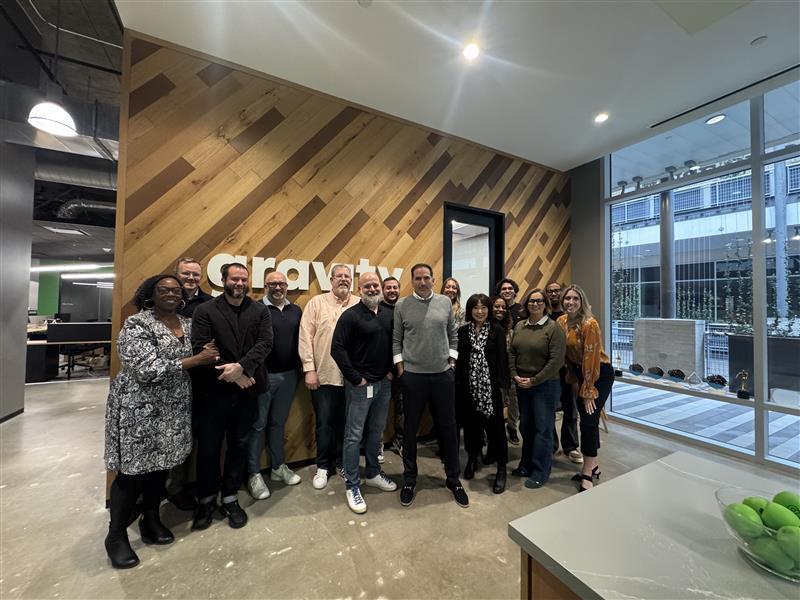
Landing the plane
In January 2026, Lozano called the coming year “the year of destination,” following integration in 2024 and transformation in 2025. His first 100 days as global CEO emphasized team culture and the use of AI alongside human judgment. He also described traveling with Lethbridge for in-person town halls and allowing each office to choose its own cause initiative.
The local choice is a revealing management decision. It gives colleagues responsibility for something they care about in their own community. A shared company can have common ambitions while allowing different offices to express them differently. The test is whether the freedom feels real to the people receiving it.
Lozano remains based in Houston, where he lives with his wife and three children. His connection to Baylor continues through the Hankamer School of Business S3 Board. The global role has added geography to a life whose home base is still recognizably Texan.
The office tour offers one final detail: he enjoys cooking ribs and brisket while following the Texans. Theater, planes, football, family, horror films and barbecue coexist without a committee having to approve their compatibility. An agency is a more demanding arrangement. It needs decisions, responsibility and results as well as interesting people.
Across Lozano’s career, the recurring effort has been to make those people useful to one another. The collective became an agency. Specialists acquired a shared financial interest. Marketing questions widened to include the business behind the advertisement. The next chapter depends on what happens between the offices after the announcement, when someone needs help and someone elsewhere knows how to give it.