Andrea Diquez makes a point of hiring people who make her laugh. It is a pleasingly inconvenient detail in an industry that can turn a simple introduction into forty slides. A sense of humor is harder to certify than a qualification. You have to spend some time together. You have to notice what happens in the room.
There is a similar detail in the beginning of her career. Visiting New York, she took a friend’s suggestion to try advertising. Her interview at Saatchi became a conversation about theatre with the head of human resources. She got the job. An enthusiasm that seemed to belong outside the office had helped her get inside it.
Today, Diquez is GUT’s global CEO, based in Miami. Her résumé runs through agency leadership in Mexico, New York, and Chicago. It also runs through an enduring problem: how to help people make something interesting together, then give a client good reason to put it into the world.
A detour worth taking
Born in Caracas, Diquez had an architect for a father and spent two childhood years in London. Museums, opera, and theatre entered the picture. She later studied communications in Venezuela. Advertising was an unplanned destination. The theatre interest survived the change of address.
She began at Conill in New York in 1995. Global account responsibilities followed. By 2001, she was directing regional account work for Ariel across Latin America. In 2004, her remit included Tide, Ariel, and Cascade in the Americas. Further promotions brought responsibilities across North America, Western Europe, and Latin America.
Detergent is an instructive place to learn advertising. The product performs a practical task; the communication must give somebody a reason to care about one version of that task over another. Diquez worked on consolidating Ariel’s regional communication, which had involved seven different campaigns. She described later campaigns in Mexico and Venezuela as helping reverse a business that had endured eight years of declining sales.
In 2011 she became CEO of Saatchi & Saatchi Mexico. Over two years, the agency doubled its business and won three Cannes Lions and three Effies. The pairing matters: recognition for creativity alongside recognition for effectiveness. Both would recur in her career, with increasingly large rooms attached.
A stain, a clean shirt, and a crowded room
Back in New York, she became the office’s president in 2015 and CEO in 2016. Javier Campopiano joined as chief creative officer. They already knew how to work together: earlier, she had handled regional business for Ariel while he handled regional creative work.
Their shared history soon had a conspicuously public outing. In the 2017 Super Bowl campaign for Tide, Terry Bradshaw’s shirt stain became the problem that propelled the entertainment. Saatchi New York won thirteen Cannes Lions that year, twelve for the Bradshaw work. A laundry problem had found itself a very large audience.
The following year, David Harbour appeared in commercials that borrowed the familiar language of other advertisements. Clean clothes kept providing the punchline. A car commercial, a beer commercial, a perfume commercial: if the clothing looked clean, perhaps Tide could claim the occasion. Watching the rest of the advertising became part of watching the Tide advertising.
Diquez was the agency CEO in the campaign credits. The creative and production credits run much longer. That distinction is useful when looking at an executive’s achievements. She led the organization around the work; the idea and its execution belonged to a team. Advertising makes a crowded room look deceptively effortless on television.
P&G then placed her at the head of its People First agency model, bringing together talent from Publicis, WPP, and Omnicom for North American fabric care. Rival holding companies do not usually appear on a collaboration diagram for decorative purposes. The arrangement asked whether the client’s problem could determine the team, even across corporate boundaries.
“It’s a Tide Ad” subsequently topped WARC’s Effective 100 ranking compiled from effectiveness awards in 2019. Diquez credited a brave client, a diverse team, and the partners who expanded the idea. The joke had earned a second hearing in a rather different room: one interested in what the advertising accomplished.
Rebuilding the room
In May 2021, she left Saatchi after twenty-six years for DDB Chicago, becoming its first Latina CEO. The move required more than inheriting a famous agency name. By the following spring, she was rebuilding the leadership team and bringing new skills into the office.
Rodrigo Jatene joined as chief creative officer. Milo Chao returned as chief strategy officer. Sandra Alfaro became head of business leadership, and Matt Blitz headed integrated production. Around a hundred people had joined an agency with a reported headcount of 240. Those figures describe a substantial change in who would be sitting across the table.
Alfaro, who knew Diquez from their earlier careers, expected hard work and plenty of laughter. Her assessment provides a more human picture of recruitment than an organizational chart. A senior hire chooses a role, certainly, but also chooses the person whose calls will arrive when the easy part is over.
By November 2022, Diquez had another new role: GUT’s first global CEO. Founded in 2018 by Anselmo Ramos and Gastón Bigio, the network then operated six offices in five countries. Her assignment was to help oversee and grow it with the founders, partners, and local leadership.
CEO
CEO
CEO
Global CEO
Alfaro followed her to GUT as its first US CEO in 2023. The appointment reunited former DDB colleagues and put another experienced leader into the growing network. Familiarity can save some introductory speeches. It still leaves the work to do.
Bravery with a business case
GUT’s vocabulary gives courage a prominent place. Diquez has described a practical version of it: understanding where a client begins on a scale of creative bravery, then working together to move along that scale. The relationship has a starting position. Demanding a leap does not make the landing more likely.
At the ElDorado festival in 2023, her talk carried the title “Bravery Means Business.” Her account of leadership emphasized knowing the people in the team, recognizing individual strengths, and organizing collaboration around them. She finished the accompanying interview with advice to enjoy the work. An agency can be serious about its responsibilities without making every conversation feel like a summons.
At Cannes Lions in 2023, GUT became Independent Network of the Year and LATAM Network of the Year. Buenos Aires won Agency of the Year and Independent Agency of the Year. These were collective achievements across the network, arriving in Diquez’s first year as global CEO.
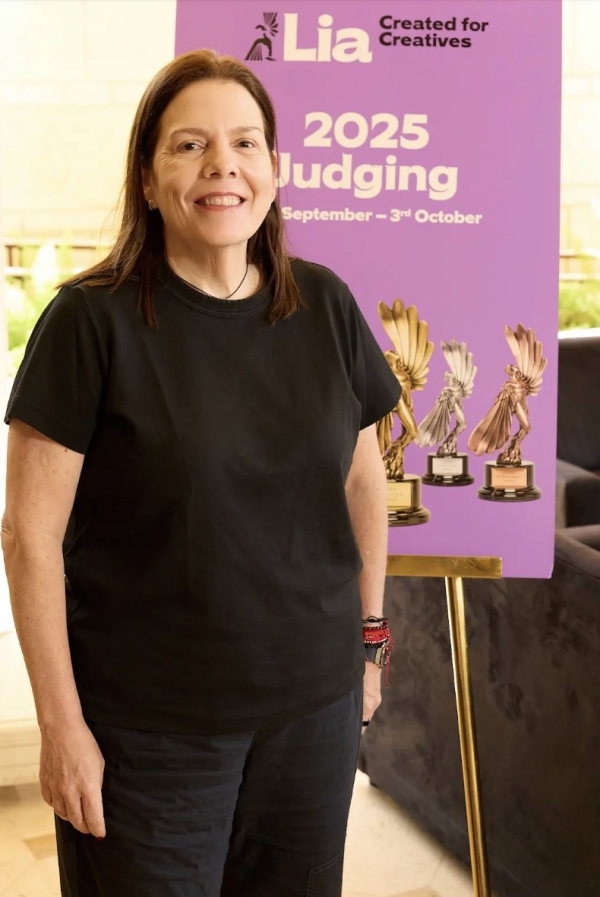
In 2025, she chaired the Cannes Creative Effectiveness jury. The category brought her recurring interests into the same discussion: an idea, its execution, and evidence that something happened because of it. She favored clear insights and simple, carefully made work. Pressure on budgets sharpened the commercial question.
“When budgets are tight the bar is always higher”
Andrea Diquez, June 2025
Her position requires clients and agencies to share responsibility for the result. Effectiveness cannot sit quietly in the strategy department while everyone else admires the film. Somebody has to connect the creative decision to the business problem that justified making it.
The map gets bigger
GUT sold a majority stake to Globant in late 2023. In 2024 it opened offices in Madrid, New York, and Singapore, the last marking its first entry into Asia. Diquez described that year through growth and expansion. The network also reported more than thirty percent global business growth for 2024.
Then, in October 2025, Globant consolidated its marketing and advertising capabilities under GUT Network. The announced scope was twelve offices and more than two thousand people. Diquez remained global CEO. Bogotá and Copenhagen joined the map, while the offering broadened across digital marketing, consumer experience, social, content, media, technology, and data analytics.
The change makes her job easier to understand in one respect: there are more capabilities to bring to a client’s problem. It also makes the coordination question harder to ignore. An office list establishes presence. It says much less about whether colleagues can find each other, share knowledge, and make decisions together.
Dated network counts, rather than a measure of Diquez’s individual contribution.
In March 2026, Agustina Garavilla became global COO, reporting to Diquez and overseeing integration and collaboration across offices. In May, Ryan O’Hagan became CEO of GUT Toronto, also reporting to her. The network’s growth was acquiring more explicit operational responsibilities. The map needed people to keep its connections working.
The last slide asks a question
Diquez’s work as a judge continued in 2026. She led the New York Festivals Advertising Awards Executive Jury and appeared on the Gerety Awards Grand Jury. Moving between running an agency and evaluating other agencies’ work gives her repeated encounters with the same question: what makes an idea worth someone else’s attention?
In a State of the Biz conversation, she discussed storytelling as a reason good work can lose in awards judging. The entry needs to make its problem, response, and value intelligible. An audience should be able to follow the thought, rather than admire the density of the explanation.
She also described GUT presentations ending with a question about how the audience feels. Her view of AI preserves a place for human instinct and the craft of writing. The tools may produce material; people still have to judge what deserves to be said, how it should sound, and whether it means anything to the person listening.
The theatre enthusiast has spent a career around those decisions. The stage has changed size. The audience still needs a reason to care. And somewhere in the process, if Diquez has had a say in the casting, there should be somebody who can make her laugh.