The car dealer had a problem that a larger advertising budget might have solved. It did not have the larger advertising budget. So Sean Blixseth and his colleagues at R\West helped put a chimpanzee in the trunk. The resulting Trunk Monkey commercials turned a dealership in Sandy, Oregon, into something people wanted to talk about. A customer could forget a financing offer. A monkey summoned by a dashboard button was harder to misplace.
This was 2003. Suburban Auto Group wanted to stand out, and Blixseth, then the agency’s president, understood the constraint. The dealership could not simply outspend its local competitors. It needed an idea capable of escaping its allotted commercial break. The practical question was how to give a business with limited buying power a disproportionate share of attention.
That question makes a useful entrance to Blixseth’s career. He is the founder and CEO of R\West, the independent agency established in Portland in 1997. He also makes films. His work moves from invented comic situations to real people making wine, with creative direction, production and the business of marketing meeting along the way. A title on an office door captures only part of the job.
A dealership acquires an improbable extra
Before Trunk Monkey, R\West had already worked with Suburban for about a year and a half. An earlier approach dramatized the dealership’s service. The client wanted the next round pushed further. Blixseth’s team returned with several directions, and the monkey concept won the argument. The brief had found a character.
The premise was wonderfully economical: a driver presses a button and an unlikely assistant appears. The same device could produce another predicament, another rescue and another joke. It gave the dealership a recurring identity rather than a succession of unrelated announcements. Advertising had borrowed the machinery of a television series, with the trunk providing both the entrance and the explanation.
By October 2004, reporting described the ads being syndicated in the United States, Australia and New Zealand. Other dealers could license versions for their own markets. Blixseth saw the benefit for his agency, too: work that began locally was giving R\West a national profile. A campaign designed around a spending disadvantage had become something other advertisers wanted to purchase.
“It’s an insane story - people really are obsessed with it.”
Sean Blixseth on Trunk Monkey, 2004
The credits also make a useful correction to the lone-genius version of advertising. On the Trunk Monkey spot “The Date,” Blixseth is credited as creative director, alongside associate creative director Todd Munn, director Marc Greenfield, producer Cassandra Brown and other specialists. The joke may arrive in thirty seconds. Getting it there takes quite a few names.
The campaign’s route from one dealership to a wider audience.
Optical illusions, then a salesman named Rico
Blixseth’s creative credits extend beyond the automotive joke. For an Oregon Museum of Science and Industry gala, he worked as creative director with designer Juli Unger on materials built around optical illusions. The magic-themed fundraiser used an invitation that functioned as a three-dimensional viewer and a save-the-date piece that created a spiraling illusion when spun.
It was a different sort of attention problem. A gala invitation has to persuade someone to open it, examine it and remember the date. Making the object do something gives the recipient a small experience before the event begins. The museum’s subject matter and the invitation’s behavior belonged together. Even stationery was allowed to have a trick up its sleeve.
In March 2008, another automotive campaign appeared. R\West created the concept for six spots produced by Limbo Films for Brondes Ford in Toledo, Ohio. Their central figure was Rico, a suave car salesman whose antics gave the series its comic engine. The plan again included offering the commercials to dealerships nationally through syndication.
The continuity is instructive. A recognizable character could carry a commercial idea into more than one market. The client bought a particular execution; the agency and its production partner built something adaptable. Blixseth was identified in the announcement as both creative director and president. At that point, the business and the creative responsibilities were explicitly occupying the same sentence.
Two rabbits and one intended audience
In a 2013 interview about the Oregon Lottery’s Keno Confidential campaign, Blixseth offered a proverb: “if you chase two rabbits you catch neither.” The target was adults aged 21 to 34. The team wanted to reach them without making existing players feel unwelcome. Specificity, in his account, required both a decision and some restraint.
The campaign made a fictional conspiracy investigator, Jeff, its guide. Older players were portrayed as holding inside knowledge of the game. That comic arrangement turned a potential generational divide into the premise. It also let the campaign explain something through a character’s curiosity, rather than asking the audience to sit still for an instructional announcement.
Blixseth discussed combining television, mobile, desktop, tablets, radio and billboards. The story had to work across the places its intended audience spent time. His explanation suggests a disciplined working preference: choose whom to address, then make creative and distribution decisions answer to that choice. A rabbit is a useful strategic adviser. Two can make a meeting exhausting.
A harvest declines to follow the shooting schedule
By September 2022, Blixseth’s filmmaking had taken him to Rioja, Spain. He directed The Heart of Harvest, a five-episode documentary series following that year’s grape harvest. More than thirty people connected to the region participated. The films were released while the harvest was happening, with episodes appearing only hours after their final scenes were recorded.
That arrangement changes the director’s relationship with a subject. A fictional salesman can repeat a line. A harvest develops according to conditions that a production team has to follow. The work of growers, pickers and winemakers supplies the action, and the film has to make that action understandable while it remains current. There is very little use in asking September to come back for another take.
Blixseth described being struck by decisions made on the fly, hour after hour. The observation gives the project a human scale. A wine region can be presented as scenery, acreage or a collection of bottles. A decision introduces a person: someone assessing what is happening and accepting responsibility for what comes next.
The series’ episode structure followed the grower, the picker, the maker, the regulatory council and the celebration. Together, those subjects carried the viewer through the people and institutions behind the finished product. The last installment made room for the communal occasion. A bottle has a label; a harvest has a cast.
from grower to celebration
- The Grower
- The Picker
- The Maker
- The Consejo
- The Celebration
Rioja reported more than 360,000 viewers by October 2022. The project subsequently received the Best International Marketing Campaign award at the International Wine Challenge Merchant Awards Spain that November. These were results for a collective production and its commissioning organization. They also mark a particular chapter in Blixseth’s work: documentary observation serving an international marketing purpose.
The return trip comes with a host
He returned to the region for Rioja Paired, released in 2024 and hosted by food writer and chef Marti Buckley. Blixseth directed the series and shared writing credit with Taylor Siolka. The crew included cinematographer David Fernandez Draña, executive producer Rodrigo Gutierrez Gutierrez and editors Alfonso Lozano, Casey Nolan and Josiah Sheffer. Again, the finished story had a working community behind it.
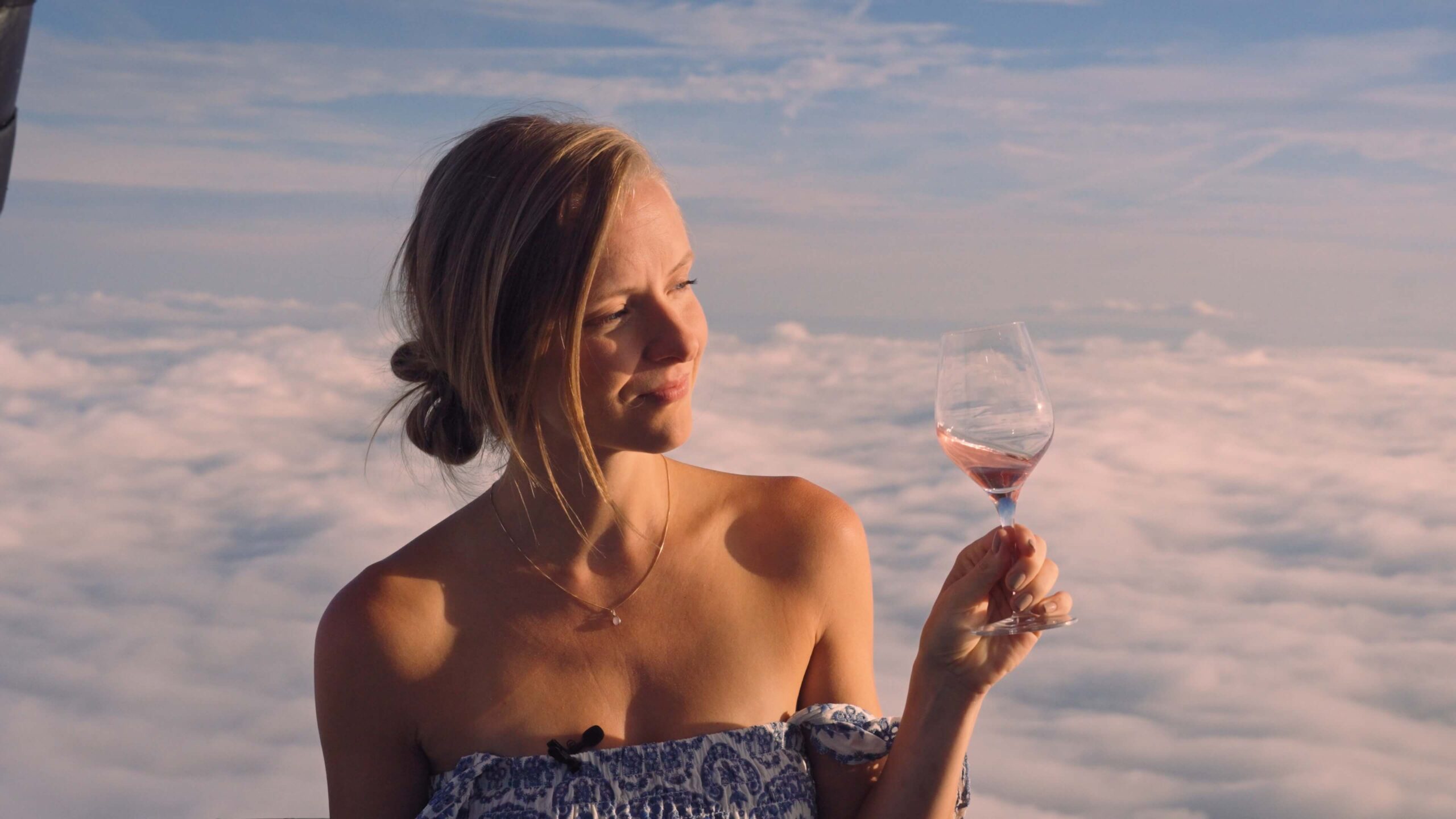
The project widened the frame from the work of a harvest to food, wine and regional culture. Buckley’s journey gave viewers a host to accompany, while the episodes visited Rioja’s different zones. For an American audience, the approach supplied both an introduction and a way of moving through unfamiliar territory. The film offered encounters rather than a catalogue.
In December 2024, Rioja’s regulatory council reported that the series had passed five million viewers in the United States. That is the council’s reported audience figure, attached to that period. Blixseth described the creative aim as exploring connections among food, wine and culture, with the histories and traditions behind the pairings supplying the substance.
There is a clear change of pace between a Trunk Monkey gag and a destination series. One must establish its joke almost immediately. The other can allow a host and her encounters to accumulate meaning. Seen together, the projects show a director and agency founder using different lengths and forms for different invitations to watch.
Seventy people, and the work between them
R\West now describes a team of seventy across Portland, New York and Amsterdam, working with twenty-three active client partners. Its stated principles are grit, guts and grace. It emphasizes senior leaders’ participation on accounts and lasting relationships. Those are the agency’s operating claims, and they provide the present-day setting for Blixseth’s role as CEO.
The founder’s history gives those claims a practical context. His public work includes collaborations with designers, producers, directors, writers and a documentary host. An agency depends on such combinations. A strong concept has to survive production, reach an audience and remain useful to the organization paying for it. The cheerful part is the idea. The calendar is less easily charmed.
Blixseth’s career makes room for both. A dealership’s request for something edgier became a repeatable comic premise. A museum invitation became an object to play with. A wine harvest became a series people could follow while the grapes were still coming in. Across these projects, he has helped give the client something more interesting to put in front of an audience.
The chimpanzee and the vineyard make an unlikely pair. They belong together here because each answers the same practical question: what would make someone choose to watch? Blixseth’s work has returned to that question in several forms. Sometimes the answer fits in a trunk. Sometimes it takes a season, a crew and a trip to Spain.