The original Topix proposition was almost disarmingly sensible: give every place a news page. In 2004, its founders built software that crawled thousands of publishers, identified where stories happened and placed them on pages for towns and topics. A person in a small community could find a local feed even when no local paper had bothered to build one online. The machine would do the sorting; advertisers would pay to meet the reader.
- Topix organized news by place, then added local comments and forums when readers proved more interested in one another.
- Its free pages made money from ads and from technology shared with newspaper partners.
- Open discussion brought repeat visits and moderation trouble. By 2018, Topix chose quizzes and visual stories over the town forum.
- Publishers Clearing House bought the entertainment business in September 2019.
The founders knew something about ambitious classification. Rich Skrenta, Chris Tolles and several colleagues had worked on the Open Directory Project. A contemporary visitor to the Topix office reported that four of the six founders had gone to the same Pittsburgh high school. The venture was small enough, at first, to occupy an office above a trophy shop. Its map was not small at all: a 2004 account described more than 150,000 pages for locations and subjects.
The clever machine and the quiet reader
Early Topix had a particular expertise: making a page for a place that had little web coverage, then helping a search engine find it. The company classified stories from a growing pool of sources by geography and theme. Google News offered a broad news search; Topix offered a ready-made front page for your town. Its potential customers were local readers, nearby advertisers and publishers that wanted stronger digital community tools.
In 2005, Gannett, Tribune and Knight Ridder took a majority stake. The group later included McClatchy after it acquired Knight Ridder, and Topix announced another $15 million from the publishers in 2006. These newspaper companies were investors and distribution partners. Topix supplied related-news widgets, embedded discussion tools and, in one Tribune arrangement, classifieds technology. The partnership gave old publishers a piece of a new kind of local network, and gave Topix both money and places to put its software.
There was a catch. Search traffic did not amount to devotion. Skrenta later said that readers visited the news pages only a couple of times a month and viewed about two pages each time. It is the kind of metric that can make a technically elegant product feel oddly lonely. People found the town; they had little reason to stay in it.
The comment box becomes the main event
Topix added comments and then forums for communities across the country. The visitors who had arrived to read about a road closure or a mayoral race could now answer back. Sometimes they had a question no reporter would have thought to ask. Sometimes they had a grudge. Both forms of participation kept them on the site longer. In a 2007 interview, Skrenta said forum users viewed about 20 pages per visit - ten times the earlier figure.
before the forums
after the forums
Figures reported by founder Rich Skrenta in 2007; they describe different versions of the site, not a controlled experiment.
The 2007 relaunch made that change official. Topix moved from topix.net to topix.com and invited local volunteers to edit pages, submit stories and correct the automated selection. The old software still posted news where humans were absent; Topix called it a “roboblogger.” More than 100 journalists at the newspaper partners were expected to help edit local pages. The idea was to use the machine for breadth and people for judgment. Rich Skrenta handed the chief executive job to co-founder Chris Tolles that June.
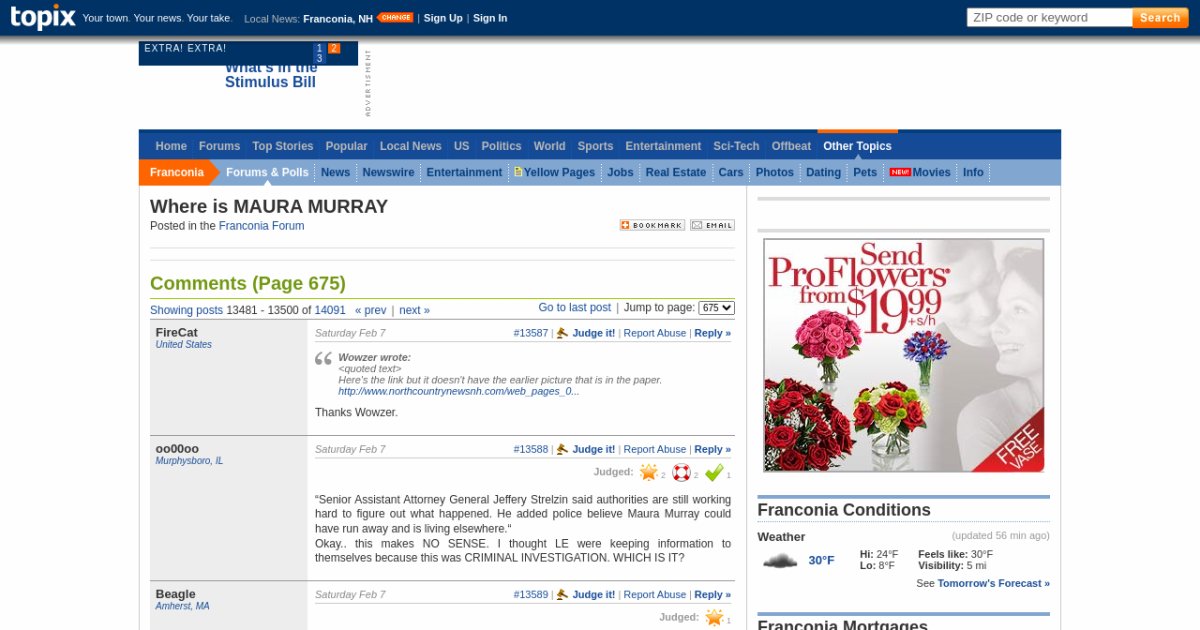
The forums also overturned an assumption about money. The team had expected discussion to be a loss leader. Local context made it valuable to advertisers: a conversation tied to a ZIP code could carry ads for restaurants, real estate or farms nearby. Topix reported roughly $4 per thousand ad views across the site and about $2 in forums in 2007. The company offered newspaper partners a share of that revenue when they used its forum system. For a publisher facing expensive, clumsy discussion software, a tool that paid to be installed was a persuasive pitch.
A porch with 100 million voices
Topix did something larger news brands could miss: it made a gathering place for people who did not live in large news markets. A 2010 account said the site was nearing 100 million cumulative comments, with about 125,000 coming in each day. Tolles described a community where a sudden local event might bring people in and everyday chatter would keep them around. During tornadoes in Caruthersville, Missouri, residents used the forum to ask whether neighbors were safe. The same space could later host disputes about local government.


The cost was not theoretical. Topix allowed posts without a verified identity. That lowered the barrier for a neighbor with a useful tip, and for someone with a lie. In 2010, Tolles said the company removed about 45,000 comments a month and received roughly ten subpoenas a week. By then the service was also appearing in painful accounts of reputations damaged by anonymous allegations. In one Texas case, a couple won a large jury award against individual posters after thousands of comments circulated about them. Topix itself was not the defendant in that verdict, but the episode showed how a local forum could magnify a local accusation.
The company tried software filters, user flags and human moderators. Skrenta described a practice of hiding banned users' posts from everyone except the author. It was ingenious in the narrow sense that the poster might not try a new account. It could not make every conversation trustworthy. The more specific the place, the more easily a rumor could identify and hurt someone. Topix had found an audience that wanted to speak; providing the room meant dealing with what they said.
The economics of a slideshow
From 2014, according to its company profile, Topix concentrated on original, shareable entertainment. By 2018 it was publishing quizzes and visual stories on celebrity culture, history, pets, parenting and other subjects. It ran titles including Stars, Offbeat, Sideline, Blackbeat and Pawsome. A reader could spend a spare minute testing what they knew or clicking through a gallery. Advertisers could buy the resulting attention. The company was now closer to entertainment publishers such as BuzzFeed than to a local newspaper.
Topix was unusually candid about how it selected stories. In 2018, it examined its 50 highest-grossing visual pieces and grouped them by emotional hook. Nostalgia and schadenfreude each accounted for 30 percent; humor, 24 percent; pride of knowledge, 16 percent. The figures measured Topix's winners, not a universal formula for taste. Still, they reveal the editorial method: make a story that prompts a feeling, watch the clicks, and commission more of what holds readers.
One published example is gloriously absurd: a Topix piece about hipster wedding trends drew 5.4 million visitors and generated $782,000 in revenue, according to the company. Another, about risqué historical facts, reportedly drew 9.9 million visitors and $776,000. The numbers are company-reported, and they are gross revenue for individual stories, not profit. They explain why a slideshow could look more attractive on a spreadsheet than a fight in a town forum.
Topix closed its local news forums in December 2018 and directed users toward Patch for local discussion. Its own announcement said news and conversation had become less central to what the company was. In September 2019, Publishers Clearing House announced the acquisition of Topix's entertainment business. PCH said Topix brought more than 18 million monthly unique visitors, 2.8 billion monthly page views and an average visit of 13 minutes. The sale price was not disclosed. PCH planned to use the team's writers, engineers and growth marketers across its media properties.
What is worth copying?
Topix offers two useful habits. First, measure whether people return, not merely whether a search result delivers them once. Second, match a distribution advantage to a real local need: the company reached communities that had few digital gathering places. The caution sits beside the lesson. If discussion is the product, moderation has to scale with it; if visual stories are the product, advertising revenue depends on a large supply of attention. Neither method can be copied cheaply by a site without the traffic, technology and editorial judgment to support it.
What makes Topix memorable is not that it pivoted. Media companies do that whenever the audience moves. It is that the company left such clear traces of what it learned: a page visit becoming ten, a forum page earning unexpected ad money, a slideshow about wedding fashion earning three quarters of a million dollars. Each number pointed the company toward a different idea of its audience. Topix began by asking where people lived. It ended by asking how long they would stay.