A national news story can change your opinion. A neighborhood story can change your route home. That difference is the small hinge on which NewsBreak built a large business. The app began with a deceptively ordinary idea: if someone opens a phone in Mountain View, the first useful story might concern Mountain View, not Washington. Scale that logic across thousands of places and you have a national platform whose organizing principle is proximity.
The short version
- NewsBreak personalizes local news, alerts, weather, and community information for readers across the United States.
- Publishers, independent contributors, and local businesses provide the stories; advertising and media technology pay the bills.
- The company reported more than 40 million monthly active users in 2026. Its automated content errors showed why reach and reliability must grow together.
A newspaper with no single hometown
Jeff Zheng, a former Yahoo executive, founded Particle Media in 2015. NewsBreak, its consumer brand, launched on iOS and Android the following year. The original pitch was not to outreport every local paper. It was to solve an irritating problem of discovery: people live in a place, but their digital feeds often behave as though they live nowhere in particular.
In the app, location and reading behavior help choose a mix of local publisher stories, national headlines, weather, safety alerts, and contributor work. A reader can find a neighborhood opening or a crime map alongside larger news. The product is free to use. That gives it a broad audience, and the audience gives advertisers a way to target people by place and interest.
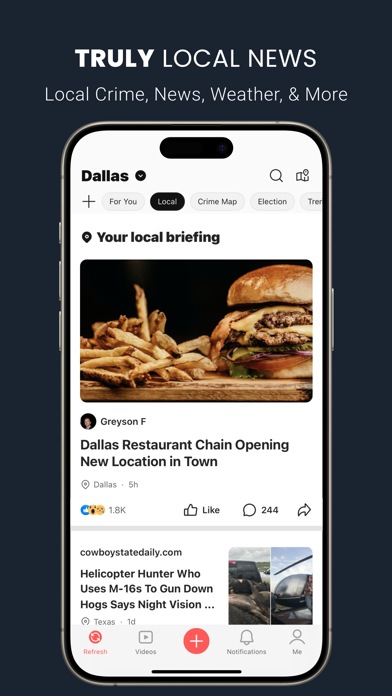
The logic has a commercial elegance. A national advertiser wants scale; a neighborhood business wants the right few blocks. NewsBreak can offer both through one feed. The company says its advertising inventory extends beyond the app into newsletters and partner sites, with native placements inside feeds and articles. Readers are the audience. Advertisers buy access to that audience. Publishers and creators supply much of what makes the visit worthwhile.
The supply problem comes first
A local feed cannot be made from recommendation code alone. Someone has to report the zoning meeting, film the flood, or tell the shop owner’s story. NewsBreak assembled supply in layers. Licensed and partner publishers bring established reporting. Its Contributor Network, launched nationally in 2022 after an earlier creator program, aims to cover places with thin newsroom presence. The company said its 2021 expansion added 956 local publications.
For a publisher, the offer is practical: send full articles through an approved feed, keep a publisher profile, decide which articles to share, and use analytics to see how they perform. NewsBreak promises attribution, wider reach, and revenue opportunities. The Wilson Times and New Haven Independent are among the publishers it has publicly named. San Diego Red joined the partner program in 2026 to distribute local and cross-border coverage more widely.
This arrangement solves a real publisher problem: producing a story and getting it seen are different jobs. Yet it also creates a dependency. Distribution platforms can change ranking rules, pricing, and traffic. A local newsroom may gain new readers while surrendering some control over the path to them. NewsBreak’s publisher contract permits broad use of submitted content, so the bargain deserves more attention than an easy promise of exposure.
The first wobble, then the bigger one
NewsBreak’s original content program had trouble finding its shape. In 2021, Digiday reported that the roughly year-old creator effort was seeking stability and that the company had hired Xana O’Neill, previously involved with Snapchat publisher partnerships, to lead original content. The Contributor Network that followed put a clearer emphasis on local reporters and community voices. That is an instructive adjustment: if the product promises neighborhood utility, a general creator pool is not enough. It needs people who know the streets.
The more serious failure concerned accuracy. A Reuters investigation in 2024 documented at least 40 erroneous or misleading NewsBreak stories associated with AI tools since 2021, including a nonexistent New Jersey shooting. Local police publicly corrected that account. Other errors sent people to food or health services at the wrong time or place. NewsBreak told Reuters it removed erroneous content and said one disputed story came from an outside source. Whatever the route by which an error entered the feed, distribution made it NewsBreak’s problem.
A false national story misleads. A false local story can send someone to a clinic that is not there.The cost of proximity
That is the awkward arithmetic of local automation. A ranking system can understand that a story is close to a reader. It cannot, by location alone, establish that the event happened. NewsBreak’s promise of relevance makes verification more urgent, not less. The company’s current publisher rules favor established editorial organizations and require full text and images from approved feeds. Those rules describe an attempt to control supply; they are no substitute for checking claims before a notification travels.
The feed becomes a toolkit
The next act is larger than news aggregation. In 2025, NewsBreak marketed ClearStream, an AI-based ad screening and ranking system originally built for its own ad operations, to other publishers. The Weather Company tested it on weather.com; NewsBreak reported that it cut manual ad review work by 80 percent. The product won an ADWEEK Tech Stack award. It is a shift from selling attention inside NewsBreak to selling machinery to the wider media market.
Then came SPOTLIGHTS in May 2026. A small business owner answers prompts, reviews the resulting feature, and approves it before NewsBreak distributes it to nearby readers. The launch offer includes one article and a push notification free of charge. NewsBreak said about 750 businesses in the early program generated 76 million impressions and 1.52 million views. Those are company-reported campaign totals, not proof that every shop gained customers, but the proposition is wonderfully concrete: the bakery does not need to go viral. It needs its neighbors to know it exists.
In September, NewsBreak announced two more ventures: Nearby AI, for connecting people with local businesses and services, and NDot AI, a publisher technology platform for audience growth, recommendations, engagement, and monetization. Nicolas Zylberstein joined as chief business officer to help grow them. The company is trying to turn a decade of feed-building into infrastructure other businesses can use.
A useful idea with a difficult standard
There is a lesson here for any company tempted by an underserved market. NewsBreak did not invent the local story. It made local discovery easy, built a supply network, and found customers willing to pay for geographically relevant attention. The replicable move is to start with a specific need that large platforms flatten, then build distribution around it. The cost is substantial: NewsBreak had raised more than $36 million before its $115 million Series C, and its network requires technology, publishers, creators, sales, and moderation.
The model weakens where there are too few credible local sources, where advertisers will not pay for narrow reach, or where accuracy checks cannot keep pace with automated distribution. NewsBreak’s enduring insight is that “near me” is a powerful editorial filter. Its enduring obligation is to make sure the thing nearby is real.