Water is an awkward product for a software entrepreneur. It refuses to stay inside national borders, behaves differently from one valley to the next and has never once read a quarterly forecast. José Ignacio Galindo built his first business in advertising technology, where software helped brands manage what people saw. His next business would ask companies to look at something they could too easily overlook: the water on which their operations depended.
The change followed a perfectly respectable entrepreneurial ending. Herolens, the advertising software company he co-founded, was acquired by Innovid in 2019. Galindo had helped build something another company wanted to buy. He could carry that experience into another familiar market. Instead, he spent time studying climate technology and eventually co-founded Waterplan, bringing his experience in business software to a problem with a stubbornly physical address.
That last detail matters. A business can have a global water ambition, but its factory still draws water somewhere in particular. Galindo’s working territory lies between those two scales: the corporate promise and the local conditions that determine whether it can be kept.
From Ushuaia to a successful exit
Galindo comes from Ushuaia, in Argentina’s Patagonia. He left for Buenos Aires to study software engineering, completing his education at the Instituto Tecnológico de Buenos Aires. The journey placed him in a different kind of environment: startups, engineering teams and the networks through which young founders find colleagues, customers and their next opportunity.
His early career included Wolox, where he worked in software and later held a CSO role. He also became involved in entrepreneurial organizations, including the World Economic Forum’s Global Shapers community. These were overlapping circles rather than a straight road toward a water company. One connection would become consequential: Nicolas Wertheimer, who brought years of experience working on water.
Before that partnership became a business, there was Herolens. Galindo co-founded it with Alan Karpovsky and Cristian Pereyra. Its work involved managing and personalizing digital advertising, serving brands including Coca-Cola, Renault and Mercado Libre. When Innovid announced the acquisition in September 2019, it described a profitable company of roughly 40 employees, with product and engineering making up almost the entire team.
Those details make the exit more interesting than the usual ceremonial photograph. Herolens had customers, a substantial technical team and a business that earned money. The acquisition brought its display advertising capabilities into Innovid’s wider offering. Its Buenos Aires office would become Innovid’s Latin American headquarters. Galindo’s first entrepreneurial chapter had produced an organization someone else could build upon.
The next problem took some homework
The attraction of another startup was accompanied by a question about its purpose. “But I wanted to do something a little bit more impactful with my next ventures,” Galindo said. He began researching climate technology after the acquisition. The period of study lasted about a year and a half before Waterplan began, a useful corrective to the tidy founding myth in which an entire business arrives during a particularly productive shower.
He listened to the My Climate Journey podcast while learning about the field. Later, appearing on that same show with Wertheimer, he traced Waterplan’s beginnings back to it. There is something pleasingly practical about the loop: a founder uses an interview series as a classroom, then returns as a participant. Curiosity had become a company, although it required considerably more work than pressing play.
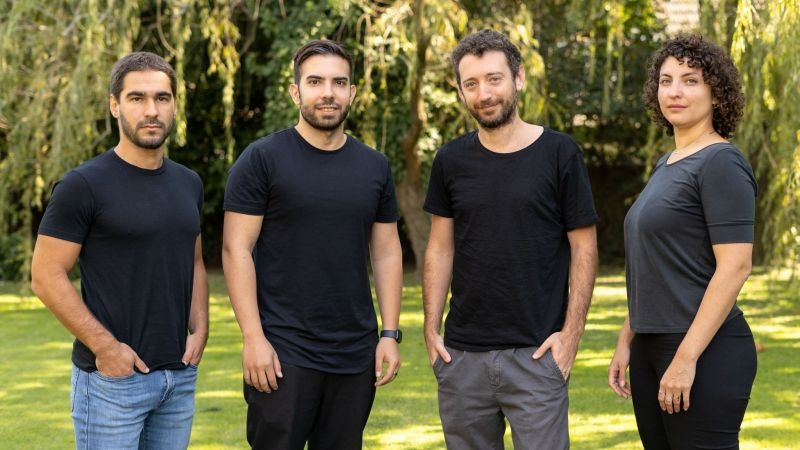
Wertheimer and Galindo had met through Global Shapers in Buenos Aires. The partnership joined distinct kinds of experience. Galindo understood how to build and sell business software; Wertheimer understood corporate water stewardship and the conditions around watersheds. Alongside Matías Comercio and Olivia Cesio, they formed the founding team behind Waterplan.
Waterplan went through Y Combinator’s Summer 2021 batch. The company’s opening proposition was concrete enough to fit on the accelerator’s listing: water risk mitigation for industrial sites. The ambition was international, but the initial customer and unit of work were specific. Start with businesses that depend on water. Help them understand the exposure of the places where they operate.
An editorial schematic of the problem Waterplan addresses.
A cheap input can carry an expensive risk
Consider the distinction between a water bill and the consequences of interrupted supply. The first records a purchase. The second can involve a production schedule, an investment decision or a site’s ability to keep operating. A small bill does little to explain those possibilities. Galindo’s business sits in that gap, helping organizations connect environmental conditions with decisions that have budgets attached.
Waterplan combines company information with satellite imagery and public and proprietary environmental data. Its work is intended to help customers assess water exposure, evaluate responses and report what they are doing. Customers named in its 2023 financing announcement included AB InBev, AWS, Danone, Diageo and Kurita. The Nature Conservancy also described using the platform to monitor stewardship projects in Latin America.
In May 2023, Waterplan announced an $11 million Series A led by Base10 Partners. That brought its disclosed venture funding at the time to $18.5 million. Base10 co-founder Adeyemi Ajao joined the board. Earlier investors participating included Giant Ventures, Transition Global, Y Combinator, MCJ Collective and the Branson family. The money was intended for research, product development and geographic expansion.
Led by Base10 Partners.
$18.5m in total venture funding disclosed at that date.
“Taking action on water risks is essential for climate action and it makes business sense.”
José Ignacio Galindo, May 2023
There is a recognizable continuity with his earlier business. Both companies sell software to organizations and ask customers to use data to make better decisions. The underlying subject has changed. Advertising systems organize creative material and delivery; water-risk work must account for local environmental conditions. The business-software experience travels. The knowledge of a particular watershed must still be earned.
A founder with a narrowing field of attention
Galindo’s public conversations often return to focus. A 2023 interview explored his approach to leadership, fundraising and choosing which opportunities to decline. It also described an earlier Galindo who joined student and volunteer initiatives, including TECHO, Google’s ambassador program and World Business Dialogue. His trajectory contains both impulses: enter enough rooms to discover possibilities, then become selective about where the hours go.
That interview also discussed his use of the Entrepreneurial Operating System, a management framework, and his habit of reading. Ray Dalio’s Principles appeared among the recommendations. These are modest but revealing details. His public interests extend beyond the product’s technical machinery to the routines that allow a company to work: priorities, culture, leadership and the allocation of attention.
His collaborators remain visible in the story. Waterplan’s technical work includes research with the Suntory Institute for Water Science and Kurita Group. In December 2023, Galindo published an account of their work using deep learning and remote sensing to improve freshwater availability modeling. The research addressed a difficult hydrological problem: estimating streamflow in basins without the measurements available elsewhere.
It is a fitting problem for this company. Software becomes useful partly by reaching places where a specialist cannot constantly be present. Yet the absence of measurements also makes certainty harder to justify. Waterplan’s product ambition depends on improving the reach of expertise while respecting the differences between locations. A persuasive interface still has to answer to the river.
The AI argument comes with a checking step
By July 2025, Galindo and Wertheimer were making a more explicit case for AI in water-risk management. Their argument emphasized the burden of assembling changing local information: measurements, research, government material and other evidence. They described systems that could update assessments as information changed, shortening the path from collection to a useful recommendation.
They also described validation against water-expert datasets. Outputs including descriptions, analyses and risk scores were evaluated rather than accepted merely because an AI system had produced them. That detail deserves attention in a market fond of demonstrations. For an industrial customer considering a location or an investment, the ability to check an answer belongs alongside the ability to generate one.
Galindo’s public work has increasingly involved those practical conversations. In March 2025, he appeared in a Waterplan session about corporate water targets with representatives from Diageo and Nestlé. In February 2026, a conference session paired him with Colgate-Palmolive sustainability executive Vance Merolla to discuss site-level climate and water risk and carbon roadmaps. The subjects connect environmental goals with the work of individual operations.
Before the next site gets built
In May 2026, Galindo joined Waterplan colleague Angeles Clutterbuck for a session on adapting AI inference pipelines to data center site selection. It extended the company’s work into a decision made before an operation exists. Rather than assessing an established facility alone, the question becomes where to put the next one, and how to assemble the evidence needed to choose.
This gives his career an unexpected symmetry. His first company helped advertisers manage digital material. His current work increasingly concerns the physical conditions underneath digital growth. Data centers occupy land, require infrastructure and operate within local constraints. The word “cloud” has always been unusually good marketing for something with so much equipment attached.
Galindo’s stated ambition is to accelerate the transition to a water-secure world. The work visible along that path is more granular: an engineering partnership, a validated assessment, a factory’s plan, a site-selection decision. From Ushuaia to advertising software to Waterplan, his career has brought him toward a resource people often notice most when it becomes uncertain. His wager is that companies can learn to pay attention earlier.