Water looks simple on a factory invoice. So many cubic meters came in, so much went out, someone paid the utility. Then a drought tightens an allocation, a flood cuts access, a permit changes, a community objects or a supplier several tiers away runs short. Suddenly the cheap line item becomes an expensive interruption. The trouble is not that companies have never heard of water risk. It is that the evidence lives in too many places, arrives at different speeds and speaks to different departments.
Waterplan, founded in 2020 by José Ignacio Galindo, Nicolas Wertheimer, Matías Comercio and Olivia Cesio, has built enterprise software around that organizational mess. It pulls together local watershed evidence, satellite and climate data, plant consumption, production metrics, financial exposure, reporting requirements and mitigation projects. The resulting workspace is designed for sustainability managers, EHS teams, engineers, plant operators and finance leaders who need to reach the same decision without first reconciling five spreadsheets and three definitions of risk.
The company does not pump, filter or desalinate water. It sells the intelligence and workflow around those physical decisions. That distinction matters. A factory still needs meters that work, people who know its pipes, money for improvements and local partners who understand the basin. Waterplan's job is to show where attention belongs, make the supporting evidence auditable and keep the response from disappearing into an annual report.
The first thing to break was the spreadsheet
Customer stories reveal a remarkably consistent failure pattern. At Kurita Group, global public tools updated too slowly, worked at insufficient granularity and did not tailor scores to individual assets. Colgate-Palmolive had internal and external water information scattered across sources; teams assembled it reactively when a reporting deadline or executive request arrived. Tronox relied on site experts and bespoke processes, which made portfolio-wide comparison and standardization difficult. At a plant, even meter readings can be stranded in separate systems, collected at incompatible intervals or attached to an outdated diagram.
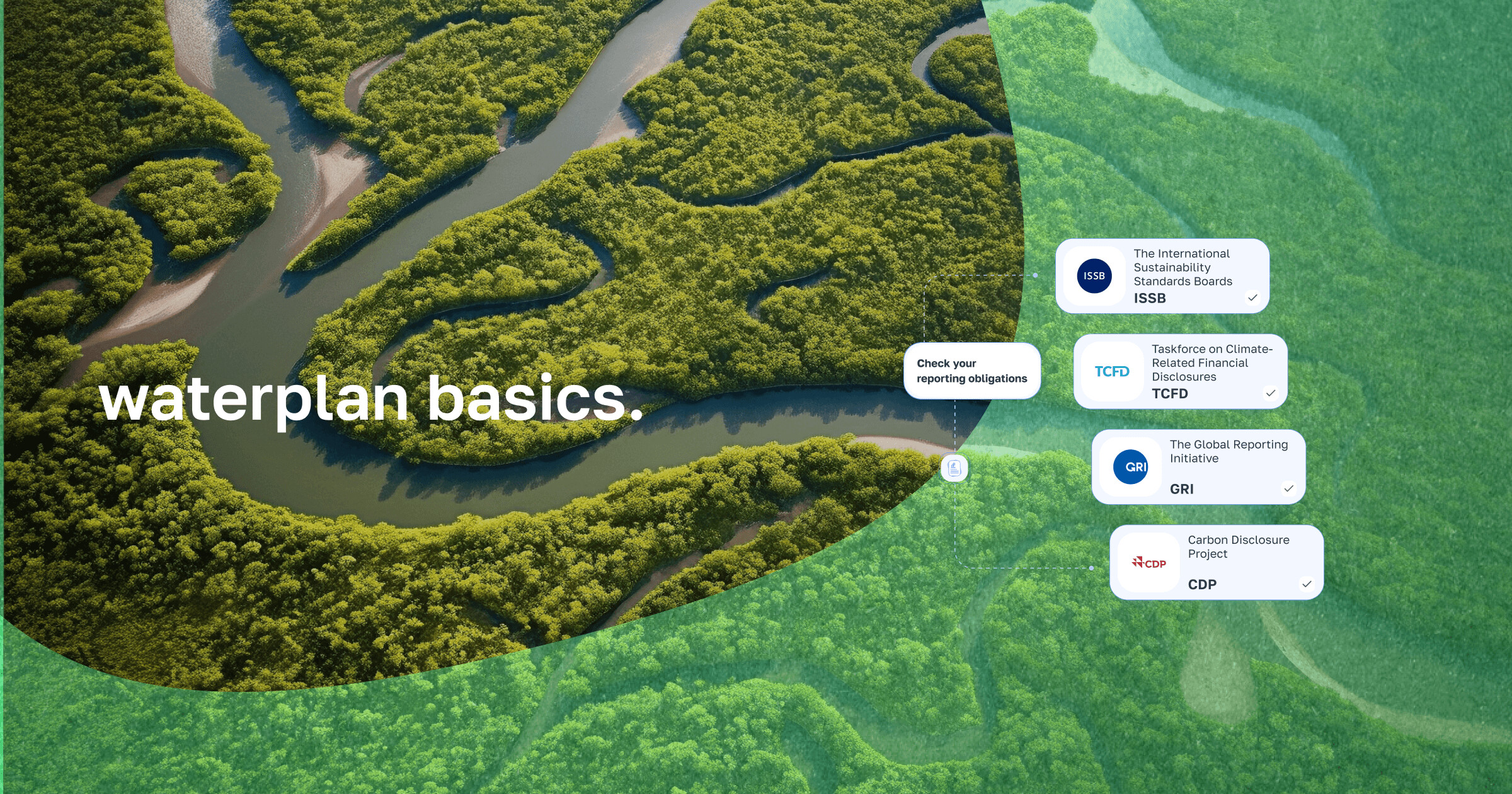
Waterplan's answer is a four-part loop. Measure the local and facility conditions. Translate them into operational and financial consequences. Assign and track a response. Report the same underlying evidence to management and disclosure frameworks. Then repeat as conditions change. It sounds obvious. In a multinational with dozens or hundreds of sites, obvious is usually where the hard work begins.
Measure
Combine basin, satellite, regulatory and plant data at the site level.
Translate
Score the exposure and estimate the operational or financial consequence.
Respond
Prioritize projects, owners and timelines instead of leaving a risk on a map.
Prove
Track targets, benefits and disclosure evidence from the same record.
“Being able to monetize water risk is the next frontier of water stewardship.”Cecilia Coates, Climate and Water Lead at Colgate-Palmolive
That sentence contains Waterplan's strongest commercial idea. Sustainability teams understand watershed pressure; chief financial officers understand money at risk. By combining local conditions with information such as production, infrastructure and planned capacity, the platform tries to express water exposure in the language used to approve capital. The number is not magic. It is a structured estimate whose assumptions need to remain visible. But it gives an internal advocate more to work with than a red dot on a global map.
One platform, several jobs nobody wanted to reconcile
The product now spans three visible lines. Water Risk monitors site-level conditions and prioritizes exposure. Water Stewardship manages goals, restoration work and volumetric water benefits - a way of estimating how much water a project replenishes or saves. AI Metering analyzes water, gas and energy readings for anomalies and helps plants maintain a dynamic water balance. Around those modules sit reporting workflows and human water advisers who validate assessments, interpret standards and help shape action plans.
In 2026, Waterplan also introduced AI Water Expert, a research and scoring layer built for questions that generic chatbots handle badly. The company says it synthesizes five evidence types, including satellite information, government pipelines and local-language research, into scores across six risk dimensions. The more important design choice is auditability: a user should be able to trace a claim back to its evidence. For a brainstorm, a plausible answer may be enough. For siting or permitting a facility, it is not.
Decision-grade water intelligence
This breadth separates Waterplan from several adjacent options. WRI's Aqueduct and WWF's Water Risk Filter are useful, widely used screening tools. A consultancy can conduct a deep one-off study. A broad EHS suite can store environmental records. A metering vendor can find leaks. Waterplan's wager is that a water-dependent business wants those jobs connected around the facility and updated as a continuous management process.
| Option | Good at | Gap Waterplan targets |
|---|---|---|
| Global risk atlas | Fast portfolio screening | Local evidence, company context and action tracking |
| Consulting study | Deep expert analysis | Continuous updates and a reusable operating workflow |
| Broad EHS suite | Records and compliance | Water-specific risk, hydrology and stewardship projects |
| Waterplan | Connecting risk, operations, finance and response | Still depends on sound inputs and real-world execution |
The proof is in what changed after login
Waterplan's customer list is heavy on companies for which water is ingredient, coolant, process input, cleaning medium or community flashpoint: Danone, Ambev, Colgate-Palmolive, Coca-Cola Europacific Partners, Nestlé Waters, Mars, Brown-Forman, mining company Tronox, water-treatment specialist Kurita and data-center operator EdgeConneX. The buyers are not consumers checking a footprint. They are teams managing a portfolio of exposed assets and suppliers.
At Coca-Cola Europacific Partners, the software consolidated information across more than 50 stewardship projects and tracked contributions to company targets in near real time. Kurita deployed the platform at production facilities in Asia and Europe, combined site and catchment data, reduced manual entry and shifted water-risk monitoring to a monthly cadence across three countries. Colgate-Palmolive shortened the work required to assemble assessments and standardized how results were presented to a cross-functional Water Security Task Force.
EdgeConneX offers a different test. Its expanding data-center portfolio uses mostly dry or no-water cooling, yet occupancy, landscaping, cleaning and maintenance still consume potable water. Waterplan helps the company forecast scenarios, rank regions and audit the volumetric benefits of replenishment projects against a water-neutrality goal. The point is not simply to count gallons. It is to know which project has evidence, which site needs attention and what story can withstand a customer or investor asking how the number was produced.
The cost of the product is not public. Waterplan sells enterprise SaaS with implementation and advisory support, which usually means a negotiated contract shaped by site count, modules and service depth. The more useful cost comparison is with the status quo: consultant studies repeated site by site, employees gathering data by hand, meetings spent debating versions and capital allocated without a shared estimate of exposure. Waterplan's own case studies claim time and cost savings, but do not publish enough dollars to calculate a universal payback period.
Four founders and a useful collision of worlds
The founding team met through the World Economic Forum's Global Shapers community. Galindo brought repeat B2B software experience: he co-founded Herolens, later acquired by Innovid, and worked at Wolox, acquired by Accenture. Wertheimer came from the water side. A physician who treated waterborne disease, he founded Proyecto Agua Segura, which expanded safe-water access across Latin America. Comercio brought product and engineering leadership; Cesio was also a technology entrepreneur.
That mix explains why Waterplan is neither a pure data feed nor a conventional environmental consultancy. The software wants scale, recurring revenue and repeatable workflows. The advisers provide the judgment required when two sites with the same basin score have different intakes, permits, production lines or community relationships. Water, inconveniently for software, is local.
Investors bought the thesis. A $7 million seed round in 2022 was led by Transition Global and Giant Ventures, with the Branson family and Leonardo DiCaprio among the participants. In May 2023, Base10 Partners led an oversubscribed $11 million Series A, bringing announced venture funding to $18.5 million at the time. Waterplan had joined Y Combinator in 2021 and later participated in Google for Startups programs.
What changed minds: not another alarming climate chart, but a workflow that joined a local risk to production, dollars, an owner and a next action. The customer evidence repeatedly points to speed, consistency and internal alignment as the reasons teams kept using it.
The part worth copying
A company does not need Waterplan to borrow its operating logic. Start with one facility where water can interrupt production or licensing. Map the physical system and its measurement gaps. Combine public basin screening with current local evidence. Add the plant's source, consumption, production and financial assumptions. Name the people who own each response. Review the record monthly, not only when CDP opens its questionnaire. Scale after the process survives contact with the operators who know which valve is actually open.
The approach loses force when the inputs are neglected or the organization wants software to substitute for action. An AI agent cannot repair a meter, negotiate with a utility, earn community trust or fund a reuse system. A financial exposure estimate is only as honest as its assumptions. A restoration claim needs credible field measurement. Small companies with a single low-risk site may be better served by free screening tools and focused expert help. The platform earns its keep when complexity is real: many assets, multiple jurisdictions, distributed owners, changing evidence and enough operational exposure to justify continuous management.
Waterplan's market is expanding because water is moving out of the sustainability appendix and into operating decisions. Data centers need to explain siting and cooling. Food companies need to understand farms as well as factories. Mining groups face local permits and shared catchments. Multinationals must answer disclosure frameworks without letting reporting swallow the work itself. The software category is still young, and free tools, consultants, EHS platforms and specialist vendors will keep overlapping it.
The company's best argument is not that it can predict every drought. It is that a business should not discover its water assumptions during a shutdown, a permit fight or the week a report is due. Put the evidence in one place. Translate it into the language each team uses. Leave a trail someone else can audit. Then keep looking, because the watershed has not stopped moving just because the spreadsheet was submitted.