Luke Jacobs was doing the sort of work that matters greatly and photographs badly. Environmental compliance lives in permits, inventories, spreadsheets, portal logins and deadlines. A facility has chemicals. A regulator needs a report. Somewhere between those facts, an environmental professional spends a small geological era collecting numbers and moving them from one rectangular cell to another.
Jacobs understood the work from the inside. He had studied environmental science at Indiana University Bloomington, worked in ecosystem ecology and biogeochemistry, trained as a scientific diver, and managed research funded through the National Science Foundation and U.S. Department of Energy. He later joined GHD as an environmental scientist, working with energy companies and their compliance programs. The job placed him at the exact seam where regulations meet operations. It was also where he noticed a peculiar economic problem.
He wrote software to make his work faster. The response was not the shower of rose petals that efficiency receives in business books. As Jacobs later recalled, the consulting firm ran on billable hours. He was told to stop because the efficiency was hurting the company. The machine was behaving rationally according to its incentives, which happened to be irrational for the customer. Jacobs had found a startup idea by irritating a timesheet.
“It was a business built on billable hours, and I was told to stop, because the efficiency was hurting the company.”Luke Jacobs
A field scientist learns to read incentives
The useful part of Jacobs's scientific background was not merely that he knew what an environmental report contained. He knew how fragile the path to the answer could be. Data came from different facilities and systems. Rules varied across states and local jurisdictions. A missed threshold, stale inventory or copy-paste mistake could turn administration into risk. Accuracy was not decorative polish. It was the product.
His undergraduate years had already mixed method with appetite. He entered IU on a full academic scholarship and became one of twelve fellows in his class through the Integrated Freshman Learning Experience. His extracurricular list read like a particularly sociable field notebook: biology, chess, caving, ultimate frisbee and residence-hall government. He conducted lab and field research and later co-authored work on litter decay, roots and soil organic matter that appeared in the Journal of Ecology.
After graduation, Jacobs worked as a research associate and project manager for Montana State University in a Bloomington-based position. Then came consulting, hazardous-material shipping certification and RCRA hazardous-waste training. By the time he considered a company, the problem was not a slide assembled from market reports. It had accumulated under his fingernails.
The canyon test
The decisive conversation happened about as far from a compliance portal as one can reasonably arrange. Jacobs and a co-founder were backpacking through Havasu Canyon, an offshoot of the Grand Canyon known for red rock and blue-green falls. They spent much of the trip discussing a connected platform that could hold requirements, organize data and file reports. If a person remains preoccupied with environmental data management while walking past waterfalls, the idea has probably earned a second meeting.
They joked that they should start the company. The name followed the setting: Encamp, short for environmental camp, suggested both the outdoors they loved and a place to set up the work. Jacobs has also admitted to two less poetic criteria. He wanted a real, two-syllable word, and the domain was available. A founder can admire nature and still respect a clean URL.
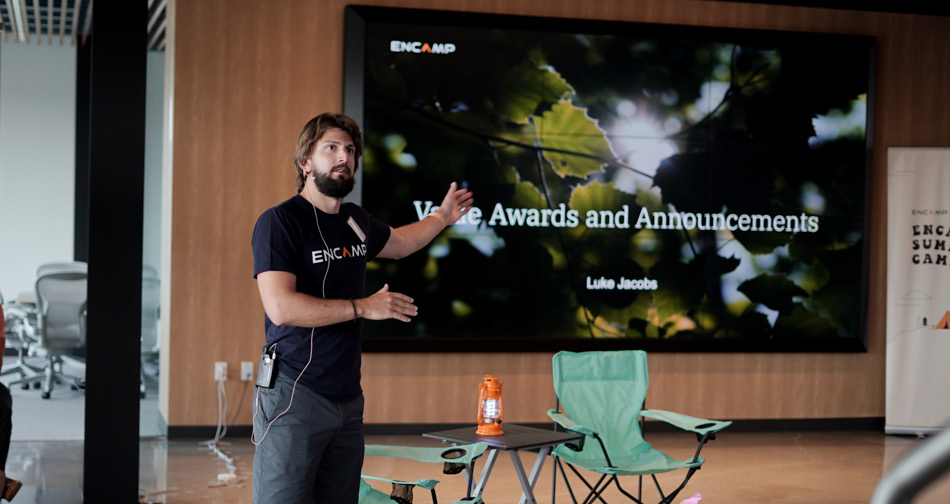
Jacobs founded Encamp with his brother Sam Jacobs and IU classmate Daniel Smedema. Each brought a different corner of the problem. Luke had environmental science and consulting experience. Sam had worked across technology companies. Smedema had studied computer science and cognitive science and written software in regulated industries. Their older brother Ben, a software engineer, advised the young company and later joined its leadership.
The beginning was compact: $12,000 from friends and family, work from home, and no marketing budget. The founders cold-called and emailed prospects. By early 2019, they said they had spent about $50,000 to win $260,000 in contracts. An initial plan to raise $200,000 looked too timid to outsiders; they raised the target and ultimately closed a $1.1 million early round, including $250,000 from the IU Philanthropic Venture Fund.
From rulebook to filed report
Selling an outcome instead of an hour
Jacobs's compact description of Encamp remains “TurboTax for environmental compliance.” The analogy makes a bureaucratic product understandable without pretending the underlying rules are simple. Encamp works as an intelligence and work layer: it connects to core data sources, determines obligations, manages the process and supports direct submission. The commercial model also answers the original irritation. Customers buy a subscription with a defined outcome rather than an expanding pile of hours.
The company grew through agriculture, energy, logistics, retail, telecom and manufacturing. By the 2022 Series C, Encamp reported nearly 200 business customers and more than 8,000 regulated facilities. The $30 million round, led by Drive Capital with participation from existing investors, came together in six weeks and brought reported total funding to roughly $47.2 million. Jacobs said the round was oversubscribed.
The recognition arrived along the way. Jacobs appeared on the Environment + Energy Leader 100 list in 2020 and joined the Forbes 30 Under 30 class for Enterprise Technology in 2022. Yet the more revealing part of his early CEO education was less ceremonial. He said he learned fundraising and organization by reading and seeking mentors. Encamp turned early to Indianapolis software founders including Max Yoder and Ade Olonoh for advice. Technical knowledge supplied the wedge; asking for help supplied some of the scaffolding.
“You will accomplish less in a year than you think you can, and more in five years than you think you can.”Luke Jacobs
AI enters a room full of experts
By 2026, the Encamp story had acquired the letters every software story eventually meets: AI. Jacobs describes Scout AI as part of a compliance system that still depends on subject-matter experts. Regulations arrive as prose, not tidy database rows. Research agents help gather and parse updates; specialists map program areas and maintain regulator relationships; daily benchmarks and deterministic checks test the outputs. The ambition is to cover more rules without accepting an “mostly correct” compliance engine.
This division of labor suits Jacobs's background. Field science is comfortable with instruments but suspicious of unexamined readings. Consulting taught him where human judgment matters and where human copying merely exhausts the human. Encamp's position is not that expertise should vanish. It is that an expert ought to spend less time asking three thousand facilities how many forklifts they own.
The founder's operating thesis
Automate the transcription. Preserve the judgment. Make the price predictable. Give the environmental professional enough time to be an environmental professional.
Jacobs's public manner carries a useful bit of resistance to founder theatre. In early 2025, he wrote that he planned to post more on LinkedIn because founder-led communication had become important. He also confessed that the impulse was unnatural. His default was to do the work rather than talk about it; he posted nowhere else and only rarely there. The compromise was to make customer results the subject. It is a modest content strategy, which may be why it sounds like a person instead of a funnel.
He has room for a joke. Asked about the company name, Jacobs praised real words, two syllables and domain availability. When a podcast host complimented his intelligence and his hair, Jacobs allowed that only the second claim was clearly true. The levity keeps a serious field from acquiring the personality of a filing cabinet.
A larger map, carefully drawn
The next version of Jacobs's mission is geographical and regulatory. Encamp began with chemical reporting, moved into hazardous waste and has been building further into air. Jacobs has identified water programs, broader North American coverage and European Union requirements as major areas of customer demand. Large customers do not end at the U.S. border, and neither do their reporting problems.
The aspiration has remained remarkably stable: make a world where good for business can equal good for the environment. That sentence avoids the false choice that first animated Encamp. Faster compliance can lower operating friction while producing better data. Better data can make obligations visible before a missed filing becomes a problem. The customer can manufacture, distribute or generate energy; the environmental team can manage risk rather than chase attachments.
Jacobs now lives in Florida, still calls himself a Hoosier and says he gets back to nature when he can. Encamp remains rooted in Indianapolis while operating as a distributed company. The canyon story endures because it contains the whole business in miniature: people who love the outdoors, unable to ignore an administrative system that was wasting expert attention.
There are more glamorous founding myths. Few are as usefully specific. A scientist made his job quicker. An incentive told him to slow down. He chose the customer, kept following the problem, and built the place where the work could move.