The most valuable word in Encamp's sales pitch may be filed. Plenty of enterprise systems can store a chemical inventory or produce a report. Then a highly trained environmental professional still has to find the correct state portal, remember the password, re-enter the data, pay a fee and save the receipt. Encamp built its company around finishing that annoying sequence. It is software for the work after the software says it is done.
That sounds narrow until the facilities multiply. A warehouse in one state may answer to a state emergency response commission. Another county may want a different format. A fire department may add a local requirement. A business acquisition introduces fresh addresses, chemicals and contacts. The federal rule is only the beginning. For a company with hundreds of sites, the annual EPCRA Tier II filing season can feel less like submitting a form and more like conducting an orchestra whose players all use different sheet music.

The origin
A camping trip and a very specific irritation
Encamp started in 2017 after brothers Luke and Sam Jacobs discussed environmental compliance on a backpacking trip in Arizona. Luke had studied environmental science at Indiana University and worked as an environmental scientist and consultant. The irritation was firsthand: smart people were spending their days stitching together spreadsheets, paper records and disconnected databases. Daniel Smedema, the third co-founder, supplied the early code. He later told Indiana University's alumni magazine that he wrote every line until the company hired its first engineer.
The first public version arrived in 2018. The early wedge was not an all-purpose sustainability cloud. It was the recurring, measurable pain of environmental reporting: documents, deadlines, permits and tasks, followed by Tier II reporting across jurisdictions. This is the part founders can copy. Start with a deadline that cannot move, a workflow people already hate and a mistake that has an obvious cost. Do not begin with a majestic platform diagram. Earn the diagram.

“If we could make large enterprises even 1% more efficient in the way they manage compliance reporting, the impact of that is vast at scale.”Luke Jacobs, co-founder and CEO
What failed first
Not expertise. Continuity.
The first thing to break in a multi-site compliance program is often the handoff. One plant keeps its inventory in Excel. Another emails a consultant. A third has the portal credentials. The veteran employee knows why a permit date is unusual, but nobody wrote it down. When that employee leaves, the calendar can effectively leave too. The system may contain records while the actual work still lives in inboxes and human memory.
Encamp's Chemicals product centralizes inventories, watches reporting thresholds, validates data and guides Tier II submissions. Its Waste product tracks hazardous-waste activity, manifests, generator status and RCRA reporting. The service layer matters as much as the interface: regulatory and technical-program specialists help customers interpret requirements and get the work finished. Encamp calls this “guided compliance,” a neat way of admitting that rules software without humans is risky, while humans doing rules-based copying is expensive.
The customer math
Boring hours are the sharpest ROI
Encamp says more than 200 enterprise customers use its products. Its public case studies name Amazon, Marathon Oil, Ryder, UNFI, TopBuild and Bunzl. Amazon's environmental team says the platform saves 15,000 hours annually on Tier II reporting. TopBuild reports more than 1,500 hours saved in one reporting year. Bunzl says it saved 454 people-hours after a three-week implementation covering 45 reporting sites in more than 30 states. Marathon Oil puts its annual savings above 600 hours.
Vendor case studies deserve a raised eyebrow, not automatic dismissal. The numbers are not independent audits, but they make the buying logic concrete. Encamp's value is not “digital transformation” floating in a slide deck. It is fewer evenings chasing facility managers during filing season. The company also reports 100 percent on-time filings and zero violations for facilities it supports, and says it has helped file more than 63,000 Tier II reports since 2019.
What it costs
A contract, not a checkout button
Encamp sells like enterprise software: request a demo, describe the footprint and negotiate the package. The company says Scout Pro scales with facilities and team size. Its base Compliance Platform and Scout Regulatory Advisor come with an Encamp Chemicals or Waste product, with unlimited read-only users. Capterra currently lists a $300-per-user-per-month Basic price, but that should be treated as a directory figure rather than a universal quote. The true cost will turn on facilities, programs, services and implementation.
The comparison Encamp prefers is not another software seat. It is consultant spend. The company claims customers save 8 to 15 percent relative to consultants, while QTS Data Centers says its move to Encamp cut costs by 60 percent. The economic pitch works when repetitive expert hours are plentiful. It gets weaker when the buyer has one uncomplicated facility, few filings or a process that already runs cheaply.
The 2026 change
From a record keeper to a nag with receipts
In May 2026, Encamp launched a redesigned Compliance Platform centered on Scout, its embedded AI. The ambition is to move from a system of record to a “system of action.” Upload a permit and Document Intelligence extracts dates and obligations. A user reviews the findings, then turns them into assigned calendar tasks. Ask a regulatory question and Scout returns an answer tied to regulations or, in the Pro tier, the customer's own facilities, documents and deadlines.
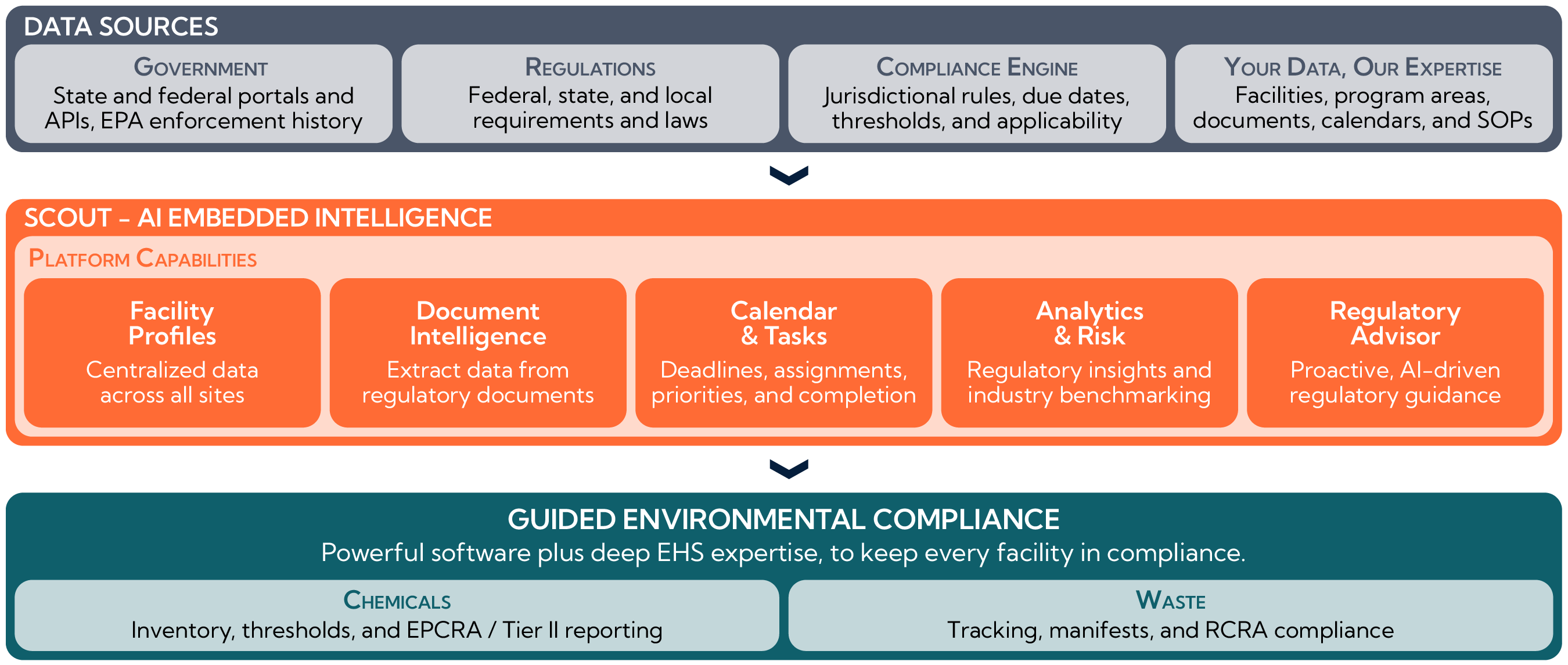
What changed Encamp's mind was not that databases stopped mattering. It was that storage did not solve the staffing problem. Documents still had to be read. Obligations still had to become tasks. The company says EHS teams are handling more work with roughly the same headcount, while enterprises spend far more on consultants than on EHS software. AI gave Encamp a plausible way to attack the work between “the information exists” and “someone acted on it.”
There are sensible guardrails in the current design. Scout shows its regulatory citations. Document findings are reviewed before becoming tasks. Encamp says customer data is not used to train underlying models. It currently uses Anthropic's Claude inside a larger set of compliance-specific tools. The base Regulatory Advisor knows the rules; Scout Pro can know the customer's program. That distinction is more honest than pretending a general chatbot becomes an environmental engineer after reading one PDF.
The market
Narrow depth in a land of broad suites
Encamp competes with broad EHS platforms such as VelocityEHS, Benchmark Gensuite, Enablon, Cority, Intelex and Sphera, plus consulting firms and the undefeated bundle of Excel, SharePoint and email. The broad suites cover safety, incidents, audits and sustainability. Encamp's position is more pointed: US environmental compliance, deep chemical and waste workflows, submissions, payments and experts who know the reporting terrain.
That focus is also the boundary. Encamp says Scout can research across environmental programs, but full data-to-agency workflows currently cover chemicals under EPCRA and waste under RCRA. End-to-end water and air support is on the 2026-2027 roadmap. Canada and Mexico are nearer-term expansion targets; Europe is longer term. A company seeking one global suite for worker safety, carbon accounting, water, air and every audit may prefer a broader platform. A small operator may prefer a consultant and a calendar.
What a founder can steal
- Look for skilled people doing rules-based copying on a recurring deadline.
- Map the exceptions at the jurisdiction level. The ugly data can become the moat.
- Own the last mile, including logins, fees, confirmation and audit proof.
- Sell hours returned, not abstract efficiency.
- Add AI where documents become actions, with human approval at consequential steps.
Encamp has raised roughly $47 million, including a $3.1 million Series A in 2020, a $12 million Series B in 2021 and a $30 million Series C led by Drive Capital in 2022. The company said that round valued it at $150 million after annual recurring revenue grew 500 percent in 2021. It remains private, and current revenue is not publicly confirmed.
The company's most charming habit may be its simplest. Encamp funds a tree for every Tier II report filed through the platform, working with One Tree Planted. It had reported 18,289 saplings by 2021. The gesture will not make hazardous-waste regulation delightful. It does, however, attach one living thing to the end of a process otherwise composed of passwords, PDFs and fee receipts.
The larger lesson is similarly modest. Encamp did not make regulation disappear. It found the point where information becomes accountable work and built there. If Scout succeeds, the product will read more of the paper, remember more of the deadlines and prepare more of the next action. The environmental professional still decides. They just get fewer spreadsheets asking for attention at 6 p.m.