Yo Shibata had become good at starting again. Build a company, sell it, take the experience into the next venture. Each round brought better connections and a little less mystery. By 2025, he had a video game analogy for the arrangement: beginning a new game with the abilities earned in the previous one. An appealing prospect, unless the habit of restarting starts to determine which games you choose.
With Tailor, he decided to stay. He had assembled a team he believed in, found a market he wanted to pursue, and concluded that another reset would offer diminishing returns. The ambition was to make software creation accessible to more people, beginning with the systems businesses use to keep themselves running. Inventory, purchasing, orders. Subjects with limited cocktail-party appeal and considerable power over whether anything arrives on time.
This is the interesting turn in Shibata's career. A founder associated with apps that helped people compare prices and collect shopping points has committed himself to the machinery behind the shop. To understand the choice, it helps to go back to a child who preferred making things to accepting them as supplied.
A telescope before a business plan
Shibata was born in Yamagata Prefecture in 1984. His father researched astrophysics, and the family home contained computers, tools and experimental equipment. He wanted to be an inventor. He built telescopes and took household appliances apart. Tools and experimental equipment gave that curiosity something tangible to work on.
He also liked photographing the night sky. Sport provided another outlet: swimming, football and eventually tennis, which he pursued seriously enough to compete in the national high-school championships. The young experimenter was quite capable of keeping score.
At the University of Tokyo, where he studied economics, his interests moved toward business. He joined WAAV, a student group that organized business competitions. The group offered something more immediate than a heroic founder biography: older students who were already trying things. Starting a company could be an activity conducted by someone you knew.
That detail gives his later career a useful continuity. Long before he invested in founders or talked with them on a podcast, he encountered entrepreneurship through a community. An example nearby can make an unfamiliar occupation look available.
The report nobody wanted
His first student business began around 2005. One early proposition was a report explaining how companies should respond to Japan's personal information protection law. The proposed price was ¥100,000 a copy. Customers declined to share the founders' enthusiasm.
The venture moved through consulting and online marketing. Shibata found search advertising absorbing: bids, leads and optimization made commercial competition feel like a game with visible feedback. Eventually, the team had something customers would buy. The first useful business lesson arrived with the rather unromantic discovery that the initial product wasn't it.
After graduating in 2007, he joined McKinsey. His explanation for taking a job was revealing. The student venture had grown, but he wanted to know how much of that reflected his ability and how much reflected an expanding market or luck. Employment became an experiment in measuring himself.
He later took leave to start Shoppi, a barcode price-comparison app. Other consultants used time away for an MBA. Shibata used his for another company. There are several ways to acquire an education in management; his involved releasing something people could download.
First the shopper, then the shop
Shoppi's company, Code Start, was acquired by IMJ. In 2011, Shibata founded Spotlight, the business behind Smapo. Its proposition was easy to grasp: visit a participating store, check in, earn points. The phone made the visit legible.
Behind that simple action was an ultrasonic beacon system used to detect store visits. Smapo connected a digital reward to a physical arrival. Rakuten acquired Spotlight in October 2013, and Shibata continued running the subsidiary before leaving in 2015.
Viewed together, these products suggest an enduring commercial interest. Price comparison helps a shopper decide where to buy. A visit-reward app helps a retailer persuade that shopper to come through the door. Tailor addresses what happens around and after the transaction: the inventory, the order, the purchase and the financial record. Retail links these chapters, even as his customers and products change.
- 2007McKinsey
- 2011Spotlight
- 2015Tokyo Founders Fund
- 2021Tailor
- 2022YC Summer batch
Eight founders compare notes
In 2015, he co-founded Tokyo Founders Fund with seven other entrepreneurs. The group included Yusuke Asakura, Kensuke Furukawa and Taichi Murakami. Its members brought experience of building and selling businesses, or taking them public, into early-stage investing.
The attraction extended beyond writing checks. Shibata wanted a place where the participants could accumulate experience and exchange ideas. Other members wanted to understand how their peers made decisions. An investment meeting could become a lesson in someone else's judgment.
He also co-founded CloudPort, now Funds, in November 2016. The record complicates any tidy account of a founder simply disappearing between startups. He was investing, helping build other ventures and searching for a project to lead. The search itself became a substantial chapter.
Choosing something worth staying for
By 2022, Shibata was describing trying roughly seven ideas over seven years without finding the conviction he wanted. Around 2019, he changed the question. Instead of looking for an original idea in a promising category, he began looking for a theme worthy of the rest of his working life.
That is a demanding filter. A promising opportunity can survive a spreadsheet and still fail it. The question requires a founder to imagine the repetitive years after the announcement, when novelty has worn off and the work remains.
Shibata has also emphasized market timing and the fit between a business and its founder. As he put it in conversation with Tim Romero, Not just growing but changing market.
Change creates an opening. Experience helps determine whether you are equipped to use it.
“Not just growing but changing market.”
Yo Shibata, on choosing where to build
Tailor was founded in 2021 with Misato Takahashi, its co-founder and CTO. It joined Y Combinator's Summer 2022 batch. Shibata's stated objective was international from the outset: build a product and an organization that could compete globally, while drawing on the team's strengths in Japan.
Taking the screens off the machinery
Tailor's central architectural choice is to separate business logic and data from the interface. The company calls this headless ERP. Enterprise resource planning is the formal name for software that coordinates operations; headless means those operations needn't depend on one prescribed set of screens.
In his writing, Shibata argues that companies need room to change workflows without rebuilding their entire operational system. Tailor exposes functions through APIs, allowing teams to connect applications and develop interfaces around their own requirements. The business can preserve shared records while changing how people work with them.
Consider an illustrative retailer with a warehouse, an online store and wholesale customers. Each team may need a different view of an order. They still need to agree on what has been promised and what remains available. An attractive dashboard offers limited comfort if two departments have sold the same last item.
For Shibata, the underlying aspiration extends to who gets to create software. A founder who depended on engineers to realize his own ideas now wants to reduce the specialist work required to bring other people's ideas into use.
The chef supplies a starting point
Freedom to assemble a system has an obvious complication: someone has to assemble it. Tailor Omakase supplies a more ready-to-use experience on the same underlying architecture. Announced in April 2025 after a Tokyo launch the previous month, it borrows its name from the Japanese expression associated with leaving the selection to the chef.
The culinary reference is unusually apt for business software. Some customers want ingredients and a capable kitchen. Others would appreciate dinner. Omakase offers a prepared starting point while retaining the ability to customize. Tailor says companies can introduce it for functions such as inventory and purchasing alongside an existing accounting system.
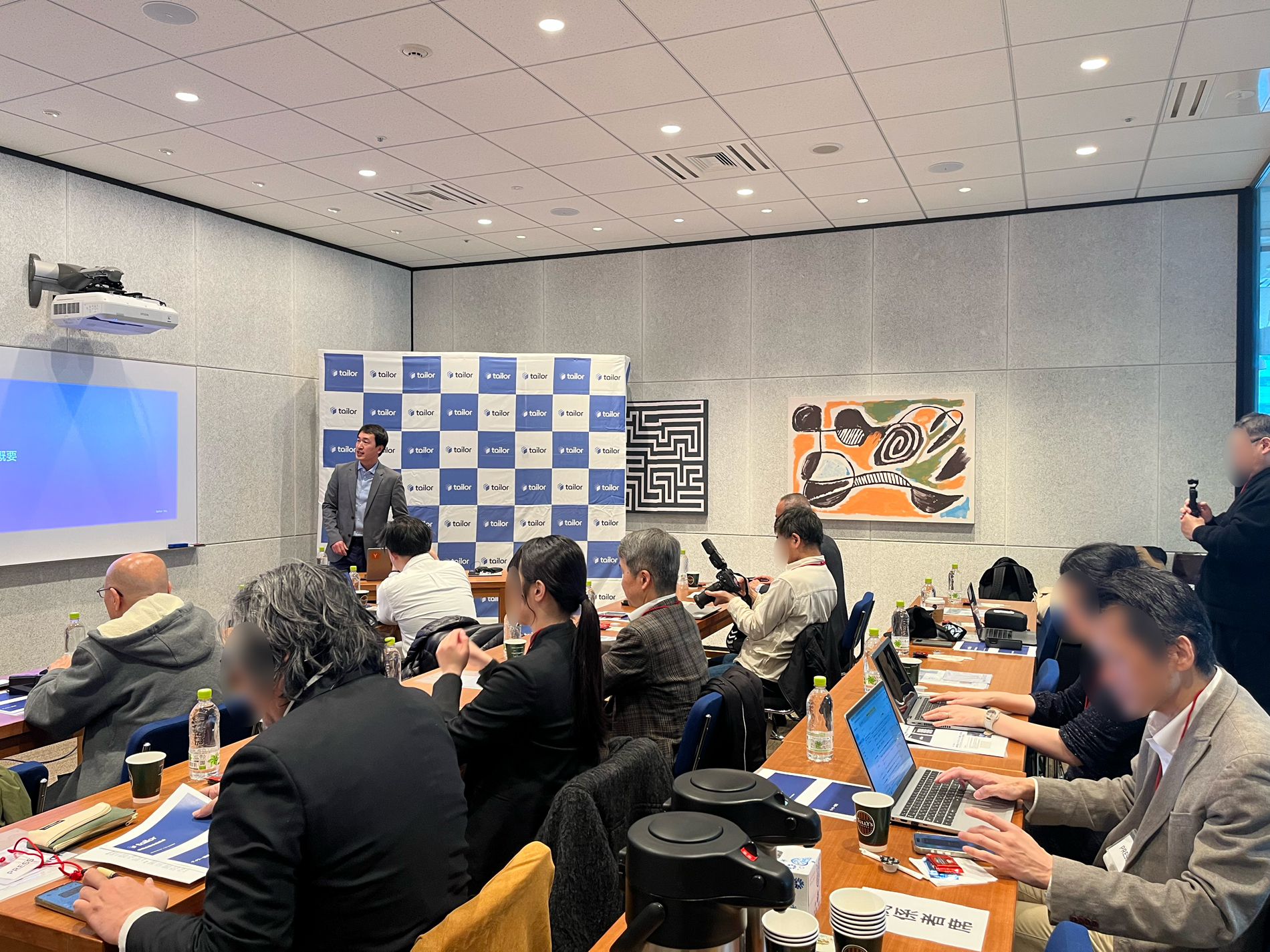
In April 2025, Shibata also announced a $5,000 operations resilience grant for U.S. retailers facing tariff-related supply-chain disruption. The program accepted applications from customers and non-customers. Its modest scale was part of its description: direct help with immediate costs while the company pursued a much larger software problem.
A longer commitment, measured in public
Tailor's Series A progressed through 2025, reaching $37 million at its final close in November. Shibata identified expansion in the United States, a deeper presence in Japan and product development as priorities. Capital made the commitment more concrete: the next phase required delivery across two markets.
In September 2026, he announced a partnership with SoftLedger. Tailor handles operational functions, while SoftLedger supplies the financial system of record and general ledger. The arrangement gives a practical expression to his argument that critical systems should evolve independently while remaining synchronized. A philosophy about modularity has to survive month-end accounting.
He continues to think aloud. START/FM, the Japanese-language podcast he co-hosts, discusses the practical questions of starting and running companies. Tailor's Big Picture webinar series gives him another setting for conversations about IT strategy and organizations. His public work includes both making a case and asking other people how they work.
He has described conversations with customers and colleagues as his favorite part of the job. That is a fitting place to leave him: close to the people whose requirements keep changing. For a founder who once measured progress by the next beginning, Tailor presents a different test. Keep listening. Keep building. Make the system useful enough that someone else's day becomes a little less complicated.