Scott Carver went fishing and found more work. After a day on Montana’s Madison River, he and a group of friends began considering where to fish next. The pleasant question produced an unpleasant amount of homework: access points, distances, river conditions, private land, local shops. For someone who had spent years building software businesses, this was an awkward discovery. The fish were elusive enough. Why should the information be?
That planning exercise became the idea for onWater. Carver had already helped build PlanSource, the employee benefits software company, and owned a fishing lodge. Here was a problem that required both sides of his working life. His response was characteristically practical: “we could build this”. A day off had acquired a product roadmap.
The connection is less improbable than it first appears. Software for employers and software for anglers both have to organize information before someone makes a decision. A misplaced detail can undo a handsome interface. Carver’s career makes an interesting case for paying attention to the practical questions that remain after the sales presentation has ended.
A lodge before the exit
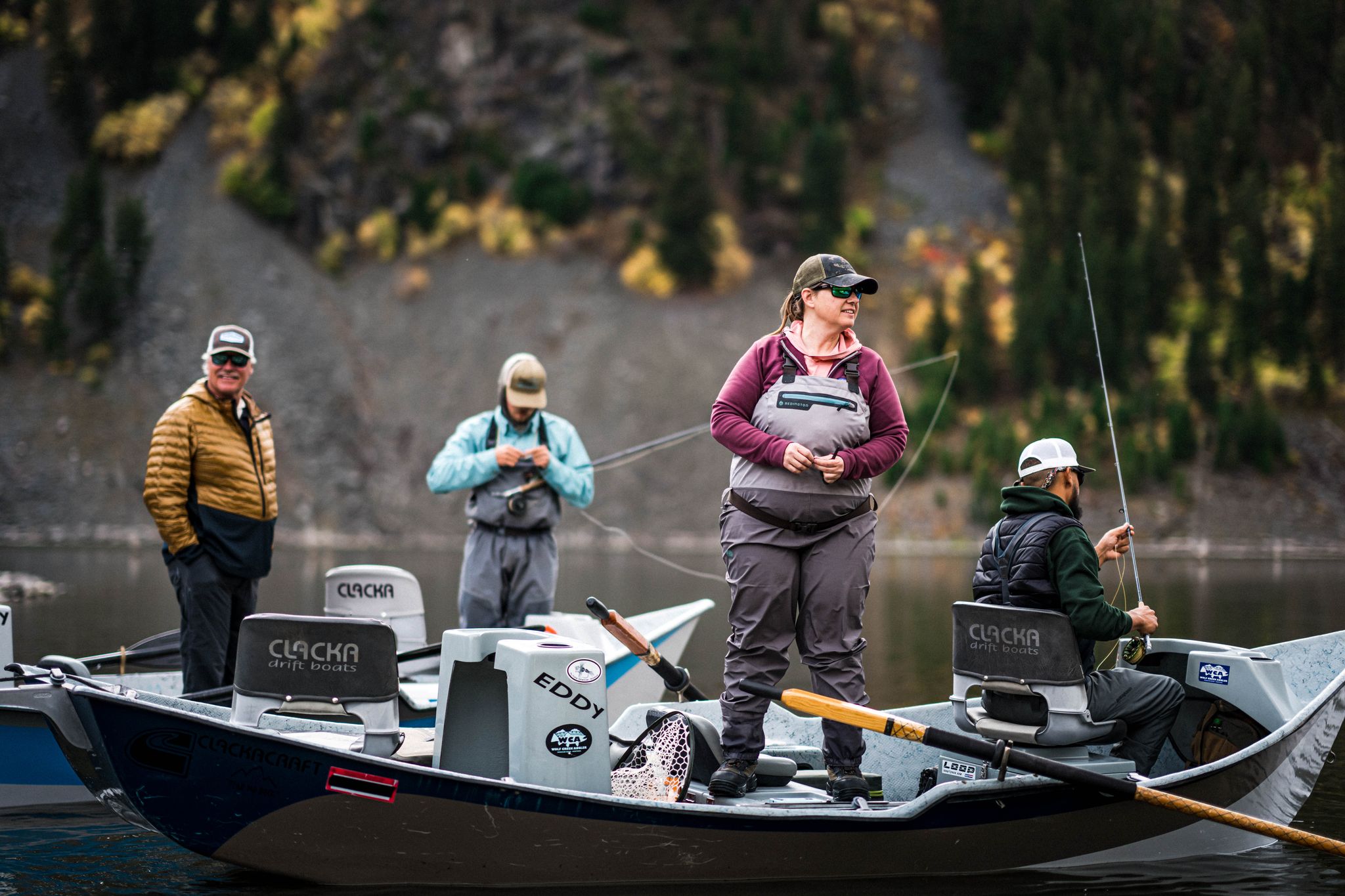
The river was part of Carver’s life long before his departure from PlanSource. In 1993, he and his family became the original owners of Madison Valley Ranch, near Ennis, Montana. The property gave an enduring address to his interest in fly fishing. This was a business with beds, meals, guides and returning guests, as well as a particularly persuasive reason to spend time outdoors.
Two of his eventual partners, Tom Fochtman and Dan Larson, had met him playing pickup basketball at the Denver YMCA in the early 1980s. They became partners at the ranch in 2003. There are elaborate theories about how business networks form. In this instance, a basketball court will do. The relationship had time to become a friendship before it became an ownership arrangement.
Eaton Outfitters became the ranch’s lead outfitter in 1996. Jeff Millhollin joined the ownership group in 2023. Those dates give the enterprise its shape: an original family investment, long relationships and later additions. Carver’s outdoor work has a history of its own, rather than serving as a scenic footnote to his technology career.
The work behind the screen
Before onWater, Carver founded SYLINQ, which Ceridian acquired in 2002. He went on to become a founder and the founding chief executive of PlanSource, later serving as its president. The succession of titles matters less than the continuity of the work: helping organizations manage transactions and information that otherwise become a collection of separate administrative chores.
In December 2008, PlanSource acquired a Spokane firm and Carver was discussing expansion in Louisville, Colorado, and Salt Lake City. At the time, he said the company planned to hire 10 to 12 employees in Louisville, with larger expansion plans in Salt Lake. It is a useful glimpse of the founder at an earlier scale, when growth could still be described in the number of people expected through one office door.
By the middle of the following decade, Carver was writing about what buyers should demand from enterprise software. His concern was the machinery behind the shopping experience: employer rules, routine changes, billing and the transfer of information between organizations. An attractive screen could introduce a service. It could hardly carry out every obligation on its own.
His argument was specific enough to be unfashionable. Buyers needed to ask whether the system could consolidate bills and handle ongoing administration. A product demonstration has an audience and a finish. Administration has tomorrow morning. The distinction helps explain why his later fishing venture would give so much attention to access information and the accuracy of a point on a map.
Retirement, with another company attached
Vista Equity Partners acquired PlanSource in April 2019. Carver retired from the company in May. That sequence supplies a clean dividing line in his career, although the next chapter would bring familiar work. His fishing experience and his experience building software were about to occupy the same business.
PlanSource continued to grow after the transaction. Its account of 2019 described a 33 percent increase in new-business bookings and more than 1,500 new employers, associations and resellers beginning to use its platform. Those are company figures for that year, rather than a personal scorecard for its departing founder. They help place his exit within a business that had moved well beyond its early office expansion.
Retirement can sound like a conclusion when it appears in a biography. In Carver’s case, it marks a change of subject. There was another set of users to understand, another collection of disconnected information to organize, and a place he already cared about in which to test the result. The river offered a different customer interview.
A phone at a gathering about getting outdoors
In 2022, onWater brought together 25 anglers at Madison Valley Ranch for its first Confluence gathering. The discussions ran over two days and addressed a question with no tidy answer: how should technology fit into a sport many people pursue to escape it? Carver put the tension plainly.
“We used to go outside to get away from technology, but now we’re using it to enhance the outdoor experience.”Scott Carver, at Confluence, 2022
Conservation and ethics occupied much of the conversation. Participants considered how digital tools might support donations, volunteer participation and the delivery of information about closures and responsible fishing. The setting gave the discussion some useful discipline. A gathering beside a river has a rather visible reminder of what is at stake.
This is a more demanding brief than helping someone find a promising stretch of water. Better information can change where people go and what they do when they arrive. An app’s usefulness has to be considered alongside its effect on the places it describes. The conference made room for that argument inside the company’s development, rather than leaving it entirely to customers after launch.
The mistake that came along for the trip
Carver has also described an early onWater decision that went wrong: outsourcing the original platform’s development. The company subsequently brought engineering in-house. In his telling, the change was costly and decisive. Experience building previous companies had supplied confidence; it had not provided immunity from an expensive wrong turn.
He also explained a principle for the product’s scope: “an inch wide and a mile deep”. It is a modest unit of measurement for an entrepreneur with a national mapping problem. The point was to concentrate on a few useful capabilities before moving into the next phase. Navigation and reliable detail would have to earn their place on an angler’s phone.
The contrast is revealing. A founder can recognize a market and still need to change how the work gets done. Bringing engineering closer to the business gave onWater a different way to develop its product. The lesson is practical, with none of the glamour usually attached to a company’s origin story. Sometimes the next step is changing the team that writes the software.
The people who make the risk possible
Asked in 2022 who deserved credit for his entrepreneurial career, Carver named his wife, Lisa. He described the support and tolerance required when starting businesses consumes time, attention and family money. It is one of the more personal parts of his public account, because it places the consequences of founding a company inside a household.
That acknowledgment adds weight to the otherwise cheerful language of starting things. Financial risk does not remain politely confined to a business plan. Time away is still time away. Carver gave Lisa a central place in explaining what had allowed him to continue. The founder’s biography has another participant, even when only one name appears at the top.
His suggested itinerary for visitors is less complicated: mountains, Denver’s Union Station and LoDo, restaurants in the Highlands, a game at Coors Field and a chile relleno at Brewery Bar II. It offers a welcome change of scale. A person can spend years thinking about markets and still have a fairly clear idea of where lunch should happen.
More people on the map
By December 2025, onWater had announced a $2 million financing round led by Scrum Ventures. Its two apps, onWater Fish and Paddleways, had a combined 400,000 users, a figure reported at the time. Carver was working with co-founder Tim Harrington and president Alex Maier. The business had grown from a fishing-trip problem into a company serving anglers and paddlers.
combined users across onWater’s two apps
Company-reported figure in December 2025 coverage.The company’s conservation work also took a concrete form through a test membership partnership with Trout Unlimited in 2024. The arrangement connected an angling app with an organization whose work centers on conserving fisheries and watersheds. It gave Carver’s stated interest in stewardship an organizational connection beyond a statement of intent.
OnWater’s current description of its purpose emphasizes preparedness, access and stewardship. Read alongside Carver’s earlier work, the continuity is persuasive: understand the decisions people need to make, gather the information those decisions require, and make the process easier to navigate. That is an editorial reading of his career, rather than a formula he has claimed for every business.
There is something appealingly inconvenient about the result. Carver found a place he wanted to spend his free time, helped build a lodge there, and eventually discovered another software problem on the water. The Madison had supplied him with a business address and then a reason to start again. He went looking for the next place to fish. The work followed.
Follow the current
Explore onWater Fish, Madison Valley Ranch and PlanSource. Connect with Scott Carver on LinkedIn.
Read the 2023 onWater conversation, his Colorado interview and December 2025 financing coverage. Watch Behind the Brand: onWater or listen to his Ask About Fly Fishing appearance.