The useful thing about a restaurant is that it will explain your mistakes by taking your money. Rent is punctual. Payroll has no interest in your theories. A beer poured but never rung up becomes a tiny amber subtraction from the month. Jose Hevia learned this grammar from the floor up: waiter, manager, licensee, owner. By the time he entered technology, he had spent decades watching the small frictions that slide between a sale and a profit.
He did not set out to found an Internet of Things company. His first ambition was more immediate. While studying international business at Auburn University, he worked weekends at Taco Mac in metro Atlanta. He left school halfway through his senior year, a decision he later called terrible, and went to work full time. He and his roommate moved from waiting tables to management. At 23, they wanted to own restaurants. Soon they were Taco Mac licensees.
The numbers were instructive. Hevia borrowed $150,000 through the Small Business Administration to open his first place with a partner. Sales could reach about $1 million a year and still leave little after taxes, wages, rent and debt. He worked behind the bar for tips while taking what salary the business could bear. The revenue looked substantial. The remainder was shy.
A tap handle, observed abroad
In 2006, cousins in Madrid took Hevia to a bar where guests poured beer from taps at their tables. He took a picture. On the nine-hour flight home, he worked through how the idea might fit the restaurant he was preparing to open in Suwanee. The imported novelty immediately ran into an operator's questions. How do you meter the beer? How do you display ounces? How do you control access?
He found people online who could write software and spent about $10,000 on an early system. When Cheeky opened in 2007, its beer tables gave customers controlled access to a tap while the restaurant tracked the pour. The first version offered a single tap at each table. Guests asked for more variety, so later tables became larger. At a second location, the idea grew into a self-serve wall activated by a merchant-issued card.
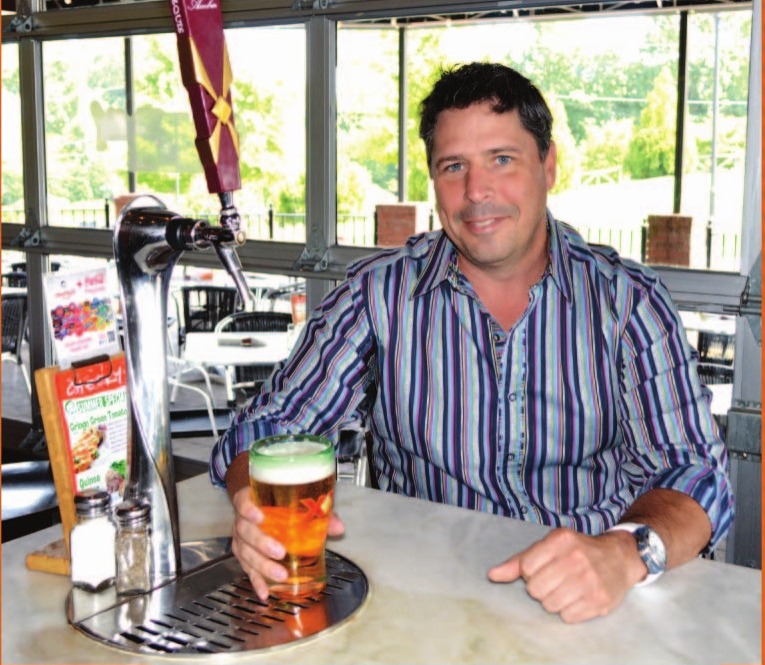
The attraction was tactile, but the business value sat behind the theater. A measured tap could tell an operator what was poured, when it moved and what should have been charged. Customers could sample an ounce instead of committing to a glass. Staff could apply limits. The humble tap had acquired memory.
Other restaurant owners began asking Hevia to build beer tables and walls for them. A feature inside one restaurant had become a product with outside demand. DraftServ was formed in 2010, somewhat on the fly, to answer it.
The connected-pour loop
the guest
the allowance
the dispense
the data
The neighbor with a ship
Expansion arrived in the convivial way appropriate to the product. A neighbor who sold software to Carnival Cruise Lines asked over a beer whether the system could work on ships. Hevia said yes, then proposed using a passenger's room key to activate a station and place the purchase on the cabin bill. The introduction became a Carnival deployment in 2013.
A ship changed the engineering problem. The product had to operate far from Suwanee and fit into a customer's existing identity and billing system. DraftServ developed mobile units capable of handling multiple drinks. The company was learning that its future did not depend on building a particular blue box. It depended on connecting permission, payment and liquid.
The larger public test came at the 2014 Major League Baseball All-Star Game in Minneapolis. DraftServ had not worked in stadium concessions before. The kiosks were placed where major concessionaires and beverage companies could watch the result in real time. Hevia later described the event as a bet on the company.
The concessionaire had hoped for roughly $2,000 on day one. Hevia said the kiosks produced $18,200 and outsold every kiosk in the stadium. Television calls followed. A Suwanee Magazine account said DraftServ's monthly website traffic jumped from about 300 unique views to 50,000 in July.
Attention, as founders discover, is an invoice disguised as applause. Orders increased. Supply became the constraint. By May 2015, sports-business reporting placed DraftServ at roughly a dozen venues, including MLB parks, NHL arenas and NFL stadiums, as well as Churchill Downs and Indianapolis Motor Speedway. Hevia said 500 systems were on order and demand exceeded supply.
When the machine became a system
The early story was easy to photograph: a guest taps a stored-value card and pours a beer. The more consequential work was harder to see. DraftServ sold analytics that could track sales patterns, improve keg yield and help concessionaires compare performance across locations. At sea, a room key supplied identity and payment. At a stadium, an RFID card supplied an allowance. The machinery differed. The logic repeated.
By 2020, Hevia was describing DraftServ as a software-platform company. Its BevBot could sit beside a dispenser and read a student ID, room key, mobile wallet, RFID tag, printed cup or QR receipt. On the other side, DraftServ's software connected to the equipment and controlled what could be poured, how often and for whom. The same platform captured the transaction data for the operator.
This was Hevia's larger observation. Cash registers had become point-of-sale systems, but most beverage dispensers remained isolated appliances. They did not know the user, the payment, the allowance or the inventory event they were creating. DraftServ's patented BevOS platform set out to give them those connections without asking the operator to replace every machine.
The restaurant experience mattered here. Hevia understood that operators rarely want technology for its own charming sake. They want a shorter line, a cleaner count, a faster transaction, less waste or a new way to sell. At New Orleans' airport, he described a coffee setup in which a customer received a QR-coded receipt, scanned it at a dispenser and received only the purchased drink. The existing beverage remained. The labor and fulfillment pattern changed.
Reinvention without amnesia
Hevia's jump into software happened in his 40s, after roughly 25 years in restaurants. He was candid about the learning curve. Early on, he assumed code was written once and finished. Instead, engineering required constant attention and a growing payroll. Rapid demand created its own danger. Every mistake cost money in an unfamiliar way.
That candor keeps the story from becoming a tidy founder fable. Cheeky itself had nearly failed before it found footing. During construction in 2007, its bank stopped lending four weeks into the project as the economy slid. Hevia put in every penny he had, promised vendors weekly payments as revenue arrived and later sold his Taco Mac stakes to keep Cheeky alive. The first year and a half were thin.
The restaurant survived long enough to become DraftServ's laboratory. The lab survived long enough to become a company. The company survived long enough to change its own definition, from beer-table builder to connected-beverage platform.
The last inch of the sale
Recent DraftServ deployments have pushed the idea into checkout-free venues. In late 2023, Hevia highlighted tap-wall integrations with Zippin at Capital One Arena and Gillette Stadium. A guest could enter with a payment method, pour and leave without using a separate stored-value card. In March 2026, he framed BevOS as a platform layer that adds identity, authentication, measurement, data and integrations to the dispenser. The following month, he shared a venue result that put fountain sales at three times forecast.
The public language has become terser as the machinery has become more complex: Scan. Pour. Go. That compression is a product achievement. A room key, QR code, student badge, mobile wallet or connected cup can carry the permission. The platform reconciles it with the machine. The guest sees a drink and, ideally, not much else.
There is an especially practical lesson in Hevia's route from waiter to founder. The best place to notice a missing system may be inside a business that still counts physical things with proxies. Cups stand in for ounces. Kegs stand in for servings. A cashier records the purchase while the dispenser performs the fulfillment, and the space between them becomes guesswork.
Hevia spent years in that space before he named it. His advantage was not arriving from the future. It was remembering every Saturday night when the line grew, the keg foamed, the tally drifted and the margin quietly escaped. Then he put a meter on the pour.