In June 2012, Nokia's Emerging Products Unit in Oulu learned that it was going to close. Later that day, employees gathered to consider their options. The work had an ending; the people still had ideas. Among them was Pasi Leipala, an engineer and manager with fifteen years at Nokia behind him. What could they do together once the company no longer required them to do anything together?
Leipala's answer became Haltian. It took a couple of months to establish the business, reach out through international contacts and win the first customer projects. He had bought design services during his previous career, so he understood the market from the other side of the table. That experience mattered. A capable team still needs somebody willing to buy its capabilities.
He later recalled discussing the possibility of a company over a beer in a local bar. The setting has the reassuring informality of many business beginnings: no stage, no carefully lit launch announcement, just colleagues considering whether their skills could pay their own way. “We knew that IoT would be really big in the future,” he said. The practical question was how to earn a living while that future arrived.
“We knew that IoT would be really big in the future.”
Pasi Leipala, 2016
The founding story is often told as a new beginning. It also describes something being kept: relationships, shared experience, the ability to turn an idea into an object that works. A corporate unit can disappear from an organisation chart in an afternoon. Rebuilding the knowledge held by its people takes rather longer. Haltian gave some of that knowledge a new place to go.
First, give the idea a working body
Leipala trained in electrical engineering at the University of Oulu. His technical curiosity had early outlets in computers and motocross, where riding came with a considerable amount of maintenance. By 2006 he was leading a global Nokia team; from 2008 he was responsible for Oulu's Symbian hardware design. His career put engineering and managing people in the same room, with all the complications that arrangement brings.
At Haltian, the early proposition was product development for other companies. It was a sensible way to begin with experienced engineers: customers supplied problems worth solving, and the team supplied the skills to make a device. Engineering services offered immediate work while the company explored products of its own. The distinction between the two would shape Haltian's next several years.
Consider Wave, the musical ring developed by Iceland's Genki Instruments. A musician moves a hand; the ring can control sound and effects. There is an appealing theatricality to that idea, but getting it manufactured is decidedly less theatrical. Haltian worked on the mechanics concept, manufacturing strategy, suppliers, logistics, testing and certification. These are the details that stand between an attractive demonstration and a product somebody can actually receive.
In 2019, Leipala attributed the project's progress to communication and a clear vision. Jon Helgi, Genki's head of design, described help ranging from mechanical design to antenna tuning. It is a useful glimpse of Leipala's business before office sensors dominate the picture: other people's inventions needed a route into production. The route involved several disciplines and considerable attention to the parts no audience applauds.
An office has a surprisingly busy inner life
Haltian developed Thingsee One and Snowfox before building out the Thingsee platform. In the Snowfox project, it worked with Kii on the connected service behind the device. The name came from the company's northern Finnish setting and the trace left by a wandering snowfox. Even a piece of electronics needed a little local colour. More substantially, the project brought device engineering and a partner's backend expertise together.
The later business moved into everyday operations. In 2019, Haltian announced cooperation with Finland's postal service, Posti, on self-service lockers. A parcel locker makes a modest promise: the right compartment should open for the right customer. Fulfilling that promise consistently requires the machinery behind it to behave. Connected technology earns its place here through a successful collection, rather than a user's admiration for the network.
Facility services supplied another audience. In 2020, ISS announced a global partnership after using Haltian's sensors and platform in Finland for more than a year. Leipala described the goal in approachable language: “Our goal is to make IoT easy for everyone”. For a facility manager, easy has to include installation, daily operation and a useful result. A sensor that produces data adds a responsibility; a service that makes that data usable can remove one.
Then, in September 2020, Haltian agreed to acquire Empathic Building from TietoEVRY. The companies had already worked together. The service supplied a digital twin of a workplace, a virtual map showing such things as available desks and meeting rooms. Tomi Teikko continued to lead the business as it transferred. The acquisition linked Haltian's data collection capabilities with a visible interface for the people using the building.
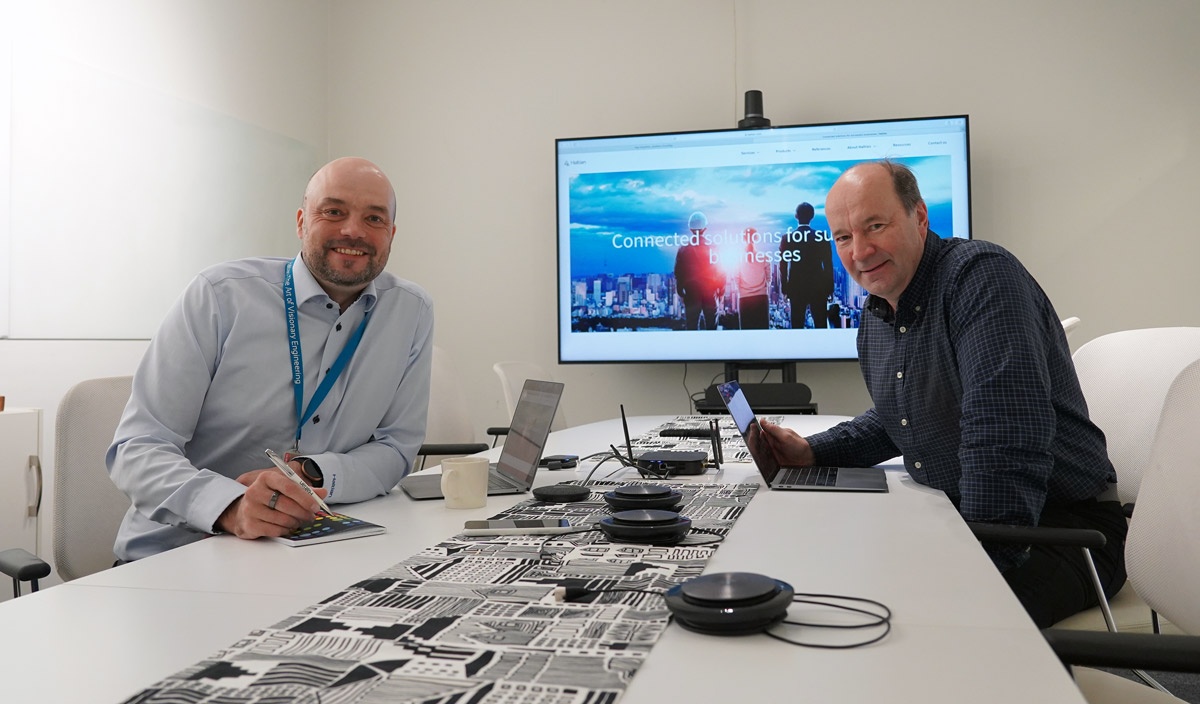
The photograph of Leipala and co-founder Jyrki Okkonen signing the papers has the unceremonious look of actual office work: a table, computers, coffee and documents. Its significance lies in the business being added. With Empathic Building, a reading from a sensor could help answer a question an employee already had. Where can I sit? Which room is free? The office finally had a way to explain itself.
Growth needs more than another clever device
The figures became larger. In 2021, Haltian's revenue rose from €9 million to €15.5 million, a reported increase of more than 71%. Its investor Nordic Option identified smart buildings as the strongest growth area. Those numbers describe company revenue, rather than Leipala's personal wealth. They show a business finding demand for its work, with the operational burden that accompanies selling more of it.
The organisation had to change as well. Tapio Arimo joined as CFO in February 2021, bringing experience of finance and international business. Leipala described the appointment as part of a move from startup to growth company. Arimo also had a fifteen-year Nokia background, a familiar point of reference in a company born from that organisation. Keeping a company together eventually requires different skills from getting its first product together.
Chairman Erik Hallberg brought experience from international executive roles at Telia. Leipala connected the board appointment with the need for the organisation to match its ambitions in smart buildings and industry. The pattern is concrete: bring in people whose experience addresses the company's next set of problems. A founder cannot personally become every specialist the business will need, however convenient that might look on a budget.
In April 2023, Haltian announced €22 million in growth funding, led by Mandatum Asset Management Growth Equity, with Varma, Tesi, Ventic and Inventure participating. It reported €40 million raised in total at that point. The stated uses included international expansion and recruitment. Offices in the Netherlands and California were already part of the picture. Funding bought room for further work; customers would still have to make that work worthwhile.
Nordic Option reported that 70% of Haltian's revenue came from outside Finland in 2023. The company's own announcement put the US share at one third. Those proportions make Oulu an interesting starting point rather than a geographical limit. Leipala's early familiarity with international engineering work now had a commercial counterpart: a business based in northern Finland selling to organisations with buildings elsewhere.
A smaller scope, after twelve years
On August 23, 2024, Mikko Moilanen started as Haltian's interim CEO. He had joined as an external advisor in June. Leipala continued as co-founder and senior advisor. Chairman Hallberg thanked him for twelve years of developing the business and described the next emphasis as scaling sales and the route to market. The handover recognised that a company's needs can change even when its founder's commitment remains.
Leipala's own account gave the transition a personal scale. The company had 135 experts, customers in more than twenty countries and a presence in six. He thanked the founding team, employees, customers, shareholders, board, partners and his family. His description of the new work was particularly revealing: special projects, a different angle and a narrower scope, with the hope of a substantial contribution. A change in title could also be a change in how much of the business occupied his day.
Leipala’s account of the company at his 2024 handover.
In a subsequent public update, he said he was continuing the advisory relationship as an independent consultant, able to work with other companies too. He listed company building, teams, product creation, wireless connectivity and partnerships among his areas of experience. He also described taking time to study and consider what to build next. It was an account of someone deciding how to use what twelve years had taught him.
In June 2025, he moved to Oura as senior director of hardware engineering. His own later posts recruiting electronics engineers in Oulu confirm the new affiliation. The engineering thread continues, now with another team and another set of products. His recruiting language covers the full product lifecycle, a familiar concern for somebody whose business has repeatedly dealt with the distance between an idea and a finished device.
Away from those roles, Leipala has named golf, motorcycles, family and friends among the things that fill his time. The list is ordinary in a pleasing way. Business profiles can make a person seem to exist entirely inside a funding announcement. Here is an engineer with a life around the work, and a career in which colleagues keep appearing alongside the products. Haltian began because a team saw a way to continue. Twelve years later, its founder could continue too, without remaining its CEO.