Dr Lynne Lim would like to build a hundred tree houses. Her personal biography describes a place full of unusual designs, interesting materials and little corners worth exploring. It is a rather elaborate dream for someone already running a company. Most executives would settle for a holiday with a reliable internet connection. Lim has imagined an entire settlement in the branches.
The tree houses remain an aspiration. NousQ, the Singapore company she founded with Gan Chee Wee in 2021, is very real. Between the two lies a useful clue to her character: she likes the act of making things. A finished object interests her, but so does the work of finding its shape, deciding how it should function and figuring out whom it might serve.
That creative interest predates her business. As a young woman, she wanted to study architecture. Years later, she was still drawn to design, reading and writing. The route into entrepreneurship was indirect, which makes it more interesting than a tidy childhood prediction. People often explain a founder’s life backwards, arranging every early incident into an orderly procession towards the company. Lim’s story leaves room for a change of mind.
A company after a career
By the time NousQ began, Lim had already held senior academic and administrative responsibilities. She served as vice-dean for academic affairs at the National University of Singapore’s Yong Loo Lin School of Medicine from 2011 to 2014, following a year as assistant dean. These were roles inside a large institution, with obligations that extended well beyond her own projects. Starting a company meant taking on a different sort of responsibility.
Her move into private practice in 2014 gave her more control over her schedule. The distinction mattered because an invention takes time in a way that a job description rarely anticipates. Research can occupy the space left over after other duties. Developing a product asks for a place near the centre of the calendar. Lim wanted the idea she and Gan were working on to progress beyond a research project.
In a later account of NousQ’s beginnings, she described making the decision to establish the company almost overnight. The decision followed years of development. Sudden choices can have very long preparations. By 2021, she had reached the point at which continuing the project meant becoming responsible for its commercial future, as well as its technical one.
There is a social awkwardness to starting again after acquiring expertise. An experienced person becomes a beginner in several public ways at once. The founder has to learn how to raise money, assemble a team and explain a proposition to people who bring entirely different questions. Lim had considerable experience to draw on. She also had a substantial amount to learn. Both conditions can exist in the same person.
“I like to be proud of my work.”
Dr Lynne Lim
The small team with several jobs apiece
NousQ’s early arrangements were modest. Lim and Gan began without a proper office for the first year. She took no CEO salary; his pay was low. A small seed round followed four months later. The company then added a third person for finance and strategy in 2022, followed by a fourth for operations and quality assurance. Each appointment filled a practical gap.
Lim described the group with the phrase “Bao Gar Liao”, capturing a team whose members take on whatever needs doing. The description is more revealing than a polished claim about culture. It suggests the everyday flexibility of a small business: a responsibility belongs to somebody because somebody has to carry it. Job titles become a starting point for work, rather than its outer boundary.
Gan brought an engineering background from the National University of Singapore and became NousQ’s chief technical officer. The company describes a collaboration on its flagship product, CLiKX, stretching across a decade. A partnership that long has room for countless revisions. It also gives the familiar startup picture of a lone inventor a useful correction. Here, two people have carried different parts of the same problem.
A founder and a technical cofounder must keep translating. One person’s description of what an object ought to do has to become another person’s workable design. The design, in turn, may reveal limits that require the original description to change. Lim’s account of the project includes major and minor revisions. The work proceeded through those revisions, rather than around them.
A decade-long collaboration, with major and minor design revisions.
An audience gets a vote
In September 2022, NousQ reached the grand finals of the MedTech Innovator Asia Pacific accelerator. The winner was decided by a live audience vote at the event in Singapore. NousQ won, receiving a US$175,000 grand prize. The announcement followed in October. After the private work of developing a product, the company now had a public result to point to.
The programme placed NousQ among other founders, mentors and industry participants. Lim has emphasised the value of that contact, including weekly webinars and detailed advice. An accelerator is often discussed as a route to money or visibility. Her account gives attention to the less glamorous benefits: learning from people who have already met a difficulty, and discovering a blind spot before it becomes an expensive mistake.
A vote also asks a founder to become an editor of her own work. Years of development cannot all fit inside a pitch. Choosing what to explain means choosing what the audience needs first. The technical team may know every revision; the listener needs a reason to care. That change of scale, from intimate knowledge to a clear public account, becomes another part of building the company.
Shenzhen, and the conversation after the prize
On May 22, 2024, Lim received first place in the Science & Technology Pioneer category at the Cartier Women’s Initiative awards in Shenzhen. The category had attracted 234 applicants. Her award came with US$100,000 in grant funding. The programme also offered mentoring, education and entry into a continuing international community. For a small company, those different forms of support serve different needs.
Awards Week supplied a useful encounter. Other fellows repeatedly encouraged Lim to meet Cécile Réal, an entrepreneur and investor who had been a Cartier fellow in 2012. Réal was also hearing that she should meet Lim. When they finally crossed paths, Lim arranged an impromptu pitch in her hotel room between lectures. Formal networking acquired a rather informal address.
Réal’s recollection makes Lim easier to picture than a list of awards does. She remembered a founder who smiled, joked and spoke openly about the project’s challenges. Lim, for her part, valued Réal’s precise questions and considered advice. The attraction was professional and personal: useful expertise arrived with a manner that made it possible to talk frankly.
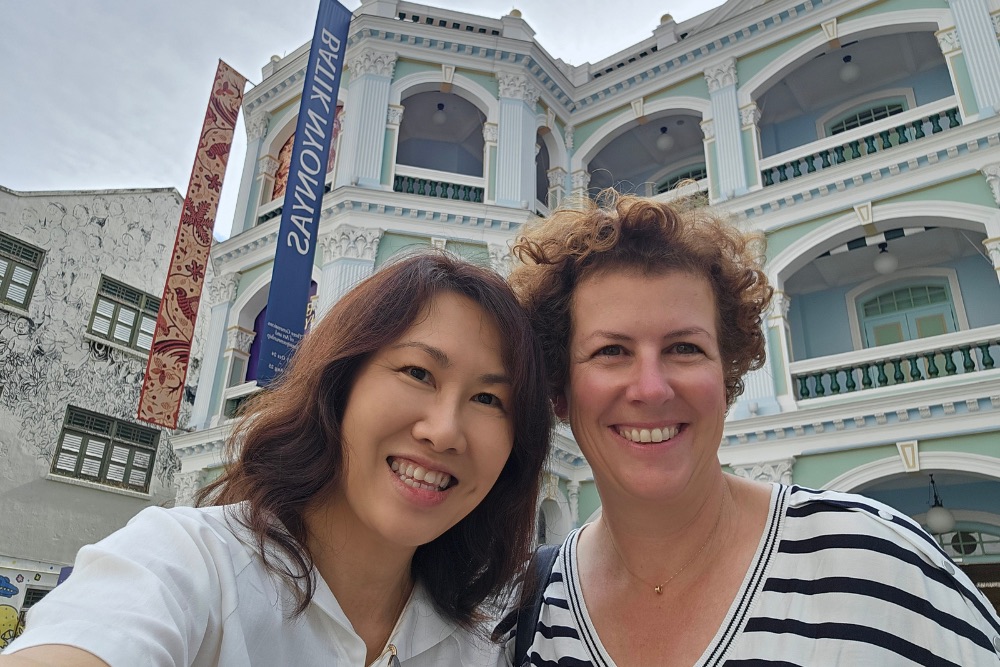
By the end of 2024, Réal had joined NousQ’s advisory board. The two spoke most weeks, and Réal visited the company in Singapore. The connection became an ongoing working relationship. It is tempting to give the ceremony all the narrative attention, because ceremonies have lighting and a definite ending. The recurring conversation afterwards is less photogenic, but it is where advice has a chance to affect decisions.
The next questions are practical ones
In early 2025, NousQ closed an oversubscribed US$7.5 million pre-Series A funding round. The sum belongs to the company’s financing, not Lim’s personal wealth. It marks a change in resources available to the business. The work ahead still requires choices about people, product development and expansion. Funding gives a team more room to act; it also gives the founder more decisions to make.
In January 2026, Lim and NousQ colleagues planned meetings in San Francisco during JPM week, including RESI. Her public post looked forward to new connections and partnerships. The team’s international ambition was appearing in the calendar as meetings with prospective collaborators and investors. A global business is built partly through those very ordinary entries: a place, a date, a person to speak with.
Lim also makes a practical point about product adoption: support matters. At a 2025 industry panel, she emphasised training and technical help for the people expected to use new equipment. The observation connects a founder’s wish to make something useful with the experience of receiving it. A product has a life after the presentation, and the company needs to be present for that life.
This is a demanding definition of making. It stretches beyond the object to include the explanation, the introduction and the help available when a question arises. Lim’s career has taken her through teaching, institutional leadership and entrepreneurship. Each setting gives her a different view of what happens when an idea meets another person’s working day. NousQ asks her to bring those views together.
There are still tree houses to imagine
Away from work, Lim’s personal biography records a taste for good writing and travel to quieter places. Her hundred-tree-house dream remains there too, wonderfully specific in its appetite for materials and unusual spaces. It would be premature to turn it into a second business plan. It can simply stand as a private ambition, a reminder that a founder has interests beyond the company she leads.
The appealing thing about that dream is the pleasure it takes in detail. A hundred tree houses would allow a hundred answers to the same broad question. NousQ has demanded a different kind of repetition, in which successive versions must move towards a workable product. In both cases, Lim’s interest in design gives her something to return to when the first answer needs more work.
Her story makes starting again look substantial. It involves a calendar cleared for development, an early team working with limited resources, a technical partnership maintained over years, and conversations that become continuing commitments. The awards are part of it. So are the revisions. For Lim, a long career supplied the experience to begin another undertaking, and the new undertaking supplied plenty of reasons to keep learning.