Before Hanson Gifford had a board to answer to, he had the Coast Guard looking for him. Growing up around Dartmouth, Massachusetts, he sailed with friends across the bay and out to islands. Sometimes the teenagers ventured out when they should have stayed ashore. Years later, recalling those excursions, he connected the experience to starting companies: uncertainty arrives, the situation changes, and getting flustered makes a difficult problem harder.
It is a useful opening for a career usually described with acquisitions, patents and investment funds. Those measures have their place. But Gifford’s story becomes more interesting when you watch him change jobs within a job: the engineer learning marketing, the company founder learning finance, the executive arguing that other people should make decisions. Each move gives him another way to understand what happens between an idea and a functioning business.
A builder changes seats
His education was in mechanical engineering at Cornell, where he earned a bachelor’s degree. His early engineering employers included General Dynamics and Oximetrix. From 1985 to 1990, at Devices for Vascular Intervention, his responsibilities stretched across engineering, research and marketing. That sequence matters. A product can be sound on the drawing board and still leave unanswered questions about how an organization will introduce it, support it and persuade someone to buy it.
For an engineer, crossing into marketing changes the questions. Specifications stop being the whole conversation. The audience has its own priorities, vocabulary and timetable. Moving between departments gives a builder a view of the points where technical work meets other people’s expectations. Gifford’s subsequent career would put him repeatedly at precisely those intersections.
He became president of Cardiovascular Therapeutic Technologies, which Eli Lilly acquired in 1991. In 1992 he co-founded Bavaria Medizin Technologie in Germany and served as managing director. Then came Heartport, where he was vice president of research and development. Between 1993 and 1998, he built and led a 62-person team. Heartport went public in 1996.
A team that size adds another kind of engineering. People need clear responsibilities, information has to travel, and choices have to survive contact with colleagues who see a different part of the problem. The progression from individual contributor to department leader helps explain why Gifford’s later advice spends so much time on the workings of a group.
The company before the company
In 1998, Gifford co-founded The Foundry. Its first address was unusually domestic: a guest cottage at his house. Allan Will supplied the original idea; Kara Liebig helped with the books, and Mark Deem became a close collaborator. It is a pleasingly modest beginning for an organization concerned with creating other organizations. Before it could build a pipeline of companies, somebody had to handle the accounts.
The Foundry’s method gives that mundane work a central place. In a 2004 talk, Gifford described selecting one or two ideas a year and spending six to eighteen months closely engaged in a new venture. The work included assembling the team, securing intellectual property, developing the business plan and raising money. He could take the chief executive’s seat himself while the company took shape.
That is a demanding definition of incubation. The word can suggest a room, a desk and occasional advice. Here it means doing the early organizational work: turning a promising proposition into something another group of people can operate. Eventually the venture gets its own team and its own momentum, while the original builders remain involved through board and advisory roles.
- 01Find an ideaInside the team or beyond it
- 02Test the businessMarket, feasibility, intellectual property
- 03Build the teamPeople, resources, financing
- 04Give it independenceOperations of its own, ongoing support
A condensed view of The Foundry’s published company formation process.
The handover is part of the design. An incubator that keeps every decision can leave its companies dependent on the people who started them. An organization intended to launch successive ventures has to make room for other leaders. The practical question becomes how much to do early, and how to leave behind a company capable of continuing.
An invention still needs a business
Gifford’s current Lightstone Ventures biography lists him as a named inventor on more than 400 issued U.S. patents. It also describes his work forming, financing and staffing more than twenty companies at The Foundry. Put the two figures side by side and a distinctive career emerges: sustained invention coupled with the work required to organize it.
A patent and a payroll ask rather different things of their author. One requires an idea to be articulated precisely. The other requires money to arrive on time. A company needs both technical judgment and people willing to take responsibility for everything around the technology. Gifford has occupied those roles himself, then helped recruit others to fill them.
The Foundry reports more than $3 billion in shareholder value created by its companies. That is a portfolio measure, spread across many ventures and many contributors. It belongs beside the institutional machinery that produced it: evaluating opportunities, securing financing and helping new teams establish independent operations. The number describes an outcome; the process offers a more useful look at the work.
There is an almost comic mismatch between the glamour of invention and the list of jobs that follows it. The interesting idea gets the applause. The business plan gets another revision. Someone must do both. Gifford’s long involvement in company formation makes that second list harder to dismiss as an administrative afterthought.
Six months later, come back
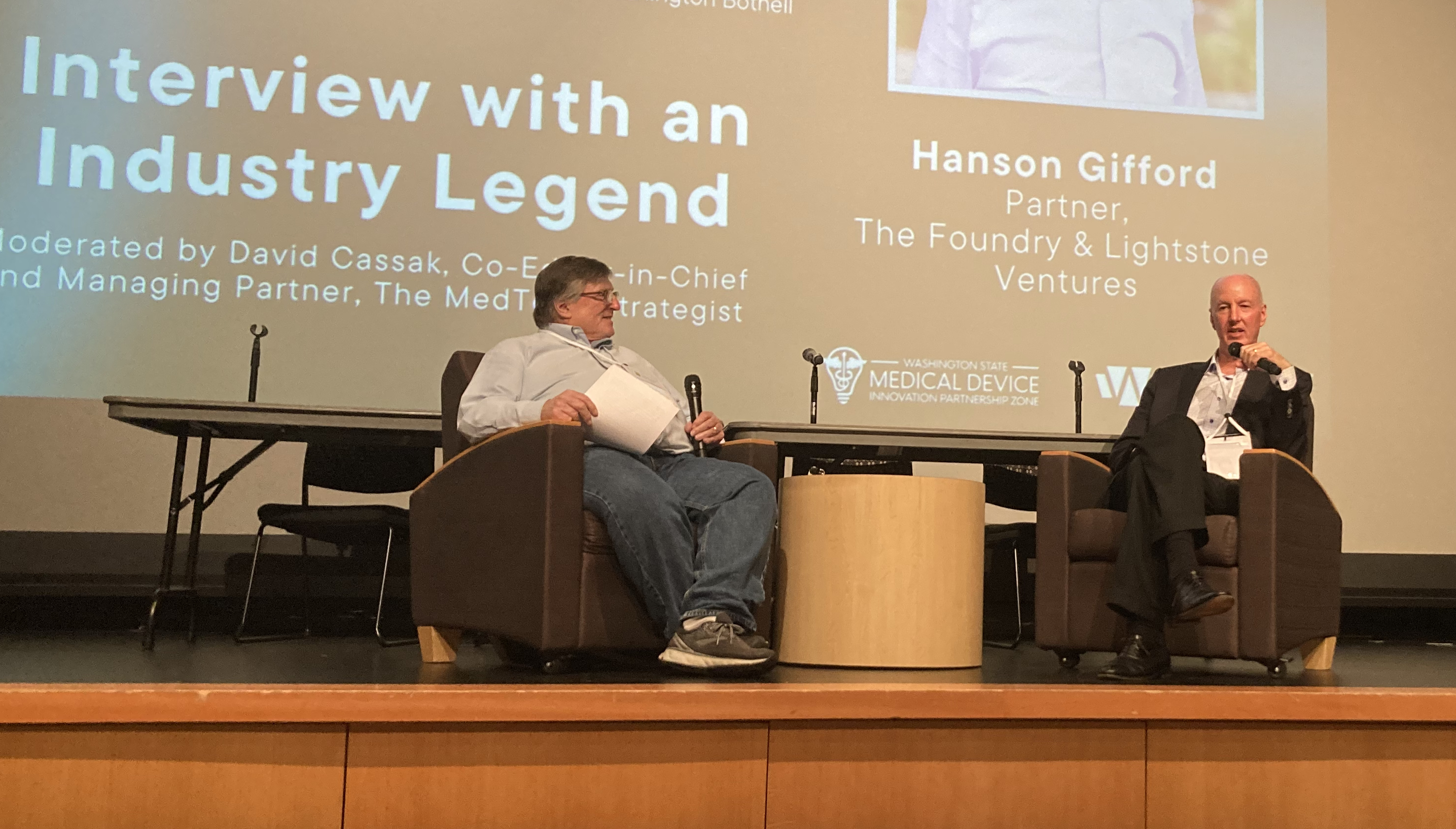
At a November 2022 summit in Bothell, Washington, Gifford offered entrepreneurs a practical way to approach larger companies. Explain the product and what you intend to accomplish over the next six months. Then return six months later. The repetition allows a prospective partner to see progress and get to know the entrepreneurs behind it.
That advice makes the relationship part of the product’s commercial future. A single presentation can explain an opportunity. Repeated conversations allow another organization to observe whether promises and performance line up. For a founder hoping to work with a larger business, the calendar becomes a way to build credibility.
Gifford also pointed out that established companies in his industry remain potential investors when other sources of capital look elsewhere. His attention is on who has a continuing reason to care about the work. It is a useful question for any entrepreneur: which prospective partner has an interest that will last beyond the excitement of a first meeting?
When the buyer changes its mind
By 2025, Gifford was discussing a related problem onstage with Andrew Cleeland and Chris Cleary: ventures created with a possible future buyer already involved. The attraction is understandable. A startup can develop something an established company wants, with collaboration and financing organized around that interest. The complication is that the buyer’s interest can change while the startup is still building.
Gifford recounted one negotiation in which six months of detailed agreement-making came undone just before signing. Leadership changed at the prospective partner. The new decision-maker suspended signing new agreements for six months. The startup’s carefully prepared arrangement was suddenly stranded. No amount of detail in yesterday’s plan could make yesterday’s decision-maker stay in office.
His argument was to preserve alternatives: build something with appeal beyond a single buyer, and maintain other investor relationships. He also emphasized direct communication about setbacks as well as progress. These are unromantic precautions. They give a small company more room to keep working when a larger company rearranges its priorities.
The anecdote puts a human face on corporate risk. A partnership can be negotiated by capable, committed people and still encounter a change neither side expected. The founder’s task includes preparing for that possibility without allowing it to consume every decision. The paperwork matters; so does the ability to continue when the people around it change.
The chief executive makes room
Gifford has been a partner at Lightstone Ventures since November 2013, assisting with sourcing opportunities, evaluating them and managing portfolio companies. He also mentors Stanford Biodesign fellows. The working engineer now spends part of his time helping other people make their own judgments, with the accumulated experience of having sat on several sides of a company’s table.
At a 2025 discussion of a chief executive’s first 180 days, he argued for a short list of priorities and for giving colleagues authority to decide. He also described the leader’s role in making it possible for people to challenge ideas, including the leader’s own. A room full of capable people offers little advantage if everyone waits for one person’s answer.
“If you have a list of 10 things, you might as well not have a list.”
Hanson Gifford · LSI USA, 2025
The observation has an engineer’s economy. A long list can be impressively complete while remaining difficult to act on. Choosing fewer priorities means deciding what will wait, a less flattering exercise than adding another worthy ambition. Giving other people authority then requires a further choice: accepting that their answer may differ from yours.
Read across Gifford’s career and the recurring concern is how to make a group capable of moving forward. He has designed, led, founded, financed and advised. Each role supplies a different view of the same troublesome interval between having an idea and getting people to work on it together. The teenage sailor’s lesson still fits: keep your composure, understand the situation, and work out the next move.