On a trip to Spain in 2006, Jose Hevia found the sort of bar trick that makes a restaurant owner forget the rest of the vacation: beer taps built into the tables. His cousins paid one price and poured for themselves. On the flight home, Hevia sketched his version. The scene had the useful ingredients of a founder myth - Madrid, a napkin, a nine-hour obsession - but the first result was less romantic. He needed to measure the beer, display each table’s ounces and keep the restaurant in control. Developers he found online charged about $10,000 for the software.
Hevia installed the taps at Cheeky, his Georgia restaurant. The table worked. Customers talked about it. When another Cheeky opened, they asked for more choices, so one tap became community tables with five or six, then a wall of them. By 2010, other restaurant operators were asking Hevia to build their systems. DraftServ Technologies emerged from a simple observation: people enjoyed pulling the handle, while operators needed to know exactly what came out.
The first thing to fail was the money
The beer table did not rescue Hevia from timing. He was building the first Cheeky in 2007 as the economy cracked. Four weeks into construction, the bank that had lined up his loan stopped making loans. Hevia had to solve the restaurant’s financing before he could discover whether anyone wanted to pour a beer at the table. It is an important detail because DraftServ was not born in a software incubator. It was funded by a working restaurateur who already understood slow lines, waste, staffing and the uncomfortable arithmetic of a half-full glass.
That operator’s view became the company’s advantage and its early blind spot. Hevia later admitted that he thought code was something you wrote once. Hardware broke visibly; software accumulated work quietly. Four years in, he said he had not made a penny from DraftServ and that the restaurants he had built over decades kept the technology company alive. The lesson was expensive and wonderfully unglamorous: a connected tap is a service obligation wearing a stainless-steel costume.
“I was very naive. Software requires constant attention. I thought you just write code once and you are done.”Jose Hevia, founder and CEO
The bet at the ballpark
Cruise ships forced the next useful change. Carnival wanted self-service, but a ship does not need a cute restaurant table. It needs equipment that can move, accept a cabin key, understand a drink package, charge a room and conserve scarce storage. DraftServ developed mobile units and learned to connect the pour to a property-management system. In 2014, a major concessionaire tried the machines during MLB All-Star festivities at Target Field.
Hevia later described the event as a bet on the whole company. The concessionaire hoped for about $2,000 in first-day sales. He said the kiosks did $18,200 and outsold every kiosk in the stadium. The appearance triggered television coverage and sent the company’s web traffic from a reported 300 unique monthly views to 50,000 in July 2014. Orders followed. A year later, Cedar Point installed two mobile four-tap units where guests bought $10 or $20 RFID cards and paid 50 cents per ounce. Two park employees still sold cards, checked identification, watched consumption and helped guests pour.
The machine became a sentence
Early DraftServ was easy to describe as a self-serve beer machine. Today the better description is a sequence of verbs. Scan. Authorize. Unlock. Pour. Measure. Charge. Report. Its BevOS platform sits between a user and an ordinary dispenser, turning physical flow into a software event. The user might arrive with an RFID card, a QR-coded cup, an office fob, a phone app, a cruise cabin key or a payment card at a checkout-free store. The system decides which beverages that identity may access, how much, at what price and during which window.
The operator gets the reverse view: live pour volume, product status, transaction information and remote control from a phone or dashboard. Prices can change for happy hour. Premium products can be limited to one tier of guest. A souvenir cup can permit refills for a season while a disposable code expires after one fill. Hotels can charge coffee to a room; casinos can accept player cards; cruise lines can reconcile drink packages. The company says most standard dispensers can be retrofitted, which lets an operator keep its preferred refrigeration or equipment partner.
Why the control layer matters
In a conventional bar, several facts are reconciled after the shift: what the point-of-sale system says was sold, what the keg appears to have lost, what was sampled, spilled or overpoured, and what the staff remembers. BevOS tries to collapse those facts into the instant liquid crosses the meter. This is the difference between DraftServ and a company that merely fabricates a tap wall. The wall is a format. The company wants the transaction logic.
That became explicit in 2020, when Hevia said DraftServ had begun primarily focused on hardware but learned from major foodservice operators, retailers and brands that the larger opportunity was consumer experience and data. The pandemic made touchless interaction more urgent, yet the pivot had already been underway. DraftServ had patented systems for authorizing and tracking multiple beverage categories, and BevOS could manage beer, wine, cocktails, soft drinks and coffee. In 2022, the DraftServ mark was registered for a platform that monitors dispenser performance.
The quiet connector in a loud venue
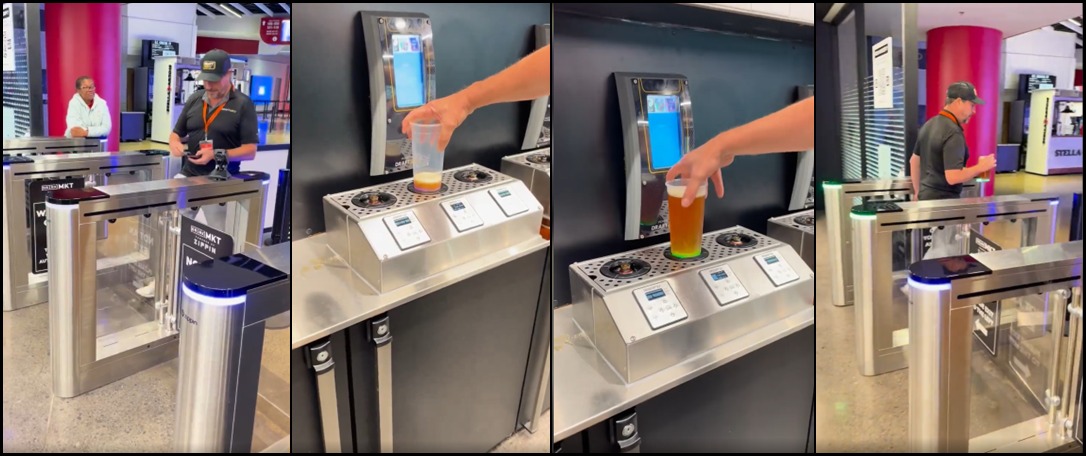
A 2023 deployment shows where DraftServ fits in the market. Zippin operates checkout-free stores. GS Draft supplies refrigeration and pour hardware. At Gillette Stadium and Capital One Arena, DraftServ connects the variable-sized pour to the retail transaction. A human checks age. The fan enters with a payment method, takes a cup and pours. Zippin hands the transaction to DraftServ; BevOS measures the ounces and passes the completed amount back.
Draft beer had been awkward for checkout-free cameras and sensors because a cup is not a consistent unit like a can. At Capital One Arena, a ReverseTap fills a special cup from the bottom in about seven seconds. Sports Business Journal reported that the location replaced a traditional bar that had ranked among the venue’s bottom five performers and became a top-ten food-and-beverage stand. At Gillette, Hevia said customers chose draft 70 percent of the time when packaged beer was available beside it.
The same partnership logic is now stretching into cocktails. Smart Bar USA announced in 2026 that its Smartender automated cocktail equipment would integrate with BevOS. DraftServ is trying to become the neutral layer across specialized machinery: let another company perfect the cooler, tap or cocktail robot; let BevOS manage who gets what and record what happened.
What to copy - and what not to
The stealable move is not “put beer on the internet.” It is to start with a visible, narrow experience and keep following the operational pain underneath it. Hevia began with a table that guests could understand in five seconds. Customer requests pushed it toward more taps. Carnival demanded mobility and cabin-key billing. Stadiums demanded throughput, payment and oversight. Each demanding environment added a reusable capability. The novelty acquired an operating system one constraint at a time.
A second move is architectural: make the customer’s existing equipment an asset. DraftServ offers mobile and fixed walls, but it also sells a technology-only approach. That widens distribution through equipment, concessions and automation partners and reduces the need to own every physical component. It also puts the hard work where defensibility tends to live - integration, uptime, rules and data.
Works when
The venue has high beverage volume, stable connectivity, compatible equipment, clear payment or guest records, and staff who can handle age checks, training and exceptions.
Breaks when
The line is poorly maintained, guests are not taught to pour, local rules block the service model, integrations are brittle, or low traffic cannot justify the installation and support.
Self-service does not eliminate service. It moves it. A DraftServ installation needs 115-volt power and stable internet, according to the company. Alcohol service still needs identification, monitoring and local compliance. Draft lines still need correct temperature, pressure and cleaning. Guests who timidly crack a faucet may produce foam and blame the machine. At a venue, staff shift from taking each order to checking eligibility, teaching the process and resolving exceptions. If the operation cannot do those things reliably, a bartender and a simple point-of-sale terminal may be the better system.
DraftServ is therefore neither a robot bartender nor just a SaaS dashboard. It is enterprise plumbing in the literal and software senses. Its closest alternatives include self-pour platforms such as iPourIt and PourMyBeer, beverage-management systems such as BeerBoard, liquor controls such as Berg, and the unautomated bar itself. DraftServ’s argument is that one equipment-flexible layer can connect more beverage categories, more identities and more back-office systems than a single-purpose wall.
The beer-by-the-ounce was the hook. Knowing who poured it, charging the right account and seeing it remotely became the company.YesPress
The last inch of the internet
DraftServ remains a small private company. Public employee indicators hover around ten, and its current pricing is quote-based. The supplied company record lists a $400,000 Series A in 2014 and estimated annual revenue of $366,000, figures that should be treated as database estimates rather than audited accounts. The more concrete evidence is installed work: cruise lines, amusement parks, major sports venues, certified technology kits, patents, and partnerships that keep adding different machines to BevOS.
There is something pleasingly literal about its ambition. Software companies often promise to connect the physical world. DraftServ picked the final few inches: the identity at the reader, the valve in the line and the ounces entering a cup. Its product is most successful when the technology disappears and the guest simply pours. For the operator, however, disappearance is the problem. Every invisible ounce is inventory, revenue and responsibility. DraftServ built a company by making it show up.