The agentic AI operating system quietly rewriting how restaurants run.
Most restaurants don't fail because the food is bad. They fail because the math is invisible - the labor booked for a slow Tuesday, the produce over-ordered and thrown out, the payroll that quietly outran the till. Conor Sheridan lived that math. Before Nory, he grew the fried-chicken group Mad Egg to more than 100 staff and roughly €6M in turnover in about a year, and spent his nights buried in spreadsheets that told him what had already gone wrong rather than what to do next.
Nory is the answer he wished he'd had. Founded in 2020 - originally under the name Skueeze - the company has built what it calls an AI-native restaurant operating system: a single control centre that folds business intelligence, inventory, workforce management and payroll into one place. It plugs into a restaurant's existing tech stack, reads the real-time data, and then does something most software still won't: it acts.
The pitch is deliberately unglamorous. Nory predicts how many customers will walk in, builds the staffing plan around them, places the orders, runs the payroll and keeps the profit-and-loss statement on track - increasingly on its own, across every location. In September 2025 the company closed a $37M Series B led by Kinnevik, taking total funding to $62.6M and pointing the whole operation at the United States.
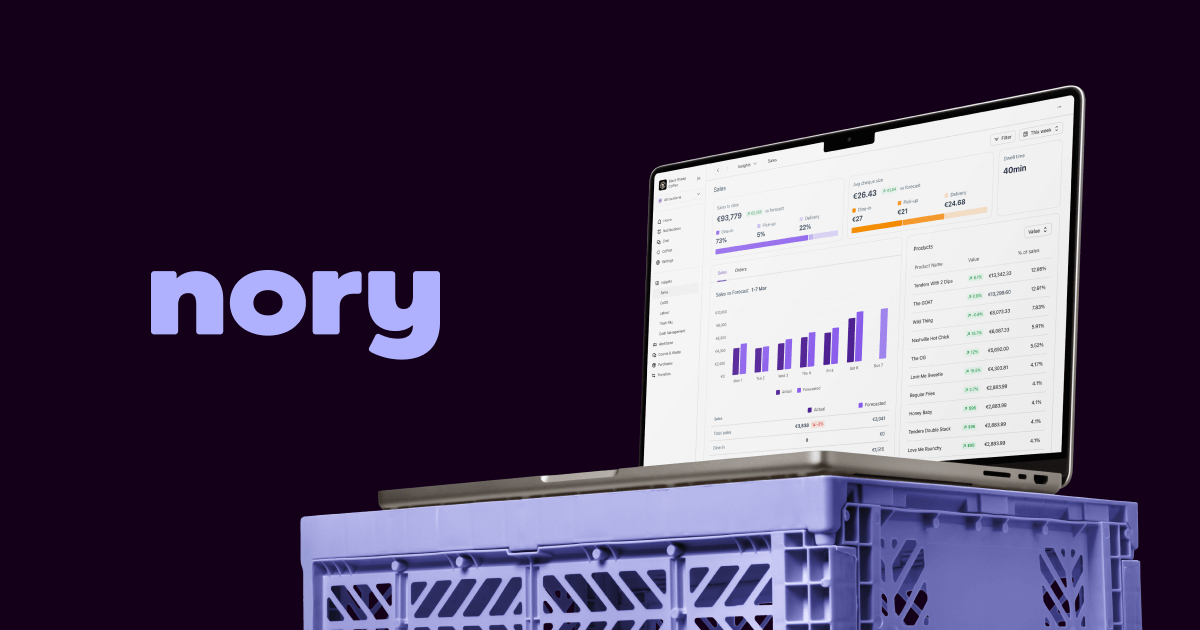
Restaurants have never had more technology - point of sale, scheduling, ordering, delivery, accounting - and somehow never had less clarity. Nory's core bet is consolidation. Instead of ten tools that each report a sliver of the truth, it unifies the operational picture and turns it into decisions the frontline team can act on the same day. The company describes itself less as a dashboard and more as a "system of action."
A crew of AI assistants that predict demand, build staffing plans, manage ordering and payroll, and keep the P&L on track - autonomously, across every location.
Real-time analytics that fold daily revenue, cost and performance metrics into a single view for operators and frontline teams alike.
Demand-based ordering, stock control, invoice scanning and discrepancy detection to cut food waste and protect margins.
Labor scheduling matched to forecast demand, plus onboarding and role-based permissions across multi-site teams.
Payroll automation wired directly to scheduling and hours worked, removing a recurring source of late-night admin.
Financing solutions for operators, extending Nory beyond software into the money that keeps restaurants growing.
Nory sells to multi-unit hospitality operators - independents, franchise networks and enterprise groups. Its best-known reference customer, Black Sheep Coffee, consolidated forecasting, labor scheduling and inventory management across an estate of more than 130 sites. Others span casual dining, coffee and quick service on both sides of the Atlantic.
The restaurant business runs on some of the thinnest margins in any industry, and the two biggest controllable costs - labor and food - are precisely the ones that leak. Staff get scheduled for shifts the demand never justifies. Produce gets ordered on habit and binned on Sunday. By the time the monthly accounts arrive, the money is already gone.
Nory's approach is to make those costs visible before they're spent, not after. Its forecasting models predict demand so ordering and staffing can be matched to it, and its assistants surface - or simply take - the corrective action. The reported results are concrete: operators cut operating costs by nearly 20 percent, lift net profits by up to 50 percent, reduce food waste by up to half, and save more than 100 hours of admin per site each month. Figures are drawn from Nory's own customer data and should be read as approximate.
The restaurant-ops market is crowded. The distinction Nory presses is not another dashboard - it's an all-in-one, AI-native platform that makes the operational calls rather than leaving them to a manager at midnight.
Nory's cap table reads as a steady escalation of conviction - from early European seed funds to Accel and, at Series B, Kinnevik. The 2025 round arrived barely a year after the Series A.
INVESTORS: Kinnevik · Accel · Base10 · Northcote Park · Playfair · Samaipata · Triple Point · Cavalry Ventures
Restaurateur Conor Sheridan founds the company (originally Skueeze) to fix the software gap he hit running restaurants.
Around $2M from Cavalry Ventures and Playfair Capital to build the platform.
Co-led by Triple Point Ventures and Samaipata to scale its AI-powered restaurant management tech.
Accel leads a Series A to grow the platform across the UK and Ireland.
Kinnevik leads in September, taking total funding to $62.6M to fund agentic AI and US expansion.
Nory opens a New York base and rolls out agentic AI across forecasting, labor, inventory and profitability.
Restaurant technology has spent a decade being "about to be disrupted," usually by tools that tried to replace the operator. Nory sits in a different lane. Its wedge is the operational back office - the forecasting, ordering, scheduling and payroll that every multi-site group runs and almost none run well - and its differentiator is that the founder spent years living inside that problem.
That operator DNA is the company's real expertise. Nory's models are trained on the grind of daily hospitality, and its assistants are pointed at recoverable, measurable decisions rather than front-of-house theatrics. The strategy is to earn trust in the tasks where mistakes are cheap and value is easy to prove, then widen from there.
The timing helps. As labor and food costs climb, operators on both sides of the Atlantic are hunting for tools that defend margin, and Nory's US move - anchored by a New York base - puts it into the world's most competitive restaurant market against incumbents like Toast, Restaurant365 and NCR Voyix. With roughly 92 employees and a fresh Series B, it is still a challenger. But it is a challenger with a clear, unfashionable thesis: put the crew back in control, and let the software do the arithmetic.