The Collar Question
Reading, Pennsylvania - and the stubborn arithmetic of a sleeve
There is a particular kind of professional courage involved in taking a job selling dress shirts in 2026. Not because the dress shirt has vanished - it has not - but because for over a decade the culture has been busy writing its eulogy, and eulogies are notoriously bad for conversion rates. Jordan Hauser took the job anyway. He runs marketing and creative at Paul Fredrick, a menswear company that has been headquartered in Reading, Pennsylvania since 1986 and which has, throughout every announced death of the necktie, the collar and the office itself, gone on quietly shipping shirts with exact sleeve lengths to men who wanted exactly that.
Exact sleeve lengths. It is worth pausing on this, because it is the closest thing the company has to a founding philosophy and it is not, on its face, thrilling. Most shirtmakers sell you an average - a 32/33, a 34/35 - and let the arm sort itself out. Paul Fredrick made a different decision in the 1980s and never unmade it. The brand was started by Paul F. Sacher, who had worked for his father-in-law at the Fleetwood Shirt Company, a Pennsylvania maker of private-label dress shirts that opened in 1951. Sacher's launch strategy was two-inch by two-inch advertisements in the Wall Street Journal and a mail-order catalogue. That is the entire marketing plan. No brand film, no launch party, no manifesto about disruption. Small squares of newsprint and a promise about your arm.
Forty years later, that promise is the asset Hauser inherited. Which raises the question every marketer of a heritage brand has to answer eventually, usually at about two in the morning: what do you touch, and what do you leave alone?
A Route Through the Whole Building
Macy's, then Market by Macy's, then everybody's leftovers
Hauser did not arrive at Paul Fredrick from an agency, which matters. His public career reads as a tour of American retail conducted from inside several very different rooms. He held director-level roles across Macy's men's business - including Director of Digital Strategy for Men's Collections, along with digital and merchant roles spanning men's and modern collections. This is department-store scale: enormous assortments, enormous data, and the peculiar humility of learning that no individual taste survives contact with a national customer base.
Then came Market by Macy's, the retailer's small-format experiment, where he served as Director of Integrated Merchandising for Men's & Home. Small-format stores are the retail equivalent of writing a sonnet after years of free verse. You have a fraction of the square footage, so every single unit has to justify itself. Nobody who has done that job ever again believes that more choice is automatically better.
And then, in a move that ought to be studied more often, he went to Offe Market as Vice President of Merchandising & Marketing. Offe is an off-price marketplace - it sells the excess inventory and overstock of roughly 75 brands, online and from a physical store in Los Angeles, at 20 to 80 percent off. Its founder, Rachel Gannon, described the customer with unusual precision: "We're capturing a shopper that's between the secondhand customer and the full-price customer." The company raised $1.25 million in pre-seed funding and set out to work with 150 brands.
Consider what that job actually involves. Every item on an off-price marketplace is a small monument to somebody else's misjudgement - a colour that did not land, a size curve that was wrong, an order placed with more optimism than evidence. Spend two years selling other people's mistakes and you develop an almost forensic instinct for the decisions that create them. It is the most useful education in merchandising available, and it is only available at the discount end.
"We're capturing a shopper that's between the secondhand customer and the full-price customer."
Rachel Gannon, founder of Offe Market, describing the business Hauser helped runSo the arc is: full-price at vast scale, then full-price at constrained scale, then off-price at marketplace scale, then back to full-price at a heritage house. Four different answers to the same question about what a garment is worth. Very few marketing executives have stood in all four positions. Most pick a lane and defend it at conferences.
The Merchant and the Marketer
Two departments, one hallway, historically minimal conversation
In most retail organisations, merchandising and marketing operate like neighbouring countries with a long-running border dispute. Merchandising decides what gets made and in what quantity. Marketing decides how it gets explained to the world. They meet formally at seasonal planning, informally at the coffee machine, and urgently when something has gone badly wrong. The gap between them is where markdowns are born.
Hauser's titles have consistently straddled the border - Merchandising and Marketing at Offe, Integrated Merchandising at Market by Macy's, Marketing & Creative at Paul Fredrick. Public directories cannot even agree on his current title, listing him variously as Senior Vice President of Marketing & Creative and as Chief Marketing Officer, which is a small comic footnote but also a hint: the job does not sit neatly in one column of the org chart.
This matters at Paul Fredrick more than it would elsewhere, because the brand's marketing story is a product story. You cannot advertise exact sleeve lengths unless someone upstream has committed to cutting them. The Perfect Fit guarantee is not a campaign line; it is an operational promise with a returns cost attached. The company's customer service is still handled by people in Fleetwood, Pennsylvania - by telephone and now online chat - which in 2026 is either charmingly antique or quietly radical, depending on how recently you have tried to reach a human at a venture-funded competitor.
Four Chapters, Four Definitions of Value
How the same shirt gets priced depending on which room you are standing in
national scale
small format
off-price
heritage DTC
Illustrative comparison based on publicly listed roles and company descriptions. Bars indicate emphasis across Hauser's documented career, not measured performance.
Small Company, Large Internet
88 people versus everyone
The numbers around Paul Fredrick are modest by the standards of the brands it shares search results with. Roughly 88 employees. Annual revenue in the region of $21 million. A headquarters at 900 Corporate Drive in Reading, with Hauser himself based in New York. Its classification codes - NAICS 458110, SIC 2299 - are about as romantic as a parking ticket.
What it does have is specificity, which is the only weapon a small brand has ever had against a large market. It also has a genuinely modern operating stack behind the antique-sounding promise: a Shopify Plus storefront, review and loyalty infrastructure through Yotpo, email and retention tooling through Listrak and Bluecore, customer service through Gorgias, analytics through GA4, accessibility tooling through accessiBe, and dozens more. Somewhere in there is the real punchline of the story - the mail-order catalogue business from 1986 now runs on roughly seventy pieces of software, and still sells the same idea it always did.
The 2x2 origin
Paul F. Sacher launched the brand in 1986 with two-inch square Wall Street Journal ads and a catalogue. The media budget was, by modern standards, a rounding error.
The Fleetwood lineage
Sacher had worked for his father-in-law at the Fleetwood Shirt Company, a Pennsylvania private-label shirtmaker that opened in 1951.
Humans, still
Customer questions are answered by real people in Fleetwood, PA, by phone and chat - a policy most brands abandoned somewhere around 2014.
The exact sleeve
Few shirtmakers sell exact sleeve lengths rather than averages. It is a manufacturing decision that became a marketing position by accident and stayed one on purpose.
The overstock detour
Offe Market, where Hauser was VP of Merchandising & Marketing, raised $1.25M pre-seed and worked with around 75 brands across a website and an LA store.
The dress code paradox
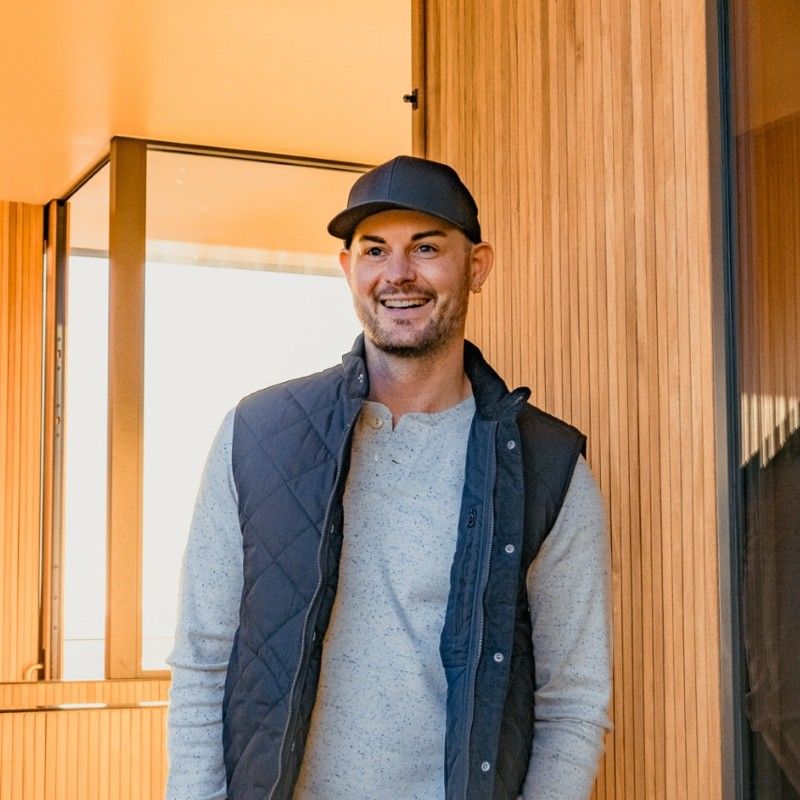
His public portrait shows a cap and a quilted vest. The man selling suits dresses like the customer who stopped wearing them - which is arguably the correct research position.
What the Job Actually Is
Retention, in a business that has customers measured in decades
The temptation with a brand like this is to chase somebody else's customer. Younger, louder, more photographed. It is an understandable temptation and it has quietly bankrupted a respectable number of heritage labels, all of whom abandoned the person who had been buying from them for twenty years in pursuit of the person who was never going to.
The more difficult work - and the work a career like Hauser's prepares you for - is the unglamorous kind. Keeping a catalogue-era customer engaged through three separate technological eras. Making a returns guarantee written in the Reagan administration feel like a modern convenience rather than a museum exhibit. Explaining a non-iron fabric, a tailored fit, a big-and-tall sizing run, and a contrast trim detail to a man who did not come to the internet looking for a lecture. And doing all of it with 88 colleagues and no venture round to burn.
There is no shortage of people in marketing who can describe a brand. There are considerably fewer who can look at a garment, understand precisely what it cost to make and what it will cost to discount, and then write the sentence that stops it from being discounted at all. That is a merchant's instinct wearing a marketer's job title, and it is the through-line of everything on Hauser's public record.
The dress shirt, meanwhile, has not died. It changed jobs. It stopped being a uniform - something you wore because a building required it - and became a choice, which is a far harder thing to sell. Uniforms sell themselves. Choices need a reason. Somewhere in Reading, Pennsylvania, the reason is still a very precise measurement of an arm, and someone in New York is charged with making that sound like the most interesting thing in menswear.
Which, on the evidence of forty years of customers, it might just be.
This profile is assembled from publicly available sources including LinkedIn, The Org, business directories, Paul Fredrick's own published brand history and trade press coverage of Offe Market. Job titles are reported as they appear publicly; sources differ on whether Hauser's current title is Senior Vice President of Marketing & Creative or Chief Marketing Officer. No direct interview was conducted, and no quotations are attributed to Hauser because none are on the public record. Where detail was unavailable, it has been left out rather than guessed at.