The first HOPWTR package had a fatal misunderstanding with gravity. Jordan Bass and his cofounder, Nick Taranto, thought the carton looked terrific. A shopper who grabbed it by the top received a quicker education: the box simply tore open. The elegant correction involved neither a redesign sprint nor a consultant's deck. The team ordered thousands of stickers and applied them by hand.
Then the copacker's equipment failed to arrive on schedule. Bass and his crew persuaded an investor to lend them an empty facility, unfolded tables and packed retail pallets themselves. When the first retailer sold through and the distributor had no reserve, Bass loaded his trunk, drove the cases over and stocked the shelf. The beverage aisle may present itself as a serene row of perfect cylinders. Behind one young brand, it looked more like a school fête with better inventory control.
That sequence is the useful miniature of Bass's career. He knows strategy, capital and e-commerce. He also knows that a case of cans must remain a case of cans between the warehouse and someone's kitchen. HOPWTR grew because its founder could speak both languages: the airy dialect of category creation and the blunt vocabulary of cardboard, pallets and replenishment.
“Progress beats perfection.”Jordan Bass on his early founder lesson
An inheritance of attention
Bass calls himself a fourth-generation food-and-beverage entrepreneur. His grandfather was a dairyman. His mother ran a citrus business. His father built a legal practice and, on walks with his son, discussed why certain businesses worked and what could be learned from the ones that did not. In high school, Bass went to meetings with his grandfather. He watched negotiations, relationships and the steady labor of a dairy farm.
It was less a family trade handed over than a habit of noticing. Products came from somewhere. Deals belonged to people. An enterprise was not an abstraction if you had seen the work before breakfast. Bass added formal layers at Pepperdine University, earning a business administration degree, then began in finance with Merrill Lynch and SAIL Capital Partners. Sales and marketing work followed at SNTech. He joined The Wonderful Company in strategy and moved into e-commerce leadership at FIJI Water.
The path looks tidier in retrospect than careers usually feel while they are happening. Finance taught him to examine a market. Consumer brands brought him nearer to the buyer. E-commerce made the distance shorter still. By the time he started HOPWTR, he had moved from analyzing businesses to operating one where the customer could answer immediately, one case at a time.
The ritual was already there
Bass grew up in Northern California and gravitated outdoors. He started skiing around four, snowboarding at thirteen and later made backcountry snowboarding a favorite pursuit. The origin story he and Taranto tell is set among similarly tactile pleasures: bouldering in Joshua Tree, surfing at Venice Beach, then opening a cold beer to mark the end of the exertion.
Both were fathers in their thirties. They liked the marker in the day, the small metallic ceremony and the permission it seemed to grant. They wanted an option without alcohol, calories or sugar, and their search did not turn up the thing they had in mind. The gap was not simply another flavor. It was a familiar occasion waiting for different contents.
That is a subtle but powerful consumer idea. A new product does not always need to invent a new behavior. It can enter a behavior that already has emotional furniture. The sound of a tab, the cold can in hand, the pause after work or play: all of it existed before HOPWTR. Bass and Taranto altered the liquid and kept the script.
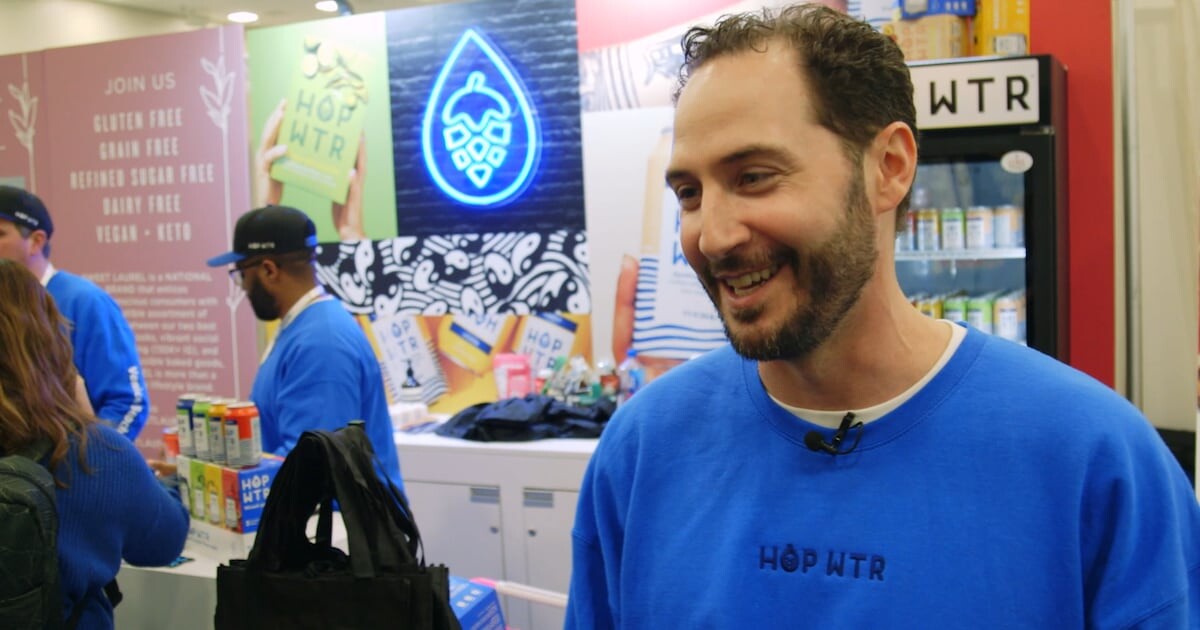
Digital first, physical quickly
HOPWTR launched direct to consumer in 2020, during a year when the normal sampling rituals of a beverage startup had gone missing. Bass's e-commerce experience gave the company another route. Digital sales were more than a channel. They were a listening device. Real orders could test the proposition, and customer responses could shape flavors, packaging and the language around the brand.
Retail arrived within months. Erewhon was an early partner, a useful Los Angeles proving ground for a drink asking shoppers to understand a new pocket of the shelf. Bass has said HOPWTR reached more than 3,000 stores in under two years. Constellation Brands invested through its venture group in 2021. A business that began by shipping cases online was becoming an omnichannel operation.
That transition changed the marketing problem. Online, a brand can explain itself across a product page, an email and a patient sequence of ads. In a store, the can gets a second or two. Bass learned to connect the two environments rather than appoint a winner. Paid social could create recognition before a shopping trip. Creators could provide reach, but also direct response. Retail placement could turn digital attention into the most persuasive advertisement available: a product the shopper could actually pick up.
Community became part of product development, too. The team listened for requested flavors and watched how people described their occasions. One campaign produced the HOP SPCR, a playful device that stacked beer and HOPWTR so a drinker could alternate between them. More than 900 people entered the online sweepstakes. The contraption was comic, but its logic was serious. Bass did not insist that every customer replace one ritual wholesale. HOPWTR could be the main event, a pause between other drinks or an ingredient in something mixed. The brand widened its usefulness without making the consumer swear allegiance.
Bass's early mistake was to treat every launch detail as if it deserved the same perfection as the product. The ripping cartons provided a brisk correction. Quality had to be right from the start. Many other things could be released, observed and improved. Moving put the brand in conversation with the people paying for it; polishing in private did not.
He also placed unusual weight on partners and mentors. Consumer packaged goods is a mature industry, even when a new brand behaves like a charming insurgent. Manufacturers, distributors and retailers have reputations for a reason. Bass's advice to founders has been to check those reputations, attend industry gatherings and pay for capable partners when the cheaper choice may become costly later. The romance of disruption still requires someone who can reliably close a carton.
A Los Angeles company acts local
In January 2025, as wildfires devastated communities around Los Angeles, Bass made the company's hometown identity concrete. He reduced his CEO salary to $1, directing the funds toward affected team members and All Hands and Hearts. HOPWTR pledged to match distributor donations and said it had already delivered more than 10,000 cans to first responders, fire stations and donation centers.
“HOPWTR was born in LA. LA is in our soul,” he wrote. It was a revealing sentence because the response around it used such practical verbs: redirect, match, deliver, keep bringing. Brand purpose is frequently announced in soft focus. Here, it came stacked on pallets.
The gesture also sharpened an aspect of Bass's public character that appears throughout the HOPWTR story. His preferred unit of progress is often collective. He speaks about trusting the team, listening to consumers and learning from experienced partners. Even the founder mythology contains folding tables crowded with colleagues, not a solitary flash of genius.
“Having a good idea is just the starting point.”Jordan Bass
The partner becomes the owner
On March 27, 2026, Constellation Brands announced an agreement to acquire the remaining interest in HOPWTR, subject to closing conditions. The relationship was already five years old. Constellation had invested in 2021 and worked with the company on its longer-term direction. Under the announced plan, Bass and other HOPWTR team members would join Constellation and continue shaping the brand.
Bass marked the news by remembering the first cases he delivered from the back of his car. He thanked the team, investors, families and supporters, and noted that the path had been anything but linear. The deal could be presented as a clean finish. His account left in the mess: early mornings, late nights, obstacles, children born, families changed and sacrifices made beyond the office.
That is appropriate. HOPWTR's larger achievement is not a theory about beverages. It is the accumulation of ordinary acts around one clear observation. People wanted to keep a moment and edit its contents. Bass helped turn that preference into a product, then a shelf presence, then a company attractive to a strategic partner that had watched it grow for years.
The next chapter will test a different operating skill: preserving a young brand's listening habit inside a much larger portfolio. Bass has said he wants to keep the momentum going and take HOPWTR to its next phase of growth. The ambition is broad. The founding lesson is conveniently specific. Keep the quality high. Put the can in someone's hand. Let reality answer. And, if the carton fails, buy the stickers before writing the memoir.