Jon Reilly liked engineering because a working circuit could settle an argument. Build it, test it, point to the result. Then he moved into product management, where the more troublesome question was waiting: why had anyone asked for that circuit in the first place? His career has since carried him through televisions, wireless speakers, industrial 3D printers and artificial intelligence. The question has travelled remarkably well.
Today, Reilly is co-founder and co-CEO of Akkio, the Cambridge company building AI tools for media teams. Its proposition begins with a familiar office frustration. Someone understands a business, has a question about its data and must wait for someone else to translate that question into something a computer can answer. Reilly wants that conversation to become considerably shorter.
There is a pleasing irony here. An electrical engineer has spent much of his subsequent working life trying to spare other people the need to become engineers. His interest in technology keeps returning to the person using it: what they know, what they need to decide and how many obstacles stand between those two things.
A debater finds a different kind of proof
Reilly grew up in Montana. His father taught marketing at Montana State University in Bozeman. As a teenager, he resisted the idea of university; speech and debate held more appeal than the classroom. His father insisted that he apply to several schools, including Gonzaga. Reilly went there, initially considering pre-law, before mathematics and physics drew him into electrical engineering.
He later earned an MBA in entrepreneurship at Babson College’s Franklin W. Olin Graduate School of Business. The combination is useful context for the jobs that followed. He could think about the mechanism inside a product and the business around it. Those are adjoining rooms, though companies sometimes seem determined to put a locked door between them.
At Sony Electronics, he worked on video-processing circuitry for televisions and later became a product manager. Engineering gave him the satisfaction of a demonstrable result. Product work added a different set of constraints: customer demand, commercial opportunity and the choices that decide which technical possibilities actually reach the shop floor.
The move makes his later career easier to read. Television, audio, manufacturing and advertising have different vocabularies. Each still requires someone to decide which problem deserves attention, what a useful solution would look like and whether it can be delivered. Reilly’s working territory gradually widened from the circuit to the decision around it.
From the living room to the factory
Phil Abram, a former Sony colleague who moved to Sonos, encouraged Reilly to apply there. Reilly was drawn to the people he met. He went on to hold senior product responsibilities, including leadership of the music-player product management team, as well as work in global channel development. The job put him inside the growth of a consumer technology business whose products had to make sense in an ordinary home.
A speaker has an unforgiving audience. People want their music; few are hoping for a second career in wireless networking. Consumer product management brings that impatience into the room. Every feature eventually faces a small but consequential test: can the customer get on with the thing they bought the product to do?
At Markforged, where Reilly became vice president of product and marketing, the setting changed to industrial 3D printing. His future Akkio colleagues included people he met there. The transition also brought him closer to a problem that would become a company: plenty of incoming sales interest, plenty of information about it, and a shortage of practical ways to decide what deserved attention first.
The printer business mattered to this story because it supplied an actual workflow. A marketing team needed to identify promising leads. A sales team needed to act on them. Historical results could potentially improve those choices, provided the people responsible for the work could make use of the information quickly enough.
The sales queue that became Akkio
In Reilly’s account of Akkio’s beginnings, lead scoring was a practical headache. His team had more incoming leads than it could readily sort. Machine learning offered a way to match new opportunities against patterns in past outcomes. Getting that capability into daily use, however, involved contractors, specialist knowledge and awkward communication loops.
The person closest to the commercial question knew the context. The person building the model knew the technical process. Something could go astray in the journey between them. Reilly’s interest was in giving a data-literate business user more direct control: build a model, understand the patterns and put the result to work.
Akkio was founded in 2019. Its founding team includes Abe Parangi, Craig Wisneski and Ekin Keserer alongside Reilly. The company’s current leadership page lists Parangi and Reilly as co-CEOs, Wisneski as head of product and Keserer as an advisor. The venture came from a group with overlapping experience, rather than a solitary founder’s sudden revelation.
By August 2023, Akkio had announced a $15 million Series A with participation from Bain Capital Ventures and Pandome. The announcement described tools for preparing data through chat, exploring it, producing visualizations and building forecasts. A sales queue had opened onto a broader ambition: make analysis and prediction approachable to people already working with business information.
Series A announced in August 2023, with Bain Capital Ventures and Pandome participating.
A question should survive the trip to a chart
In his public explanations of Akkio, Reilly often starts with people who can use a spreadsheet. They already handle information, recognize commercial patterns and understand the decisions their teams make. Advanced analytical tools have often required them to acquire another language before they can use that knowledge effectively.
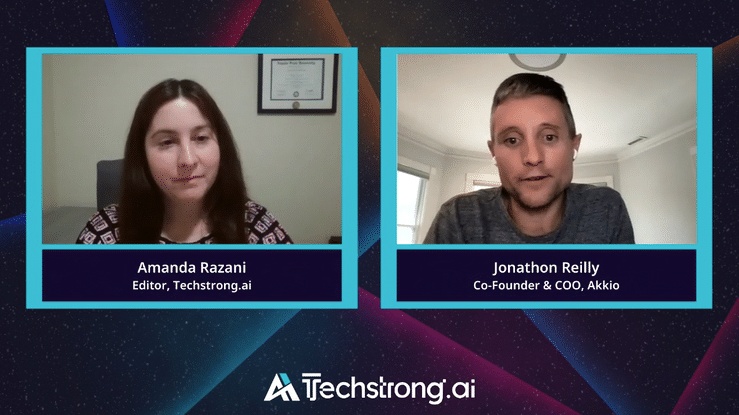
His 2023 conversation with Amanda Razani explored the operational tasks spread across sales, marketing, support and customer success. Specialist data teams understandably concentrate on major problems. Many smaller, recurring decisions still generate useful data. Reilly’s ambition was to make AI and machine learning available within those everyday workflows.
That focus gives the product a fairly demanding brief. An impressive demonstration is easy to admire and easy to forget. A tool that becomes part of someone’s Tuesday has to accommodate the unglamorous work too: cleaning information, changing formats, exploring patterns and getting an answer into a usable form.
Reilly also talks about predictive work, beyond charts showing what has already happened. The appeal is to help a business examine which factors are associated with an outcome and use those patterns when new information arrives. Prediction brings its own need for judgment. The usefulness of an answer depends on the question and on the decision it is meant to inform.
- 01 Business data
- 02 A plain-language question
- 03 Patterns and charts
- 04 A decision
A conceptual workflow, drawn from his public product explanations.
The agency has another question
Advertising agencies gave this ambition a more particular home. In July 2024, Reilly introduced Akkio’s Agency Data LLM, a system designed for advertising analytics. His explanation described teams submitting questions to specialists, waiting for analysis and sometimes discovering that the answer prompted another question. The process began again. Curiosity had acquired a ticket number.
The agency focus brought specific tasks into view: audience building, campaign performance, return on advertising spend and media planning. Reilly argued for an interface through which people could ask about campaign data in ordinary language. He also described customization around an agency’s metric definitions, calculations and naming conventions, with options to deploy within its own infrastructure.
This is where making something easy gets complicated. Two teams can use the same word and mean different calculations. A useful interface must connect the question to the organization’s particular context. The closer the software comes to ordinary conversation, the more carefully it has to handle the meaning behind the words.
Reilly’s discussion with the Agency Management Institute put the client relationship at the center. Agencies need to demonstrate the impact of their work. He also saw an opportunity for smaller agencies to access analytical capabilities through easier tools. His accompanying caution was straightforward: the finished output still has to meet the agency’s expectations.
“Make sure that the output you make at the end of the day still meets your expectations as an agency.”
Jon Reilly · Agency Management Institute
More people, more responsibility
Recognition followed the agency work. Reilly was included in ADWEEK’s inaugural Innovator 50 in 2025. His entry highlighted conversational access to data and work with companies including Horizon Media and LG Ad Solutions. The recognition concerned a recurring theme in his career: making a technical capability usable by a wider group of people.
In January 2026, Havas announced a partnership with Akkio to expand the agentic capabilities of its Converged.AI operating system. The scope included audience, planning and measurement capabilities across a group operating in more than 100 markets. The announcement connected the work to Havas’ broader €400 million investment in data, technology and AI. That figure is Havas’ program, rather than funding raised by Akkio.
Scale changes the practical question. A single user needs an answer. A global organization also needs consistency across teams, local context and confidence in how work gets done. Reilly’s public comments have emphasized observable, auditable processes and people retaining oversight as automation expands. Ease of use has to coexist with the ability to inspect the result.
His leadership outlook has a similarly practical quality. In his conversation with Chet Kapoor, the discussion ranged from leaders doing everyday work to culture being expressed through action. It also presented AI’s gains as an accumulation of smaller applications. The idea suits a founder whose own company began with a recurring operational problem.
Reilly’s career can look like a series of industry changes. Seen through the decisions he keeps discussing, it is more continuous. Build something useful. Let the person who understands the problem get closer to the tools. Check what comes back. The engineer’s appetite for a working result remains, even when the circuit has become a conversation.
Keep the conversation going
- Akkio leadership
- Jon on LinkedIn
- Jon’s writing at Akkio
- Jon on Medium
- Career conversation: Masters of Automation
- Data and visualization: PolicyViz
- Watch: Techstrong.ai interview
- Listen: Agency Management Institute
- Listen: Inspired Execution
- ADWEEK Innovator 50 profile
- Havas partnership announcement
- Series A announcement
- Agency Data LLM introduction
- Akkio on YouTube (company)
- Akkio on X (company)
- Akkio on Instagram (company)
- Akkio on Facebook (company)